Living in Miami Gardens: Pros and Cons
Best for sports fans, first-time buyers, and families who want space and relative value in northern Miami-Dade, with Hard Rock Stadium and a strong community identity, and who are selective about the block and the school zone.
The honest picture
What is it really like to live in Miami Gardens?
Miami Gardens is the sports capital of northern Miami-Dade, home to about 114,000 people, Hard Rock Stadium, and a median age near 39. Median sale prices run roughly $460,000 to $509,000, with most of the housing stock in established single-family neighborhoods built for space rather than style. Walk Score sits low at about 38, so a car is the default, and the honest trade-offs are a spread that ranges from well-kept communities to weaker blocks, schools that need an active plan, and flood exposure that is property-specific.
This guide keeps the postcard and adds the fine print: real price ranges, the schools buyers actually check, commute reality, walkability scores, and the insurance and heat costs nobody puts in the brochure. If you read one page before you start house hunting in Miami-Dade County, make it this one. And when you want the street-level version, that is a free call away.
Want the honest, street-level take on Miami Gardens? Set up a free 15-minute strategy call with Michael Wiz Wisniewski, Certified Real Estate Planning Advisor and Certified A.I. Real Estate Advisor, and he will tell you what the listings do not.
Miami-Dade County · Greater Miami
Median home price
$460KâÂÂ$509K
Walk Score
~38 (car-dependent)
Population / median age
~114,000 / ~39
Schools
Miami-Dade; many campuses in city
Source: U.S. Census Bureau (population and median age), county Realtor and MLS data (median home prices), Walk Score (walkability), state and Niche school data (school grades), and the Insurance Information Institute (insurance cost averages). Figures draw from public reporting and update often, so Michael pulls live comps, school assignments, and insurance quotes for your exact address in your strategy call.
What works
Pros of living in Miami Gardens
The genuine advantages, with the specifics that matter: neighborhoods, schools, commute math, and the numbers behind the lifestyle.
-
Hard Rock Stadium at your doorstep
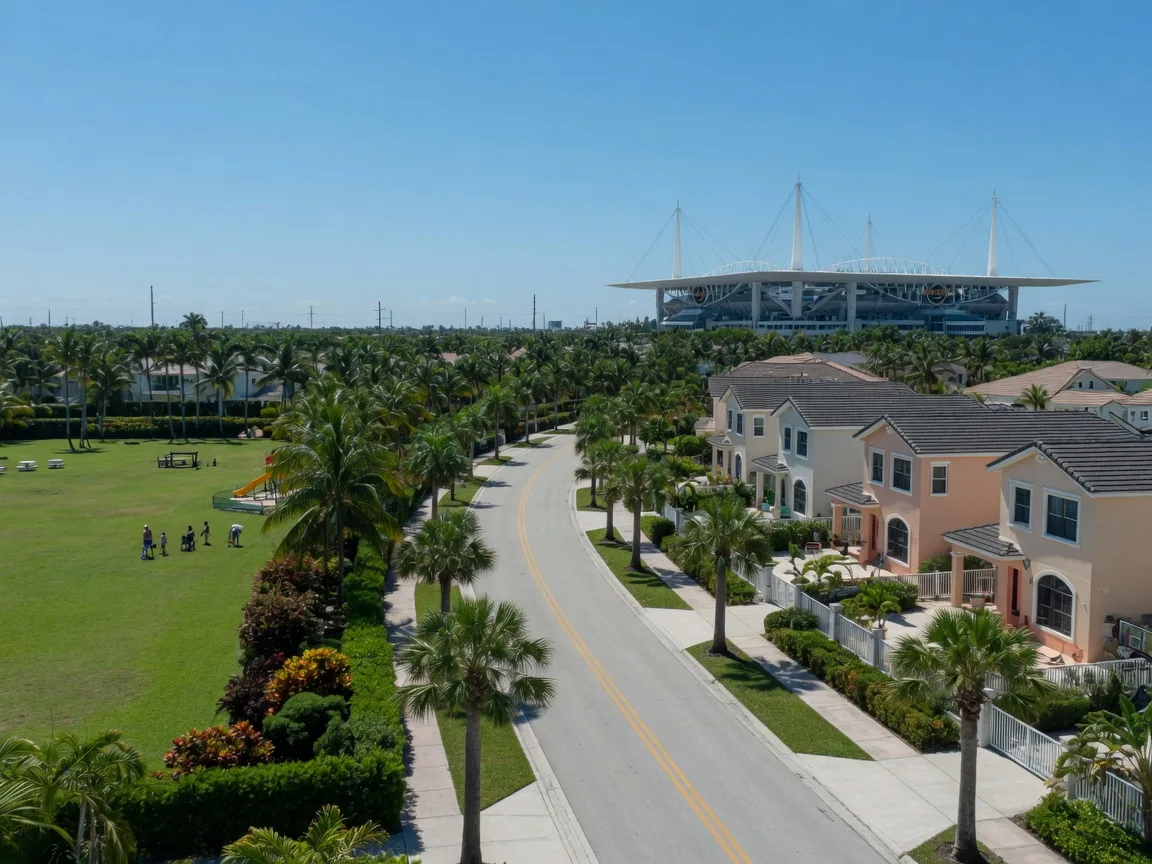
Dolphins games, Canes football, Formula 1, and major concerts are a 10-minute drive for most residents, and the surrounding entertainment district keeps adding dining and events. If sports and shows are your joy, this is a rare address.
-
Space and value
A median around $460,000 to $509,000 buys a real house with a yard in Miami-Dade, which is increasingly rare. Generous lot sizes, established streets, and community amenities give families room the denser coastal cities do not.
-
Strong community identity
Miami Gardens is one of the largest majority-Black cities in Florida, with a proud civic culture, community festivals, and a growing business district. Residents speak about the city with an ownership that money cannot buy.
-
Proximity to everything north county
Aventura and the beaches are about 20 minutes east, the Turnpike and I-95 are minutes away, and both FLL and MIA are within a 30-to-40-minute drive. Northern Miami-Dade's jobs, shopping, and healthcare are all close.
-
Newer-build pockets
Alongside the 1950s-80s core, several newer communities and infill developments offer modern floor plans, impact glass, and updated codes. Buyers who want new without leaving the city have real options.
-
Investor potential
Rental demand is steady across the city's large single-family inventory, and price points allow buy-and-hold strategies that the coastal markets no longer do. The work is in selecting the right block and checking the FEMA zone.
The honest trade-offs
Cons of living in Miami Gardens
No town is only a postcard. These are the trade-offs residents actually talk about, stated plainly, because a good advisor tells you the truth before you sign.
-
Car dependence everywhere
A citywide Walk Score near 38 means almost every errand is a drive, and transit service is limited outside major corridors. Miami Gardens was built for cars, and it shows on every block.
-
Uneven street-to-street quality
Superb communities sit blocks from struggling ones. The city's large footprint and varied upkeep mean buyers must judge each street on its own, which makes the right agent and a night drive through the neighborhood essential.
-
Schools need a plan
While strong magnets and charters exist nearby, the zoned options are mixed, and Miami-Dade's school-choice process is the norm for many families. Confirm the assignment before you buy unless a private or magnet plan is already in place.
-
Flood exposure by property
Parts of Miami Gardens sit in FEMA Special Flood Hazard Areas, where flood insurance is mandatory for federally backed mortgages, and wind exposure applies citywide. The exact zone of the lot decides the premium.
-
Heat island and summer
The inland location runs a few degrees hotter than the coast in deep summer, and the afternoon-storm rhythm is a daily fact. Older homes benefit from insulation and wind-mitigation updates.
-
Event-day traffic
Game day and concert night bring rolling congestion around the stadium complex and its parking flows. Locals learn the back routes; newcomers learn the hard way once or twice.
The bottom line: sports fans, first-time buyers, and families who want space and relative value in northern Miami-Dade, with Hard Rock Stadium and a strong community identity, and who are selective about the block and the school zone. If that sounds like you, the next step is a free 15-minute strategy call, no pressure and no obligation, at calendly.com/michaelwisniewski/15-min-strategy-call or (561) 441-8420.
At a glance
Miami Gardens: pros vs. cons, side by side
The fast comparison for the categories buyers weigh most. The full reasoning is above; this table is the one you screenshot.
| Category | What works | What to watch |
|---|---|---|
| Home values | Median $460KâÂÂ$509K with real yard space | Street-to-street quality varies |
| Schools | Magnets and charters across the district | Zoned options mixed; plan required |
| Commute | Turnpike and I-95 at the doorstep | Event-day congestion near the stadium |
| Walkability | Established street-grid neighborhoods | Walk Score ~38; car needed |
| Water and outdoors | Lakes, parks, and community pools | Property-specific flood zones |
| Insurance and costs | Entry prices support investor math | Wind premiums and inland summer heat |
Ranges reflect published market data and vary by neighborhood and source. Current as of September 25, 2026.
Match the town to your life
Who is Miami Gardens best for?
Five buyer personas get the straight answer, with the honest caveat attached to each.
First-time buyers
A house with a yard at Miami-Dade entry prices is the product. The strategy is block selection first, school plan second, and a home inspection that treats the age of the roof as the headline.
Sports and entertainment fans
Hard Rock Stadium and the district's new venues make game nights a mile-long commute. The trade is dealing with the neighborhood's density on event days and the summer heat inland.
Families
Space and community pride are strong, but the school plan must be built early. Families who lock in a magnet, charter, or private option see the city's value clearly.
Investors
Buy-and-hold rental math works at these price points. Underwrite the block, the FEMA zone, and the property's wind-mitigation status, and the yield story is honest.
Commuters to North County jobs
Aventura, Hollywood, and Broward's employment corridors are 20 to 40 minutes away, and the Turnpike makes the western routes fast. The drive-in is easy; the drive home at 6 p.m. is the real test.
Not sure which persona you are? That is exactly what the free 15-minute strategy call is for. Michael will help you see clearly which towns fit your life, your timeline, and your plan.
Book a Free CallStraight answers
Miami Gardens FAQs
The questions buyers ask Michael most about Miami Gardens, answered directly with the numbers.
01 Is Miami Gardens a good place to raise a family?
It can be excellent for families who pick the right community and build a school plan: the city has real space, parks, pools, and a proud civic culture. The honest guidance is to verify the exact school assignment and drive the specific street at different times before you commit.
02 How close is Miami Gardens to the beach?
Sunny Isles Beach and Aventura's coast are roughly 20 minutes east, and the beachfront is generally a 25-to-30-minute drive door to shore. Weekday trips are easy; weekend beach parking is the universal South Florida tax.
03 What is the housing stock like in Miami Gardens?
Mostly established single-family neighborhoods built from the 1950s through the 1980s, with generous lots, plus newer communities and infill pockets. Roofs, ACs, and wind-mitigation features are the inspection priorities in the older stock.
04 Do homes in Miami Gardens require flood insurance?
Only where the lot sits in a FEMA Special Flood Hazard Area, which is property-specific. Wind insurance applies citywide. Michael pulls the address-level FEMA zone and premium estimates before you make an offer, because two streets over can change the number.
Have a question this page did not answer? Ask it directly: (561) 441-8420 or michael@thecompleterealestateteam.com.
Keep exploring
You might also like
Living in Miami Gardens
Neighborhoods, schools, market snapshot, and things to do
Read itLiving in Hialeah
The dense, family-centered city to the west
Read itFlorida First-Time Buyer Guide
A step-by-step path to your first home
Read itCompare the coasts
Your next step
Let's decide if Miami Gardens is the town for you
Michael Wiz Wisniewski is The Life Transition Specialist, a Certified Real Estate Planning Advisor and Certified A.I. Real Estate Advisor with The Complete Real Estate Team, powered by Dalton Wade Real Estate, Florida DRE #3301665. He has built, bought, sold, and managed property from the Treasure Coast to South Florida, and he answers with the truth, not the sales pitch.
- (561) 441-8420
- michael@thecompleterealestateteam.com
- Book the free 15-minute strategy call
- Send a message on the contact page
Talk Soon
No obligation, no pressure
Is Miami Gardens the right fit?
Tell Michael about your move, your timeline, and your questions about Miami Gardens. He will reply personally with honest, local answers.
Message sent. Talk Soon!
Thank you for reaching out. Michael will be in touch shortly to schedule your strategy session.