Living in Coral Gables: Pros and Cons
Best for affluent buyers, international families, and luxury investors who want Mediterranean elegance, elite schools in the right zones, and downtown Miami 20 minutes away, and who can play at the top of the market.
The honest picture
What is it really like to live in Coral Gables?
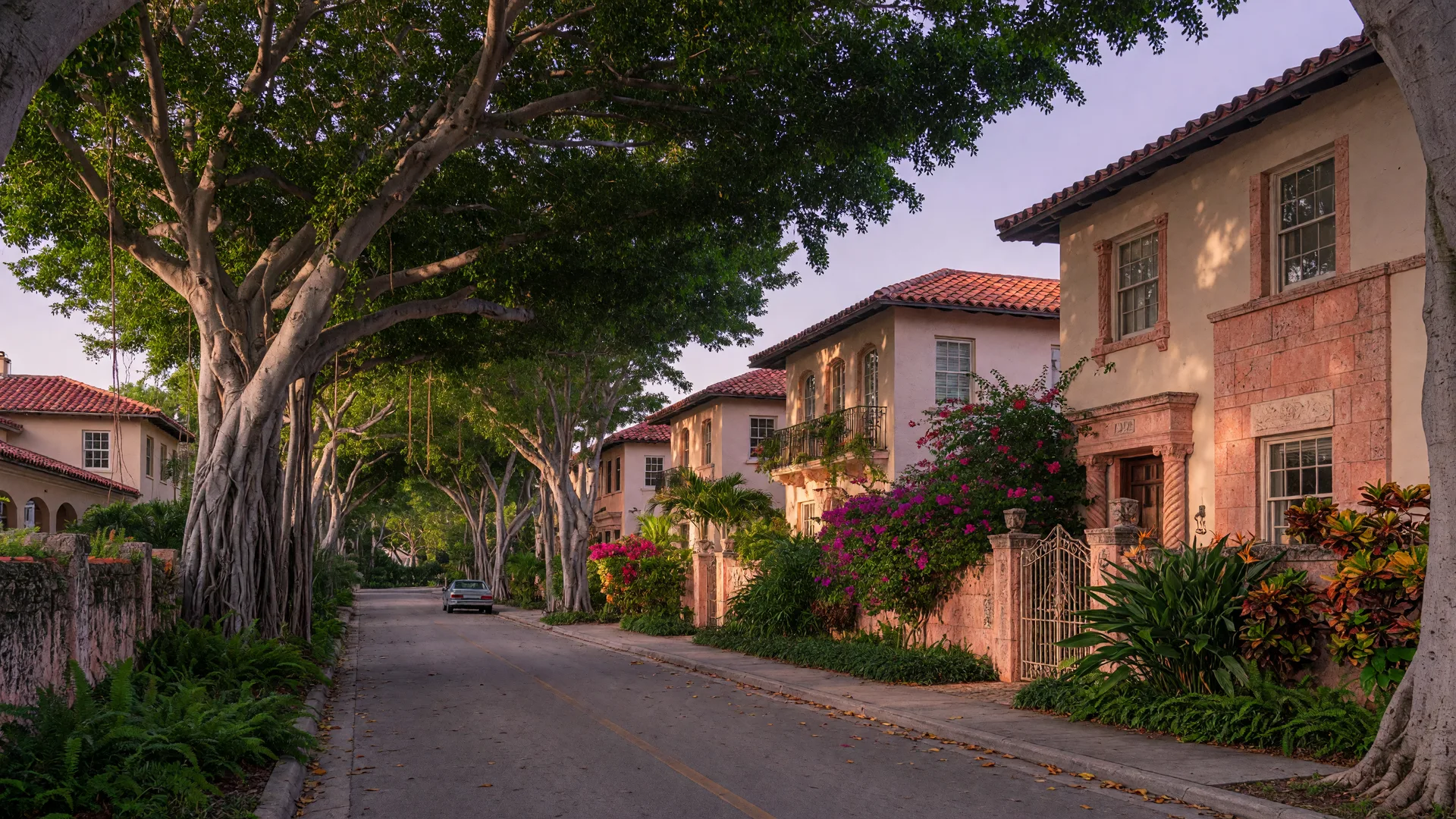
Coral Gables is the City Beautiful: Mediterranean Revival architecture planned by George Merrick in the 1920s, banyan-shaded boulevards, and a Miracle Mile shopping street whose walkable core scores near 100. It is also the most expensive market in this series: single-family medians commonly run $1.3 million to $2.3 million. Buyers get the strongest luxury lifestyle of the six, elite school options in the right zones, and downtown Miami about seven miles away, and they pay for all of it.
This guide keeps the postcard and adds the fine print: real price ranges, the schools buyers actually check, commute reality, walkability scores, and the insurance and heat costs nobody puts in the brochure. If you read one page before you start house hunting in Miami-Dade County, make it this one. And when you want the street-level version, that is a free call away.
Want the honest, street-level take on Coral Gables? Set up a free 15-minute strategy call with Michael Wiz Wisniewski, Certified Real Estate Planning Advisor and Certified A.I. Real Estate Advisor, and he will tell you what the listings do not.
Miami-Dade County · Greater Miami
Median single-family price
$1.3MâÂÂ$2.3M
Walk Score
56 citywide; core 97âÂÂ99
Commute
Downtown Miami ~15âÂÂ20 min; MIA ~20 min
Schools
Miami-Dade; Gables Prep & West Lab 10/10
Source: U.S. Census Bureau (population and median age), county Realtor and MLS data (median home prices), Walk Score (walkability), state and Niche school data (school grades), and the Insurance Information Institute (insurance cost averages). Figures draw from public reporting and update often, so Michael pulls live comps, school assignments, and insurance quotes for your exact address in your strategy call.
What works
Pros of living in Coral Gables
The genuine advantages, with the specifics that matter: neighborhoods, schools, commute math, and the numbers behind the lifestyle.
-
Lifestyle and community
The City Beautiful is Florida's most deliberate architecture: coral stone, barrel tile, and arches on every block, with Miracle Mile, Giralda Avenue dining, the historic Biltmore, and neighborhood festivals with a European rhythm.
-
Schools
Miami-Dade schools in the right Gables zones are elite: Coral Gables Preparatory Academy (K-8) and Henry S. West Laboratory School rate 10/10 on GreatSchools, Coral Gables Elementary is consistently A-rated, and the city also hosts top private schools.
-
Commute and access
Downtown Miami is about 7 miles and 15 to 20 minutes off-peak (around 30 at rush), the Metrorail Douglas Road station reaches the Government Center in roughly 9 to 11 minutes, and Miami International Airport sits 15 to 20 minutes away.
-
Home values
This is luxury real estate by design: single-family medians commonly run $1.3 million to $2.3 million, with estate waterfront and golf-front homes higher still. Values have proven deep and durable across cycles, which is half the reason buyers pay the premium.
-
Walkability and transit
The citywide Walk Score of 56 hides a spectacular core: Miracle Mile and Giralda score 97 to 99, and Metrorail plus a residential circulator make parts of the city genuinely car-optional, rare in Miami-Dade.
-
Amenities
Parks designed in the 1920s, the Venetian Pool, the Biltmore, boutique shopping, the University of Miami's campus nearby, and a dining scene that punches far above the city's footprint: the amenity density is unmatched in this series.
The honest trade-offs
Cons of living in Coral Gables
No town is only a postcard. These are the trade-offs residents actually talk about, stated plainly, because a good advisor tells you the truth before you sign.
-
The price of entry
The highest barrier to entry of the six: even the relative bargain pockets flirt with seven figures, and luxury condos carry high HOA fees. This is a market for buyers who have planned, not for first-time sticker shock.
-
Miami-Dade school variance
Outside the right Gables zones, Miami-Dade results vary sharply, and Coral Gables Senior High itself is mixed, with GreatSchools rating it 5/10 even as Niche gives it A-. Buying the address for the school means buying the zone.
-
Traffic
Le Jeune Road, US-1, and Ponce de Leon Boulevard jam at peak, and any commute across the county doubles in season. The walkable core solves your evenings, not your cross-town mornings.
-
Flood exposure
The Biscayne Bay side of the city sits in mapped flood zones, sea-level rise is a planning reality for bayfront property, and wind and flood insurance bills follow the water views.
-
Heat, humidity, and storms
Deep summer is hot and stormy, hurricane season runs June through November, and the banyan canopy that makes the city beautiful also means constant pruning, roots, and leaf cleanup.
-
The cost of everything
Property tax on premium values, insurance, HOA and club fees, and a cost of living above the county average: the Gables is a budget conversation as much as a lifestyle, and the budget is long.
The bottom line: affluent buyers, international families, and luxury investors who want Mediterranean elegance, elite schools in the right zones, and downtown Miami 20 minutes away, and who can play at the top of the market. If that sounds like you, the next step is a free 15-minute strategy call, no pressure and no obligation, at calendly.com/michaelwisniewski/15-min-strategy-call or (561) 441-8420.
At a glance
Coral Gables: pros vs. cons, side by side
The fast comparison for the categories buyers weigh most. The full reasoning is above; this table is the one you screenshot.
| Category | What works | What to watch |
|---|---|---|
| Home values | Deep, durable luxury values across market cycles | Single-family medians $1.3MâÂÂ$2.3M |
| Schools | Gables Prep, West Lab, and Gables Elementary are elite | Variance by zone; Gables Senior High is mixed |
| Commute | Downtown Miami ~7 miles; Metrorail ~9âÂÂ11 min; MIA 15âÂÂ20 min | Peak-hour roads jam; county commutes double |
| Walkability | Miracle Mile and Giralda score 97âÂÂ99 | Citywide Walk Score of 56 |
| Water and outdoors | Bayfront parks, the Venetian Pool, and boat access | Bayfront flood zones and sea-level planning |
| Insurance and costs | No state income tax cushions the bill | Premiums, HOA, and lifestyle costs run high |
Ranges reflect published market data and vary by neighborhood and source. Current as of September 25, 2026.
Match the town to your life
Who is Coral Gables best for?
Five buyer personas get the straight answer, with the honest caveat attached to each.
Families
The school-zone buyers: Gables Prep, West Lab, and Gables Elementary in the right attendance areas are elite, so the address IS the school strategy. Verify the zone at the exact house before falling in love.
Luxury and international buyers
The destination: Mediterranean architecture, privacy, and a reputation that travels. This is the top of the South Florida market for many foreign and domestic buyers.
Investors
Luxury single-family and boutique condo product with durable values and international demand. Cap rates are modest; appreciation, liquidity, and 1031 positioning are the play.
Remote executives
A walkable core, elite amenities, and MIA 20 minutes away make the Gables the favorite of executives who travel and work remotely in equal measure.
Empty nesters
Garden apartments, townhomes, and boutique condos near Miracle Mile suit downsizers who want design, walkability, and culture without the maintenance of an estate.
Not sure which persona you are? That is exactly what the free 15-minute strategy call is for. Michael will help you see clearly which towns fit your life, your timeline, and your plan.
Book a Free CallStraight answers
Coral Gables FAQs
The questions buyers ask Michael most about Coral Gables, answered directly with the numbers.
01 Is Coral Gables a good place for families?
In the right zones, emphatically yes: Coral Gables Preparatory Academy (K-8) and Henry S. West Laboratory School rate 10/10 on GreatSchools, and Coral Gables Elementary is consistently A-rated. The catch is that Coral Gables Senior High is mixed and zone boundaries decide everything, so the address must be verified before you offer.
02 How long is the commute from Coral Gables to downtown Miami?
About 7 miles and 15 to 20 minutes off-peak, roughly 30 minutes at rush hour. The Metrorail Douglas Road station reaches the Government Center in about 9 to 11 minutes, which is often faster than driving and is genuinely car-optional.
03 How much does a house cost in Coral Gables?
Single-family medians commonly run $1.3 million to $2.3 million, while all-home-type medians have been reported anywhere from about $1 million to $1.7 million depending on the quarter and tracker. Estate waterfront and golf-front homes sit higher still.
04 Is Coral Gables at risk of flooding?
The bayfront side of the city sits in mapped flood zones and sea-level rise is part of the long-term planning conversation. Wind and flood insurance follow the water views, so Michael checks the FEMA zone, elevation, and mitigation history on every property.
05 Is Coral Gables walkable?
The core is spectacular: Miracle Mile and Giralda score 97 to 99 for walkability, and the citywide score of 56 still beats most of Miami-Dade. Most of the city is best with a car, but the downtown spine is a genuine walk-and-dine district.
Have a question this page did not answer? Ask it directly: (561) 441-8420 or michael@thecompleterealestateteam.com.
Keep exploring
You might also like
Living in Coral Gables
Neighborhoods, schools, market snapshot, and things to do
Read itLiving in South Miami
The walkable neighbor just south of the Gables
Read itCommute & Transportation Guide
Highways, rail, airports, and drive times across South Florida
Read itCompare the coasts
Your next step
Let's decide if Coral Gables is the town for you
Michael Wiz Wisniewski is The Life Transition Specialist, a Certified Real Estate Planning Advisor and Certified A.I. Real Estate Advisor with The Complete Real Estate Team, powered by Dalton Wade Real Estate, Florida DRE #3301665. He has built, bought, sold, and managed property from the Treasure Coast to South Florida, and he answers with the truth, not the sales pitch.
- (561) 441-8420
- michael@thecompleterealestateteam.com
- Book the free 15-minute strategy call
- Send a message on the contact page
Talk Soon
No obligation, no pressure
Is Coral Gables the right fit?
Tell Michael about your move, your timeline, and your questions about Coral Gables. He will reply personally with honest, local answers.
Message sent. Talk Soon!
Thank you for reaching out. Michael will be in touch shortly to schedule your strategy session.