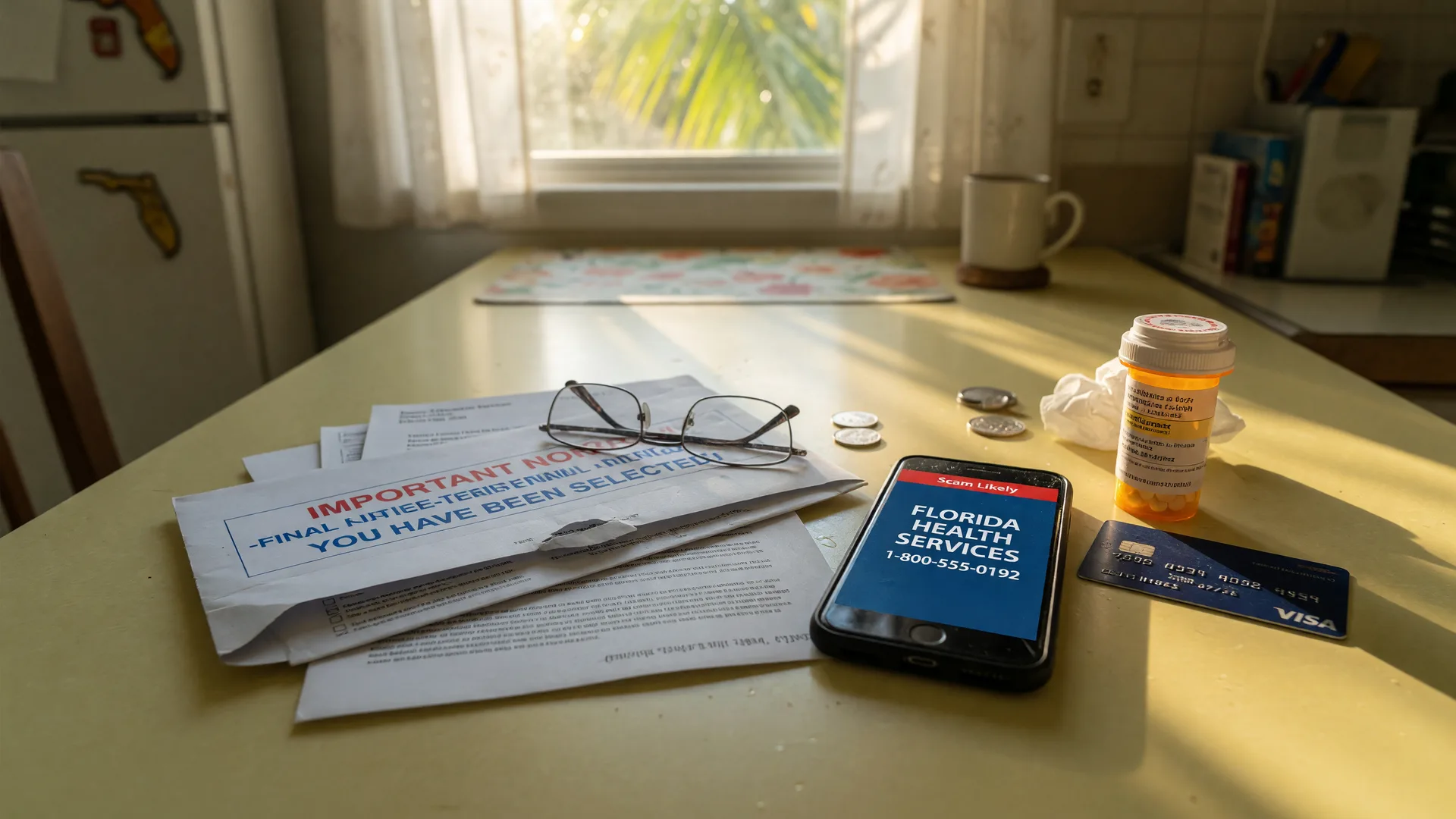
A retired widow in Port St. Lucie was settling in for lunch when her kitchen phone rang with a robocall. The recorded voice announced a “Medicare-approved” prescription discount card that promised “free and discounted” medications, and all she had to do was press 1 to activate it. She pressed 1. The caller explained the card itself was free, with just a one-time $4.95 activation fee to start, so she read out her debit card number. Then a $39.95 charge appeared on her statement every month for six months before she caught it, the card saved nothing at her pharmacy, and strangers who knew her name and her Medicare details started calling. She is a composite of the Florida seniors I work with every day, an illustrative example, not a real client, and her story is exactly how this ends when you do not yet know the script.
The quick answer
A fake prescription discount card scam is when a caller, text, or mailer offers a “free” or “Medicare-approved” pharmacy savings card, then charges hidden recurring fees to a card on file or harvests your Medicare number and personal information. A legitimate prescription discount card is free, needs no enrollment fee, and never asks for your bank or credit card number.
This is the fake prescription discount card scam, and the numbers behind it are real. The Senior Medicare Patrol estimates that fraud, errors, and abuse cost Medicare about $60 billion each year, and more than 69 million Americans are enrolled in Medicare (CMS). Better Business Bureau data shows Medicare scam call complaints surged about 40% in 2025. And in the 2024 National Health Care Fraud Takedown, federal prosecutors charged 193 defendants across 32 federal districts with about $2.75 billion in intended losses and $1.6 billion in actual losses (U.S. Department of Justice).
The defense is simpler than the offense: a real discount card is free, needs no recurring fee, and never asks for your bank card. The senior who knows that one sentence beats the robocall every time.
The red flags, in one glance
If you recognize even one of these, you already know the script:
-
Red flag 01 A caller who claims to be "Medicare-approved" or affiliated with Medicare.
-
Red flag 02 Any request for your Medicare number, Social Security number, or bank card number over the phone.
-
Red flag 03 A "free" card that still asks for a credit or debit card.
-
Red flag 04 Any activation, shipping, or processing fee.
-
Red flag 05 A "free trial" that requires a card on file.
-
Red flag 06 Pressure to decide right now, on the call.
-
Red flag 07 An unsolicited card in the mail with a sign-up pitch.
-
Red flag 08 A claim that your current Medicare benefits will be cut off without this card.
-
Red flag 09 No physical address or working phone number behind the offer.
-
Red flag 10 A recurring charge on a statement you do not recognize.
Read the full story
The full story lives in the Senior Scams series
This blog post is the companion to Story 10 of my Senior Scams series, published under the Senior Scams hub. In the full article you get the complete breakdown: the Port St. Lucie story in full, the nine shapes the recurring-fee pharmacy savings scam takes with their tells, the ten red flags, your eight safe moves, the verified reporting numbers for Florida, and the answers to the seven questions seniors ask most.
Read the full Senior Scams series articleIf it happens to you, this is your plan
Eight moves keep you calm, in control, and moving forward, no matter how convincing the pitch felt:
- 1
Hang up and do not pay another dollar. This is the single most powerful move.
- 2
Never give your Medicare number or bank card to an unsolicited caller, no matter how official they sound.
- 3
Check your statements for recurring charges, and call your bank or card issuer to dispute them and stop or replace the card.
- 4
Report to the Senior Medicare Patrol and the Florida SHINE Helpline at 1-800-963-5337.
- 5
Report to the Florida Attorney General fraud hotline at 1-866-9-NO-SCAM.
- 6
Report to the FTC at reportfraud.ftc.gov, and to the FBI IC3 at ic3.gov.
- 7
If your Medicare number was exposed, call Medicare at 1-800-MEDICARE to ask about getting a new number.
- 8
Tell a trusted person, because the shame the scammers plant is part of the trick, and reporting it heals it.
And one more thing, said with all the warmth I can put on this page: the shame you feel right now is exactly what the scammer counted on, and you are never at fault. Reporting it is not weakness; it is the strongest thing you can do, for yourself and for the next person.
The honest truth about discount cards
The entire scam rests on one lie, so the entire defense rests on one fact: a real prescription discount card is free, and free help for drug costs is everywhere:
-
A real prescription discount card is free, needs no enrollment fee, and never asks for your bank or credit card number. The golden rule is the whole defense.
-
Genuinely free help exists: GoodRx negotiates pharmacy discounts at no cost to you, Medicare Extra Help covers much of the prescription costs for qualifying low-income beneficiaries, and drug company patient assistance programs provide free or low-cost medicine to people who qualify.
-
Victims are never at fault. A professional criminal rehearses every line, and the shame they count on is exactly what you release when you report it.
Where to report a fake discount card in Florida
Reporting a scam is protection, not embarrassment. Every report helps stop the next robocall:
-
Senior Medicare Patrol and Florida SHINE Report Medicare fraud and protect your number at no cost through the Elder Helpline at 1-800-963-5337.
-
Florida Attorney General Call the state fraud hotline at 1-866-9-NO-SCAM.
-
FTC Report any fake discount card at reportfraud.ftc.gov.
-
FBI IC3 Report fraud that crosses state lines at ic3.gov, with card and statement details if you have them.
-
Medicare If your Medicare number was exposed, call 1-800-MEDICARE to ask about getting a new number.
“The card was never about saving money at the pharmacy. It was a tap into her debit card and her Medicare number, dressed up in an envelope that looked official. The real cost of a ‘free’ card is whatever they can charge you before you read the statement.”
Frequently asked questions about fake prescription discount cards
Quick, honest answers to the questions Florida seniors and their families ask me most. Tap a question to open the answer.
01 What is a fake prescription discount card scam?
A fake prescription discount card scam is when a caller, text, or mailer offers a "free" or "Medicare-approved" pharmacy savings card, then charges hidden recurring fees to a card on file or harvests your Medicare number and personal information. A legitimate prescription discount card is free, needs no enrollment fee, and never asks for your bank or credit card number.
02 Are prescription discount cards ever legitimate?
Yes, real discount cards and programs exist, and the good ones are free. GoodRx negotiates discounts directly with pharmacies and costs nothing to use, Medicare Extra Help covers much of the prescription costs for qualifying low-income beneficiaries, and drug company patient assistance programs provide free or low-cost medicine to people who qualify. None of them charge an activation fee, none of them need a card on file, and none of them call you out of the blue.
03 Why do these scams target seniors?
Seniors take more prescription medications than any other age group, so a pharmacy savings pitch sounds useful on its face, and seniors are more likely to answer an unexpected call and trust an offer that sounds official. Scammers also know that a small recurring charge can hide in a busy statement for months, and that the shame of being tricked keeps many seniors from reporting. The combination of genuine need for savings, politeness on the phone, and quiet statements is exactly what the script is built to exploit.
04 How do I know if a discount card offer is a scam?
Apply the golden rule: a real discount card is free, needs no enrollment fee, and never asks for your bank or credit card number. Treat any activation, shipping, or processing fee, any "free trial" that wants a card on file, any request for your Medicare number, and any pressure to decide on the call as immediate red flags. When in doubt, hang up and check with a real, free source: Florida's SHINE Helpline at 1-800-963-5337 or Medicare at 1-800-MEDICARE.
05 I gave them my card or Medicare number, what do I do?
Act fast and without shame, because scammers are professionals who rehearse every line. Call your bank or card issuer to dispute the recurring charges and stop or replace the card, then report to the Senior Medicare Patrol and Florida SHINE at 1-800-963-5337, the Florida Attorney General at 1-866-9-NO-SCAM, the FTC at reportfraud.ftc.gov, and the FBI IC3 at ic3.gov. If your Medicare number was exposed, call Medicare at 1-800-MEDICARE to ask about getting a new number.
06 What free programs actually help with drug costs?
Four real, free options cover most situations: GoodRx, which negotiates pharmacy discounts at no cost to you; Medicare Extra Help, the federal program that helps low-income beneficiaries pay for premiums and prescriptions; drug company patient assistance programs, which offer free or low-cost medicine to qualifying patients; and Florida's SHINE counselors, who help you compare and enroll at no cost. Call 1-800-963-5337 for a free, unbiased walk through what you qualify for.
07 Who do I report a fake discount card to in Florida?
Report to the Senior Medicare Patrol and Florida SHINE at 1-800-963-5337, the Florida Attorney General fraud hotline at 1-866-9-NO-SCAM, the FTC at reportfraud.ftc.gov, and the FBI IC3 at ic3.gov. If the scammer got your Medicare number, also call Medicare at 1-800-MEDICARE about getting a new one. Every report helps the agencies see the pattern and stop the next call.
Read the rest of the series
Every story in the Senior Scams series
Bookmark the Senior Scams hub and check it daily. Story 10 is this one, Story 9 covered unsolicited home repair scams, and the Medicare-adjacent stories in the series include Medicare open enrollment scams and Social Security impostors. Each new story adds a new layer of armor, and the whole series is written for the families of Florida seniors, because the senior who knows the script is the one who beats it.
Beat the recurring-fee pharmacy savings scam
The senior who knows the scam is the one who beats it, and knowledge is your armor. Keep the golden rule where you can see it: a real prescription discount card is free, needs no recurring fee, and never asks for your bank card. Keep 1-800-963-5337 and 1-866-9-NO-SCAM in your phone, and make the family rule that no Medicare number or bank card is ever read out on an unsolicited call. Then share what you know, at the dinner table and in the family group chat, because the senior who teaches the script protects a whole neighborhood. The families who talk about it are the ones who never become a number on the loss report.
Before the next robocall comes
Arm your family with one free call
Michael “Wiz” Wisniewski is a Certified Real Estate Planning Advisor who works with Florida seniors and their families every day. Bring any call, text, mailer, or statement charge that felt off, and leave with a clear next step for your family. Free 15-minute strategy call, no pressure, no obligation.

About the Author
Michael "Wiz" Wisniewski
Michael "Wiz" Wisniewski is The Life Transition Specialist with The Complete Real Estate Team, powered by Dalton Wade Real Estate, serving clients from the Treasure Coast to South Florida. A Certified Real Estate Planning Advisor, Certified Life Transition Specialist, and Certified A.I. Real Estate Advisor, he has worked nearly every side of real estate: fix-and-flip investing, land development, home building, and property management, and guides families through life's transitions with care, honesty, and the Golden Rule.
Certified Real Estate Planning Advisor | Certified Life Transition Specialist | Certified A.I. Real Estate Advisor
Written by
Michael Wisniewski, The Wizard of Real Estate
Certified Real Estate Planning Advisor | Certified Life Transition Specialist | Certified A.I. Real Estate Advisor
Helping Florida families protect what matters most.
Talk Soon