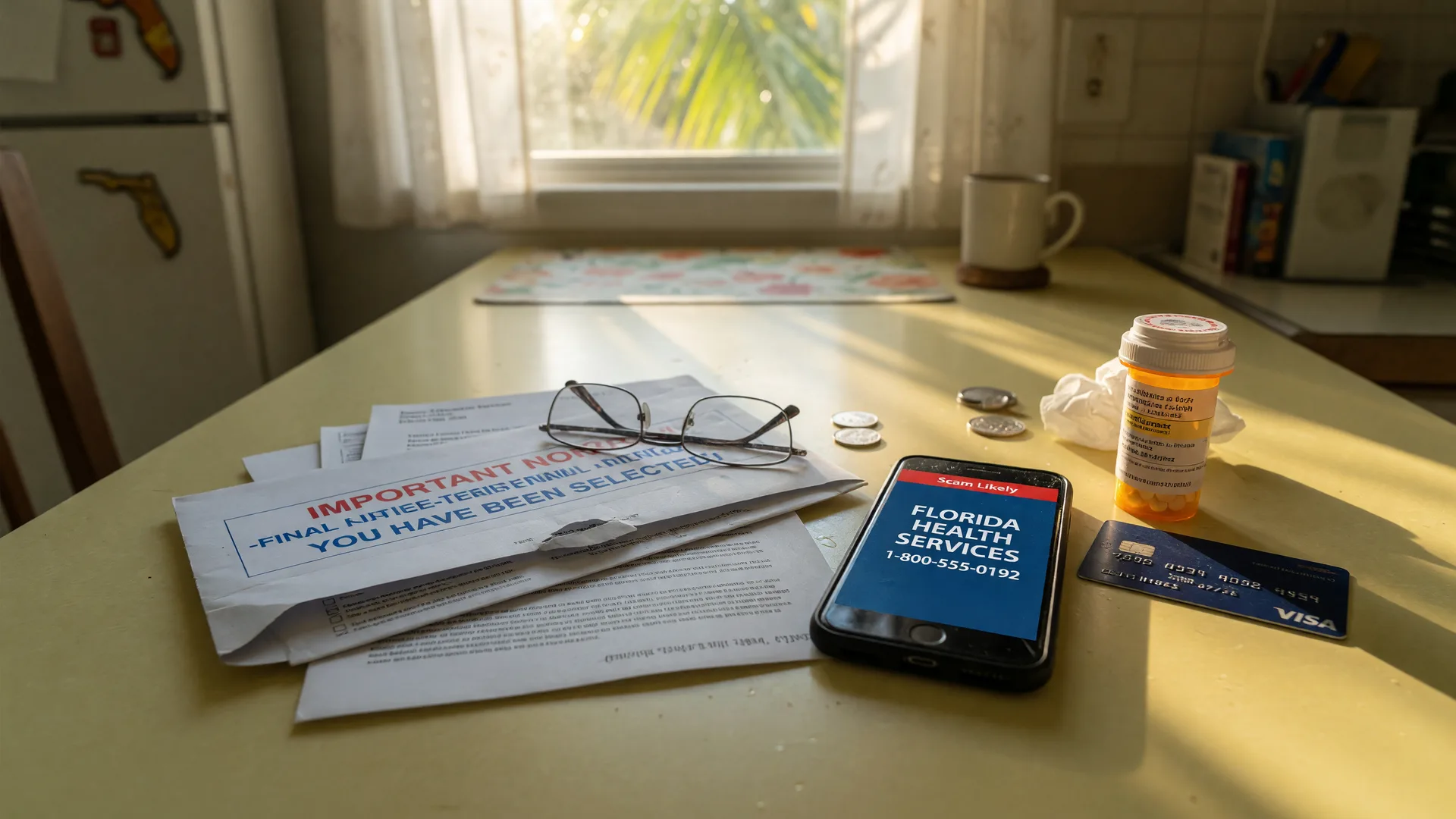
The story: one robocall, six months of $39.95 charges
A retired widow in Port St. Lucie was settling in for lunch when her kitchen phone rang with a robocall. The recorded voice announced a “Medicare-approved” prescription discount card that promised “free and discounted” medications at her pharmacy, and all she had to do was press 1 to activate it. She pressed 1. A friendly caller came on the line, explained that the card itself was free, and said there was just a one-time $4.95 activation fee to start. So, right there on the call, she read out her debit card number.
Then a $39.95 charge appeared on her statement every month for six months before she caught it. The card arrived in the mail looking like official Medicare or insurance mail, but it saved nothing at her pharmacy, and the “free and discounted” medications never materialized. Worse, the calls started: strangers who already knew her name and her Medicare details, offering more “benefit updates” and “discount programs.” Her debit card was out $244.80, and her Medicare number was now in the wild.
She is a composite of the Florida seniors I work with every day, an illustrative example, not a real client, and her story is the one I want every family to rehearse. The card was never a savings program; it was a tap into her accounts and her identity, wrapped in an envelope that looked official and a pitch that sounded kind. Here is the truth at the end of every story in this series: the senior who knows the scam is the one who beats it, and knowledge is your armor. It never wears out.
The quick answer
A fake prescription discount card scam is when a caller, text, or mailer offers a “free” or “Medicare-approved” pharmacy savings card, then charges hidden recurring fees to a card on file or harvests your Medicare number and personal information. A legitimate prescription discount card is free, needs no enrollment fee, and never asks for your bank or credit card number.
“The card was never about saving money at the pharmacy. It was a tap into her debit card and her Medicare number, dressed up in an envelope that looked official. The real cost of a ‘free’ card is whatever they can charge you before you read the statement.”
The real numbers behind the robocall
- $60B
- what fraud, errors, and abuse cost Medicare each year, the Senior Medicare Patrol estimates
- 69M+
- Americans are enrolled in Medicare, and every one of them is a target for a fake discount card pitch (CMS)
- ~40%
- surge in Medicare scam call complaints reported to the Better Business Bureau in 2025
- 193
- defendants charged across 32 federal districts in the 2024 National Health Care Fraud Takedown, with about $2.75 billion in intended losses and $1.6 billion in actual losses (U.S. Department of Justice)
How the recurring-fee pharmacy savings scam works
The fake discount card is not one trick; it is a machine with nine moving parts, and each one has a tell. Learn all nine now:
Play 01
The robocall or text offering a "free" or "Medicare-approved" discount card
The pitch arrives as a recorded call, a text, or a mailer: a pharmacy savings card that is "free," "Medicare-approved," and good for "free and discounted" medications. The words Medicare-approved are the bait, because they borrow trust that was never earned. No one at Medicare is selling cards, and Medicare does not endorse phone-sold discount cards.
The robocall is the cheapest possible fishing line. It costs the scammers almost nothing to dial a thousand Florida numbers and wait for the one person who presses 1. The senior who presses 1 has just told the caller that they are home, they are listening, and they are willing to engage.
Red flag: a robocall or text that claims a card is Medicare-approved, free, or discounted, out of nowhere.
Play 02
The buried recurring monthly fee charged to a card on file
The card is free, the caller explains, which is true only in the sense that the fee is buried. Somewhere in the fine print, the "free" card converts to a recurring monthly charge, $39.95 a month in our Port St. Lucie story, billed automatically to the debit or credit card you provided for the activation fee.
A recurring charge is the engine of the whole scam. One senior, one debit card, and six quiet months of $39.95 charges is a tidy profit for a criminal who invested almost nothing. The monthly charge is designed to be small enough to blend into a statement and big enough to matter when it goes unnoticed.
Red flag: any "free" offer that needs a card on file, because a card on file is a tap that can be opened.
Play 03
The "free trial" that auto-renews
Some versions skip the activation fee and run on a trial: 30 days free, then the plan continues at the monthly rate until you cancel. Cancelling, of course, requires calling a number that rings and rings, or finding that the fine print demands written notice to an address that does not exist.
The free trial is a subscription trap dressed as a courtesy. Real discount programs do not need a trial period or a card to prove themselves, because they are free to the patient. A trial that ends in an automatic charge is a recurring fee with a countdown clock.
Red flag: a "free trial" that requires a card on file and renews itself unless you cancel.
Play 04
The card that arrives looking like official Medicare or insurance mail
When the card arrives, the envelope is designed to look like official mail: a Medicare-style logo, an insurance-style layout, a card that mimics the shape of a real Medicare or pharmacy card. The goal is to make the scam look like something you enrolled in with a brand you already trust.
The envelope is a costume. Official Medicare and insurance materials arrive without an activation fee, without a robocall, and without asking you to read a card number out loud on the phone. If the envelope feels official but the sign-up felt like a phone call, the feeling official is the trick.
Red flag: an unsolicited card in the mail that looks like Medicare or insurance mail, with a sign-up pitch attached.
Play 05
The "activation" or "shipping" fee that opens the tap
The one-time fee is where the scam opens the tap. In our story it is a $4.95 activation fee, sold as a small, reasonable cost to start a free card. In other versions it is a shipping and handling fee, a processing fee, or a "refundable" deposit. Every version wants the same thing: your card number on file.
The fee is never the point. The card number is the point, because the card number is what turns a one-time $4.95 into a recurring $39.95. A real savings card needs no activation, no shipping fee, and no card on file, because a real savings card is free to the patient, period.
Red flag: any activation, shipping, or processing fee attached to a "free" card.
Play 06
The card that works at no pharmacy or saves less than genuinely free programs
The moment of truth comes at the pharmacy counter, and the card fails it: no coverage, no discount, or a "savings" smaller than what you already get for free. Our retired widow watched the pharmacist shrug at a card that saved her nothing, month after month, while the charges kept coming.
The honest alternatives are real and free. GoodRx negotiates discounts directly with pharmacies and is free to use. Medicare Extra Help is the federal program that pays for much of a low-income senior's prescription costs. And every major drug company runs patient assistance programs that provide free or low-cost medicine to people who qualify. None of them require a card on file, and none of them call you at lunch.
Red flag: a card that saves nothing at the pharmacy, when genuinely free programs like GoodRx, Medicare Extra Help, and drug company patient assistance exist.
Play 07
The data harvest that sells your Medicare number and personal information
The card scam is a money scam and a data scam at the same time. The activation call and the enrollment forms collect your Medicare number, your date of birth, your address, and your bank card number, and that bundle of personal information has a street value of its own.
Once your Medicare number and details are in the wild, they become inventory. The same networks resell the information to other scammers, which is why our Port St. Lucie widow started getting calls from strangers who already knew her name and her Medicare details. The discount card was the first scene of a story that kept running without her.
Red flag: any offer that asks for your Medicare number, Social Security number, or bank card number to give you something "free."
Play 08
The follow-on recovery scam that appears after a victim reports a loss
The cruelty does not end with the charges. After a victim spots the charges and reports the loss, a second scammer often appears, posing as a recovery agent, a fraud specialist, or a government official, offering to get the money back for a fee or a "verification" payment. It is the same criminal network, or a buyer of the victim list, and it preys on the very hope the first scam created.
No legitimate agency charges a fee to return stolen money, and no real investigator needs your card number to "unlock" your refund. Anyone who asks you to pay to recover your losses is running the second act of the same fraud, and the correct response is the same: hang up and report.
Red flag: anyone who promises to recover your lost money for an upfront fee or a card on file. That is the follow-on scam.
Play 09
The Florida angle: report to Senior Medicare Patrol, SHINE, the Florida Attorney General, and the FTC
Florida gives you a short, powerful reporting list. The Senior Medicare Patrol, reaching Florida seniors through the Florida SHINE Helpline at 1-800-963-5337, investigates and documents Medicare fraud and helps you protect your number. The Florida Attorney General fraud hotline at 1-866-9-NO-SCAM takes reports and feeds state enforcement. And the FTC at reportfraud.ftc.gov turns your report into national pattern-spotting.
And the golden rule of this entire scam: a real prescription discount card is free, needs no recurring fee, and never asks for your bank card. Keep that one sentence where you can see it, and the robocall loses its script before it ever starts.
The move that ends it: 1-800-963-5337 (Senior Medicare Patrol and SHINE), 1-866-9-NO-SCAM (Florida Attorney General), and reportfraud.ftc.gov, plus the golden rule: a real card is free.
Red flags checklist: spot the fake discount card early
Scams do not thrive on cleverness; they thrive on speed and shame. If you recognize even one of these, you already know the script:
-
Red flag 01 A caller who claims to be "Medicare-approved" or affiliated with Medicare.
-
Red flag 02 Any request for your Medicare number, Social Security number, or bank card number over the phone.
-
Red flag 03 A "free" card that still asks for a credit or debit card.
-
Red flag 04 Any activation, shipping, or processing fee.
-
Red flag 05 A "free trial" that requires a card on file.
-
Red flag 06 Pressure to decide right now, on the call.
-
Red flag 07 An unsolicited card in the mail with a sign-up pitch.
-
Red flag 08 A claim that your current Medicare benefits will be cut off without this card.
-
Red flag 09 No physical address or working phone number behind the offer.
-
Red flag 10 A recurring charge on a statement you do not recognize.
What to do if it happens
If the robocall already found you, or if you spot a charge you do not recognize, you already have a plan. These eight moves keep you calm, in control, and moving forward:
- 1
Hang up and do not pay another dollar
You do not owe a stranger a conversation, an explanation, or a goodbye. Ending the call is always allowed, and no more payments, no more "fees," and no more cards on file is the most powerful single move you can make.
- 2
Never give your Medicare number or bank card to an unsolicited caller
Your Medicare number is the keys to your coverage and a marketable commodity in the wrong hands. No legitimate caller needs it read out over the phone, ever, and no real savings program needs your debit card to prove you are free.
- 3
Check your statements for recurring charges, then call your bank or card issuer
Look for recurring charges you do not recognize: the $4.95 activation, the monthly $39.95, anything from a company name you do not know. Call your bank or card issuer right away to dispute the charges and ask to stop or replace the card so the tap closes for good.
- 4
Report to the Senior Medicare Patrol and the Florida SHINE Helpline at 1-800-963-5337
The Senior Medicare Patrol, reached through Florida's SHINE program at 1-800-963-5337, is the free, unbiased place for Medicare fraud questions and help protecting your number. Call it without shame; this is exactly what it exists for.
- 5
Report to the Florida Attorney General fraud hotline at 1-866-9-NO-SCAM
Call 1-866-9-NO-SCAM to put the report on the state's record and get guidance from trained specialists who handle Florida fraud every day, including the Medicare scams that ride in on the state's senior population.
- 6
Report to the FTC at reportfraud.ftc.gov
The Federal Trade Commission tracks every fake discount card report and uses the pattern to stop the network. File online at reportfraud.ftc.gov with the caller name, the card name, the phone number, and any paperwork you kept.
- 7
Report to the FBI IC3 at ic3.gov
The FBI Internet Crime Complaint Center investigates fraud that crosses state lines. File a complaint at ic3.gov, and include the card name, the phone number, and the company name on your statement if you have them.
- 8
If your Medicare number was exposed, call Medicare at 1-800-MEDICARE
Call 1-800-MEDICARE, the number printed on your own card, tell them your Medicare number may have been compromised, and ask about getting a new number. A new number closes the door on the strangers who already know your details.
And one more thing, said with all the warmth I can put on this page: the shame you feel right now is exactly what the scammer counted on, and you are never at fault. A professional criminal rehearsed every line against you, and you are not naive for being kind. Reporting it is not weakness; it is the strongest thing you can do, for yourself, for your family, and for the next person the same number gets dialed on.
Reporting resources for Florida seniors
Reporting a fake discount card is not about embarrassment; it is about protection. Every report helps the agencies see the pattern and stop the next call. These are the verified places to go:
Frequently asked questions about fake prescription discount cards
Quick, honest answers to the questions Florida seniors and their families ask me most. Tap a question to open the answer.
01 What is a fake prescription discount card scam?
A fake prescription discount card scam is when a caller, text, or mailer offers a "free" or "Medicare-approved" pharmacy savings card, then charges hidden recurring fees to a card on file or harvests your Medicare number and personal information. A legitimate prescription discount card is free, needs no enrollment fee, and never asks for your bank or credit card number.
02 Are prescription discount cards ever legitimate?
Yes, real discount cards and programs exist, and the good ones are free. GoodRx negotiates discounts directly with pharmacies and costs nothing to use, Medicare Extra Help covers much of the prescription costs for qualifying low-income beneficiaries, and drug company patient assistance programs provide free or low-cost medicine to people who qualify. None of them charge an activation fee, none of them need a card on file, and none of them call you out of the blue.
03 Why do these scams target seniors?
Seniors take more prescription medications than any other age group, so a pharmacy savings pitch sounds useful on its face, and seniors are more likely to answer an unexpected call and trust an offer that sounds official. Scammers also know that a small recurring charge can hide in a busy statement for months, and that the shame of being tricked keeps many seniors from reporting. The combination of genuine need for savings, politeness on the phone, and quiet statements is exactly what the script is built to exploit.
04 How do I know if a discount card offer is a scam?
Apply the golden rule: a real discount card is free, needs no enrollment fee, and never asks for your bank or credit card number. Treat any activation, shipping, or processing fee, any "free trial" that wants a card on file, any request for your Medicare number, and any pressure to decide on the call as immediate red flags. When in doubt, hang up and check with a real, free source: Florida's SHINE Helpline at 1-800-963-5337 or Medicare at 1-800-MEDICARE.
05 I gave them my card or Medicare number, what do I do?
Act fast and without shame, because scammers are professionals who rehearse every line. Call your bank or card issuer to dispute the recurring charges and stop or replace the card, then report to the Senior Medicare Patrol and Florida SHINE at 1-800-963-5337, the Florida Attorney General at 1-866-9-NO-SCAM, the FTC at reportfraud.ftc.gov, and the FBI IC3 at ic3.gov. If your Medicare number was exposed, call Medicare at 1-800-MEDICARE to ask about getting a new number.
06 What free programs actually help with drug costs?
Four real, free options cover most situations: GoodRx, which negotiates pharmacy discounts at no cost to you; Medicare Extra Help, the federal program that helps low-income beneficiaries pay for premiums and prescriptions; drug company patient assistance programs, which offer free or low-cost medicine to qualifying patients; and Florida's SHINE counselors, who help you compare and enroll at no cost. Call 1-800-963-5337 for a free, unbiased walk through what you qualify for.
07 Who do I report a fake discount card to in Florida?
Report to the Senior Medicare Patrol and Florida SHINE at 1-800-963-5337, the Florida Attorney General fraud hotline at 1-866-9-NO-SCAM, the FTC at reportfraud.ftc.gov, and the FBI IC3 at ic3.gov. If the scammer got your Medicare number, also call Medicare at 1-800-MEDICARE about getting a new one. Every report helps the agencies see the pattern and stop the next call.
Follow the full Senior Scams series
This is Story 10 of the Senior Scams series: a new, real-world scam warning published daily for Florida seniors and the families who love them. Every story names the trick, shows how it plays out, and ends with the move that stops it.
Bookmark the hub and check it daily. Story 1 covered Medicare open enrollment, Story 2 covered grandparent AI voice scams, Story 3 covered Social Security impostors, Story 4 covered IRS and tax agency threats, Story 5 covered romance scams, Story 6 covered cryptocurrency investment fraud, Story 7 covered social media marketplace fraud, Story 8 covered secret shopper scams, Story 9 covered unsolicited home repair scams, and this fake prescription discount card story is Story 10. Each new story adds a new layer of armor.
The cousin of this scam: fraud that rides the October 15 to December 7 coverage window, with fake representatives, new-card fees, and look-alike websites. Read the Medicare open enrollment story on the blog before the season starts.
The suspended-SSN script: a caller who sounds official, a number that is "flagged," and a payment that will fix it. The Social Security Administration never does this, and the story shows the whole script and the one move that ends it.
Start at the home page for Michael’s full story, the services he offers, and how to book a free strategy call with The Complete Real Estate Team, powered by Dalton Wade Real Estate.
The companion blog post for this story lives at /blog/fake-prescription-discount-cards/, and the whole blog holds more senior protection reading from the Treasure Coast to South Florida.
Before the next robocall comes
Arm your family with one free call
Michael “Wiz” Wisniewski is a Certified Real Estate Planning Advisor who works with Florida seniors and their families every day. Bring any call, text, mailer, or statement charge that felt off, and leave with a clear next step for your family. Free 15-minute strategy call, no pressure, no obligation.

About the Author
Michael "Wiz" Wisniewski
Michael "Wiz" Wisniewski is The Life Transition Specialist with The Complete Real Estate Team, powered by Dalton Wade Real Estate, serving clients from the Treasure Coast to South Florida. A Certified Real Estate Planning Advisor, Certified Life Transition Specialist, and Certified A.I. Real Estate Advisor, he has worked nearly every side of real estate: fix-and-flip investing, land development, home building, and property management, and guides families through life's transitions with care, honesty, and the Golden Rule.
Certified Real Estate Planning Advisor | Certified Life Transition Specialist | Certified A.I. Real Estate Advisor
Written by
Michael Wisniewski, The Wizard of Real Estate
Certified Real Estate Planning Advisor | Certified Life Transition Specialist | Certified A.I. Real Estate Advisor
Helping Florida families protect what matters most.
Talk Soon