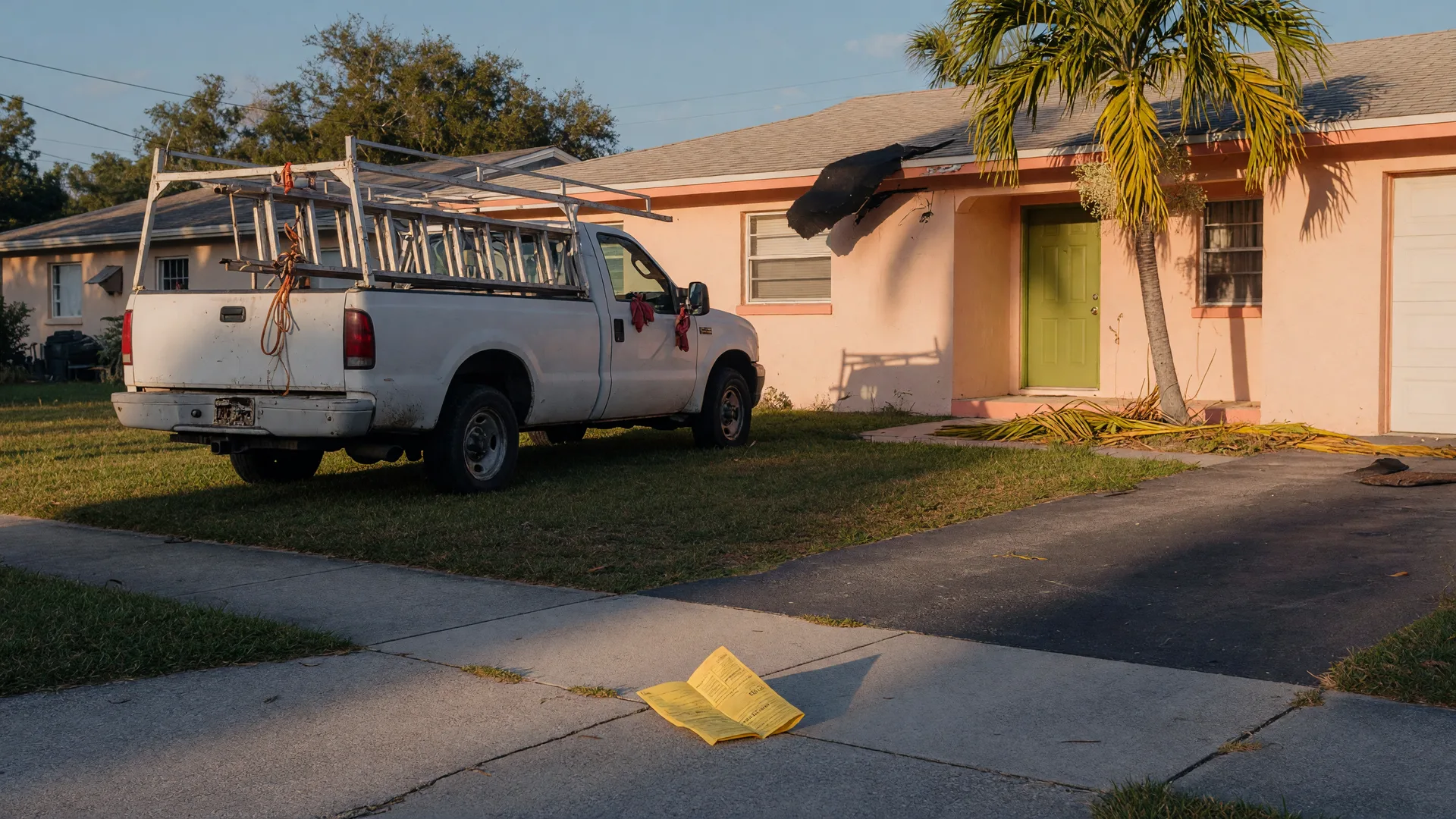
The story: the knock that cost $4,000
Two weeks after a bad storm rolled through Sebastian, a retired widow heard a knock at her door. A friendly crew stood on the porch in an unmarked truck, and the man in front said they were “just down the street” and had noticed her roof had a few loose shingles. They offered a “special storm price” if she signed today, and they needed $4,000 in cash up front for materials. She wrote a check and handed it over. They promised to start first thing in the morning.
They never came back. The check was cashed that same day, and the phone number on the flyer stopped working by the weekend. The roof was never touched, the driveway was never paved, and the $4,000 was gone before she finished telling her daughter what happened.
She is a composite of the Florida seniors I work with every day, an illustrative example, not a real client, and her story is the one I want every family to rehearse. The crew was never a roofing company, never insured, and never coming back. They were a script, and the script only needed one thing from her: her money, up front, before she could think. Here is the truth at the end of every story in this series: the senior who knows the scam is the one who beats it, and knowledge is your armor. It never wears out.
“The crew was never a roofing company and never coming back. They were a script that needed one thing, her money, up front, and they vanished the moment the check cleared. The estimate was a costume, and the only roof in that story was the one she believed in. Every cash-upfront crew loses the same way, the moment you see the script behind the knock.”
The real numbers behind the knock at the door
- 1 in 10
- Americans has experienced a contractor scam, and baby boomers are the most likely age group to encounter one (JW Surety Bonds survey, per U.S. News & World Report)
- $2,426
- the average loss for homeowners who fell prey to contractor fraud (JW Surety Bonds survey, per U.S. News & World Report)
- Thousands
- of consumer complaints tied to contractor fraud reached the Florida Attorney General after Hurricane Ian in 2022, and the Florida DBPR opened hundreds of enforcement cases
- #1
- Florida leads the nation in roofing fraud, according to NBC News and insurance industry reporting
How the cash-upfront roofing and paving crew works
The unsolicited home repair scam is not one trick; it is a family of tricks that all end the same way. Learn the eight shapes it takes now, and each one has its tell built in:
Play 01
The door-to-door crew that "just finished a job down the street"
The knock comes with a story already attached: they were working a few streets over, they noticed your roof from the road, and a couple of loose shingles caught their eye. The story is bait. A legitimate contractor does not discover your roof from a passing truck and then happen to have a crew and a price ready at your door.
The "just down the street" line exists to make a stranger feel like a neighbor. Real crews arrive because you called them, and they start with an inspection you asked for, not a sales pitch you did not.
Red flag: a crew that shows up at your door without being called, with a story about noticing your home from the street.
Play 02
The cash-upfront demand for roofing, paving, or tree trimming
The request is always the same shape: the full amount, in cash or by check, before a single shingle is lifted. Roofing, paving, and tree trimming are the favorites because the work is visible, expensive, and easy to fake with a fast estimate and a handshake.
A legitimate contractor never demands the full amount in cash before starting. Real jobs carry written contracts, staged payments tied to completed work, and a paper trail. The demand for everything up front is the tell that the job was never the point.
Red flag: a demand for the full amount in cash before any work starts. Legitimate contractors never do this.
Play 03
The "leftover materials" and "we noticed a problem" upsell
Two lines do most of the work. The first is "leftover materials": the crew claims another job left extra shingles or asphalt, so they can give you a deal today. The second is "we noticed a problem": a loose shingle, a soft spot, a cracked driveway edge that suddenly looks urgent.
Both lines manufacture a problem and a discount in the same breath. The urgency is fake, the materials are usually never delivered, and the "problem" is whatever the crew needs it to be to get a signature and a check.
Red flag: a claim that they were "just down the street" or have "leftover materials" that make today special.
Play 04
The storm-chaser who appears right after a hurricane
After a hurricane, the crews arrive before the insurance adjusters do. They knock on every door in the storm path with a too-fast estimate, a "special storm price," and a deadline: sign today or the deal disappears. The storm is their marketing department.
The estimate that takes ten minutes after a hurricane is not an estimate, it is a script. Real roof damage needs a real inspection, and real repairs are priced by licensed contractors competing for your business, not by a crew racing down the block.
Red flag: a too-fast estimate after a storm, with pressure to sign that same day for a "special price."
Play 05
The fake license or insurance that never holds up
Ask for a license number and a certificate of insurance, and the crew has an answer ready: a laminated card, a number that looks official, a story about being licensed in another state. None of it survives a two-minute check against the Florida DBPR.
In Florida, every contractor license is public record and free to verify at myfloridalicense.com or by calling (850) 487-1395. A crew that cannot produce a license that verifies is a crew that was never licensed at all.
Red flag: a license or insurance card that cannot be verified, or a claim that they are licensed somewhere else.
Play 06
The lien or "we'll take you to court" pressure
When a senior hesitates, the pressure escalates: the crew has already ordered the materials, the truck is loaded, and if you back out now they will file a lien on your home or take you to court. It is a script, and the courthouse threat is the loudest tell in it.
A contractor who has done no work has no lien to file and no case to bring. The threat exists only to move a check across the table before you have time to verify anything.
Red flag: threats to walk away, file a lien, or take you to court if you do not pay today.
Play 07
The follow-on recovery scam
The cruelty does not end with the vanished crew. After a victim reports the loss, a second scammer often appears, posing as a recovery agent, a lawyer, or a government official, and promises to get the money back for a fee. It is the same criminal network, or a buyer of the victim list, and it preys on the very hope the first scam created.
No legitimate recovery service charges an upfront fee to return stolen money. Anyone who asks you to pay to recover your losses is running the second act of the same fraud.
Red flag: anyone who promises to recover your lost money for an upfront fee. That is the follow-on scam.
Play 08
The Florida angle: verify the license, and know your three-day right to cancel
Florida gives you two weapons the crew hopes you never learn about. First, every contractor license is free to verify through the Florida DBPR at myfloridalicense.com or by calling (850) 487-1395. Second, for door-to-door sales, federal and Florida law give you three days to cancel a contract of $25 or more, no questions asked, in writing.
The crew cannot survive either weapon. A license check ends the fake contractor in two minutes, and the three-day right to cancel turns a signed contract into a paper you can tear up. That is why they push for cash and pressure you to sign before you can think.
The move that ends it: verify the license through the Florida DBPR, and remember your three-day right to cancel door-to-door sales.
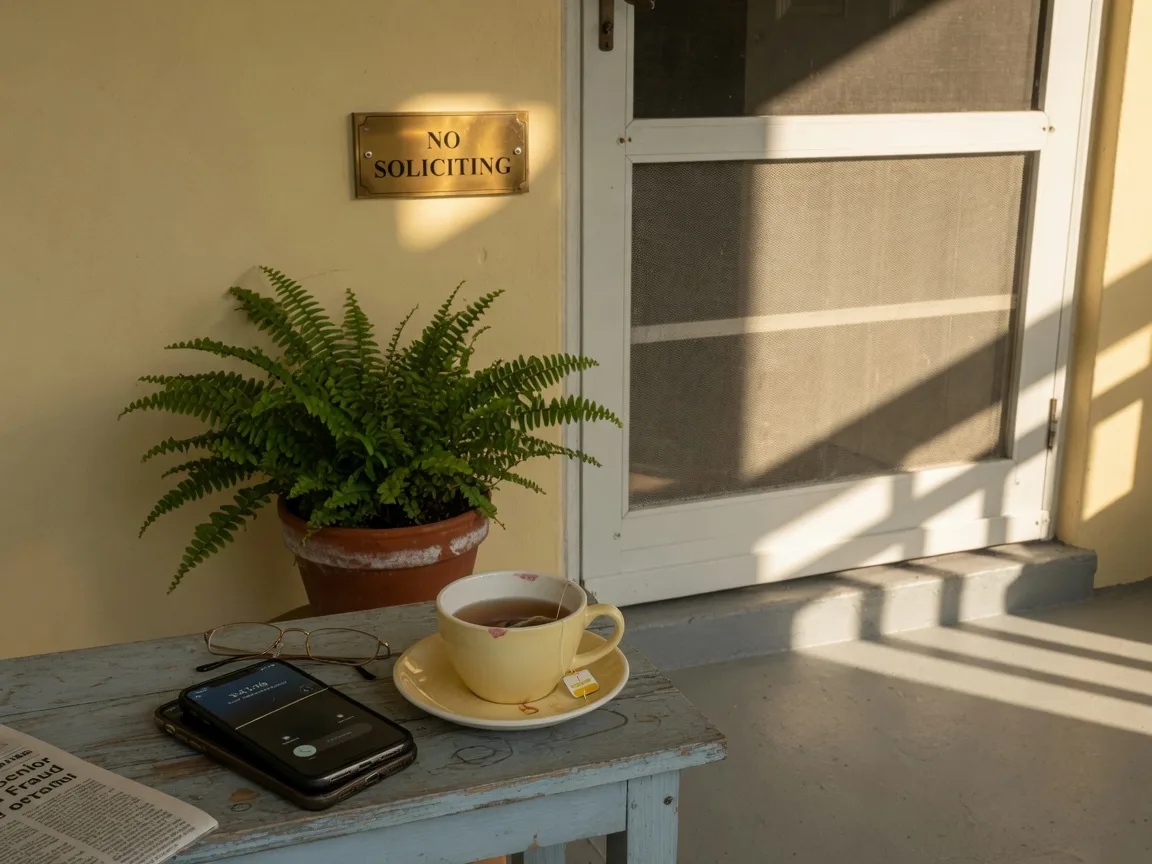
Red flags checklist: spot the cash-upfront crew early
Scams do not thrive on cleverness; they thrive on speed and shame. If you recognize even one of these, you already know the script:
-
Red flag 01 A crew that shows up at your door without being called.
-
Red flag 02 A claim that they were "just down the street" or have "leftover materials."
-
Red flag 03 A demand for the full amount in cash before any work starts.
-
Red flag 04 Pressure to sign or pay today for a "special price."
-
Red flag 05 An unmarked truck or van with an out-of-state license plate.
-
Red flag 06 No business identification, local address, or working phone number.
-
Red flag 07 A request for a check made out to an individual rather than a company.
-
Red flag 08 A too-fast estimate after a storm.
-
Red flag 09 Threats to walk away or take you to court.
-
Red flag 10 Any request for secrecy or urgency.
What to do if it happens
If it has already happened, you already have a plan. These eleven moves keep you calm, in control, and moving forward, no matter how convincing the knock felt:
- 1
Stop immediately and do not pay any more money
The single most powerful move is to stop. No more checks, no more cash, no more deposits. Every payment funds the next knock on the next door, and the crew you are trying to satisfy does not exist.
- 2
Never pay the full amount up front, and never pay in cash
A legitimate contractor prices the job, writes a contract, and ties payments to completed work. Cash leaves no trail, which is exactly why the crew demands it. If a contractor needs the full job paid before starting, that is not a contractor, that is a collection.
- 3
Verify any contractor license for free through the Florida DBPR
Check the license at myfloridalicense.com or call (850) 487-1395. The Florida Department of Business and Professional Regulation verifies every licensed contractor in the state, and the check is free and takes minutes.
- 4
Know your three-day right to cancel for door-to-door sales
For door-to-door sales of $25 or more, federal and Florida law give you three days to cancel in writing, no questions asked. If you signed at the door, the contract is not final until the cooling-off period passes.
- 5
Get written estimates from at least three licensed contractors
Real work gets real competition. Three written estimates from licensed, verified contractors show you the honest price range, and they give you the time and the paper trail that the door-to-door crew is trying to take away.
- 6
Save every flyer, contract, check, and message
Keep the flyer, the contract, the check image, the phone number, and any text or voicemail. This evidence is what investigators use to connect the crew to other victims and other jobs.
- 7
Report to the Florida Attorney General fraud hotline at 1-866-963-7226
Report the scam to the state at 1-866-963-7226 and get guidance from trained specialists who handle Florida fraud every day, including contractor fraud after storms.
- 8
Report to the FTC at reportfraud.ftc.gov
The Federal Trade Commission tracks every contractor and home repair scam report and uses the pattern to stop the network. File online at reportfraud.ftc.gov with as much detail as you have.
- 9
Report to the FBI IC3 at ic3.gov
The FBI Internet Crime Complaint Center investigates fraud that crosses state lines. File a complaint at ic3.gov, and include the crew names, phone numbers, and plate numbers if you have them.
- 10
Call the Florida Elder Affairs SHINE Helpline at 1-800-963-5337
Florida's SHINE program gives seniors free, unbiased counseling on benefits, fraud, and elder protection. Call 1-800-963-5337 for guidance and support that costs nothing.
- 11
Contact your bank about the payment
Call your bank or credit union right away to flag the fraud and ask whether the check can be stopped or the payment reversed. Time is the only thing that may still recover the money.
And one more thing, said with all the warmth I can put on this page: the shame you feel right now is exactly what the scammer counted on, and you are never at fault. A professional criminal rehearsed every line against you. Reporting it is not weakness; it is the strongest thing you can do, for yourself and for the next person.
Reporting resources for Florida seniors
Reporting an unsolicited home repair scam is not about embarrassment; it is about protection. Every report helps the agencies see the pattern and stop the next knock. These are the verified places to go:
Frequently asked questions about unsolicited home repair scams
Quick, honest answers to the questions Florida seniors and their families ask me most. Tap a question to open the answer.
01 What is an unsolicited home repair scam?
An unsolicited home repair scam is when a crew shows up at your door without being called, often after a storm, and pressures you to pay cash up front for roofing, paving, tree trimming, or other work, then disappears without doing the job. A legitimate contractor never demands the full amount in cash before starting.
02 Why do these crews target seniors?
Seniors often own their homes outright, keep cash or checkbooks at hand, and may live alone or hesitate to challenge a stranger at the door. Scammers also know that after a storm, a senior may worry about the roof or driveway and want the problem solved fast. The combination of home equity, solitude, and urgency is exactly what the script is built to exploit, and it is why the red flags matter more than politeness.
03 How do I check a contractor's license in Florida?
Check for free through the Florida Department of Business and Professional Regulation at myfloridalicense.com or by calling (850) 487-1395. Enter the license number or the contractor's name and confirm the license is active and matches the person or company at your door. If a crew cannot produce a license that verifies, they are not licensed in Florida.
04 What are the biggest red flags of a door-to-door repair crew?
The biggest red flags are a crew that shows up without being called, a claim that they were "just down the street" or have "leftover materials," a demand for the full amount in cash before any work starts, pressure to sign today for a "special price," an unmarked truck with an out-of-state plate, no business identification or working phone number, a check made out to an individual, a too-fast estimate after a storm, threats of a lien or court, and any request for secrecy or urgency.
05 I already paid a contractor who disappeared, what do I do?
Stop immediately and do not pay any more money, then act fast and without shame, because these crews are professionals. Contact your bank or credit union right away to try to stop the check or reverse the payment, save every flyer, contract, check, and message, and report to the Florida Attorney General fraud hotline at 1-866-963-7226, the FTC at reportfraud.ftc.gov, and the FBI IC3 at ic3.gov. Florida seniors can also call the SHINE Helpline at 1-800-963-5337 for free guidance.
06 Can I cancel a door-to-door home repair contract?
Yes. For door-to-door sales of $25 or more, federal and Florida law give you three days to cancel in writing, no questions asked. Send your cancellation notice within three business days of signing, keep a copy, and do not let the crew talk you out of it. The cooling-off period exists precisely because high-pressure door-to-door sales are a known fraud pattern.
07 How do I hire a trustworthy contractor?
Start with a license: verify it through the Florida DBPR at myfloridalicense.com or by calling (850) 487-1395. Get written estimates from at least three licensed contractors, ask for references and proof of insurance, and never pay the full amount up front. A trustworthy contractor puts everything in writing, ties payments to completed work, and is happy to wait while you check.
Follow the full Senior Scams series
This is Story 9 of the Senior Scams series: a new, real-world scam warning published daily for Florida seniors and the families who love them. Every story names the trick, shows how it plays out, and ends with the move that stops it.
Bookmark the hub and check it daily. Story 1 covered Medicare open enrollment, Story 2 covered grandparent AI voice scams, Story 3 covered Social Security impostors, Story 4 covered IRS and tax agency threats, Story 5 covered romance scams, Story 6 covered cryptocurrency investment fraud, Story 7 covered social media marketplace fraud, Story 8 covered secret shopper scams, and this unsolicited home repair story is Story 9. Each new story adds a new layer of armor.
The fake cashier’s check job offer, the gift cards, and the “send the difference back” trap. A check that clears then bounces is not pay, it is a costume.
The fake buyer, the fake Zelle confirmation, and the “business account” fee. A payment that never shows up in your real account is not a payment.
Start at the home page for Michael’s full story, the services he offers, and how to book a free strategy call with The Complete Real Estate Team, powered by Dalton Wade Real Estate.
The companion blog post for this story lives at /blog/unsolicited-home-repair-scams/, and the whole blog holds more senior protection reading from the Treasure Coast to South Florida.
Before the next knock comes
Arm your family with one free call
Michael “Wiz” Wisniewski is a Certified Real Estate Planning Advisor who works with Florida seniors and their families every day. Bring any flyer, estimate, or door knock that felt off, and leave with a clear next step for your family. Free 15-minute strategy call, no pressure, no obligation.

About the Author
Michael "Wiz" Wisniewski
Michael "Wiz" Wisniewski is The Life Transition Specialist with The Complete Real Estate Team, powered by Dalton Wade Real Estate, serving clients from the Treasure Coast to South Florida. A Certified Real Estate Planning Advisor, Certified Life Transition Specialist, and Certified A.I. Real Estate Advisor, he has worked nearly every side of real estate: fix-and-flip investing, land development, home building, and property management, and guides families through life's transitions with care, honesty, and the Golden Rule.
Certified Real Estate Planning Advisor | Certified Life Transition Specialist | Certified A.I. Real Estate Advisor
Written by
Michael Wisniewski, The Wizard of Real Estate
Certified Real Estate Planning Advisor | Certified Life Transition Specialist | Certified A.I. Real Estate Advisor
Helping Florida families protect what matters most.
Talk Soon