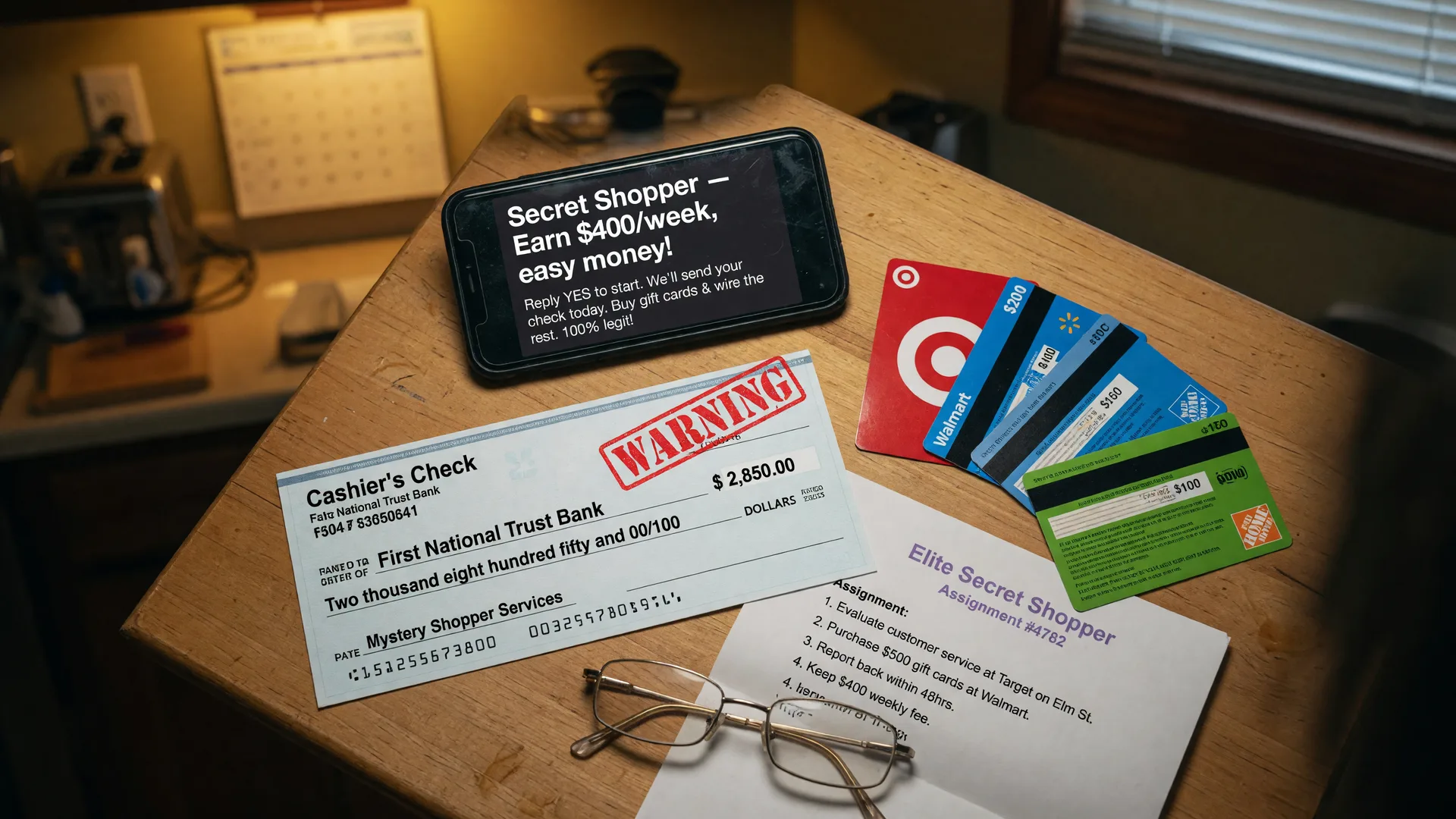
The story: the grocery chain text that cost a retired teacher $2,400
Margaret, a retired teacher in Vero Beach, was scrolling her phone one evening when a text arrived from an unknown number. It offered easy money: become a “secret shopper” and evaluate stores for a national grocery chain she knew and trusted, the same chain she had shopped at for thirty years. The pay was generous, the work was simple, and the message said they were recruiting “mature, detail-oriented shoppers” in her area. Margaret replied. She had taught for decades, she knew what good service looked like, and a little extra income sounded wonderful.
A few days later a package arrived. Inside was a cashier’s check for $2,850, a list of stores to evaluate, and a letter of instructions. She was to deposit the check, buy $2,400 in gift cards at the listed stores, keep $350 as her pay, and wire the rest of the money back to “headquarters.” Her bank made the funds available right away, so Margaret followed the instructions to the letter. She bought the gift cards, sent the money, and started making notes about store displays and checkout lines.
A week later the check bounced as counterfeit. The bank took the $2,850 back out of her account, and Margaret was out the $2,400 she had spent on gift cards plus the money she had wired. The grocery chain she trusted had never sent the text. Margaret is a composite of the Florida seniors I work with every day, an illustrative example, not a real client, and her story is the one I want every family to rehearse. The job was never a job, the check was never real, and “headquarters” was never coming back. It was a script, and the script only needed one thing from her: her money. Here is the truth at the end of every story in this series: the senior who knows the scam is the one who beats it, and knowledge is your armor. It never wears out.
“The check was a costume and the job was a script. The grocery chain never sent that text, ‘headquarters’ never existed, and the only real money in the story was the $2,400 Margaret spent on gift cards and the wire that followed. A real employer never asks you to send part of your own paycheck back.”
The real numbers behind the fake job
These are the figures the FTC tracked in 2024, and fake check scams like this one are a steady, costly slice of them. The median reported loss in a fake check scam runs near $2,000, and older adults carry a heavy share of the total. Every “paycheck” in this story has a number behind it somewhere in the reports.
- $2.4B
- in fraud losses reported by older adults in 2024, up from about $1.9 billion the year before (FTC)
- ~$2,000
- the median reported loss in a fake check scam, the family that secret shopper and mystery shopper job offers belong to (FTC)
- $12.5B+
- in fraud losses consumers reported in 2024, a 25% increase from 2023 (FTC)
- 1 in 3
- of people who reported fraud in 2024 said they lost money, up from one in four the year before (FTC)
How the fake cashier’s check job offer works
The secret shopper scam is not one trick; it is a family of tricks that all end the same way. Learn the seven shapes it takes now, and each one has its tell built in:
Play 01
The fake job offer that arrives as a text or email
The scam opens with a message that looks like an opportunity: a text, an email, or a letter offering easy money for a secret shopper or mystery shopper assignment. It often names a real national grocery chain or retailer you know and trust, and it recruits in volume, promising a generous pay rate for shopping, rating stores, and reporting on customer service.
The trusted name is the bait. The real chain never sent the message, and the "recruiter" is a criminal running the same offer to hundreds of people at once.
Red flag: a job offer that arrives out of nowhere by text, email, or letter, promising easy money for shopping or rating stores.
Play 02
The cashier's check that clears, then bounces days later
A package arrives with a cashier's check, a list of stores to evaluate, and instructions. The check is counterfeit, but it is printed to look perfect, with the chain's name, a bank routing number, and an amount that feels like real pay. You deposit it, and the bank makes the funds available right away.
This is the "overpayment and send the difference" trap in its job-offer costume. The check clears because the law says it must, then it bounces days later as counterfeit, and the bank takes the full amount back out of your account.
Red flag: a check that arrives before you have done any work, with instructions to deposit it and send part of the money back.
Play 03
The "keep a fee and send the rest" assignment
The instructions make the trap feel fair: deposit the check, buy gift cards at the listed stores, keep a fee as your pay, and send the rest of the money back to "headquarters." The math looks like a paycheck with a built-in bonus, and the assignment sounds like a real job.
The fee is your own money in disguise. Every dollar you keep and every dollar you send comes out of the counterfeit check, and when it bounces, you owe the bank the whole amount, including the "pay" you kept.
Red flag: an assignment that pays you by letting you keep part of a deposited check and send the rest back.
Play 04
The ask to wire money or buy gift cards with the "extra" money
The end of the script is always the same: the money has to come back in a form that cannot be reversed. Gift cards and wire transfers move instantly and are nearly impossible to recover, which is exactly why scammers demand them. The gift cards you buy are gone the moment you read the numbers to the recruiter.
No real employer ever asks you to buy gift cards or wire money as part of a job. The moment an assignment involves your own money leaving your account, it is not a job; it is a robbery with a smile.
Red flag: any request to wire money or buy gift cards as part of an assignment, no matter how official the instructions look.
Play 05
The fake recruiter who needs your personal details
Before the check even arrives, the "recruiter" wants paperwork: your full name, address, bank account number, and sometimes your Social Security number, supposedly to set up your pay. The details are collected to make the fraud feel official and to open the door to identity theft on top of the check scam.
A real employer collects tax forms through a verified hiring process, never by text from a stranger. Personal and banking details handed to a fake recruiter are a second loss waiting to happen.
Red flag: a recruiter who asks for your personal or banking details before you have done any real work.
Play 06
The follow-on recovery scam
The cruelty does not end with the bounced check. After a victim reports the loss, a second scammer often appears, posing as a recovery agent, a lawyer, or a government official, and promises to get the money back for a fee. It is the same criminal network, or a buyer of the victim list, and it preys on the very hope the first scam created.
No legitimate recovery service charges an upfront fee to return stolen money. Anyone who asks you to pay to recover your losses is running the second act of the same fraud.
Red flag: anyone who promises to recover your lost money for an upfront fee. That is the follow-on scam.
Play 07
The bank rule that makes a cleared check feel real
Here is the fact that makes this scam so convincing: banks are required by law to make deposited funds available quickly, often within one or two business days. The money shows up in your account, the bank lets you spend it, and the check feels real, because the law says the bank must treat it as available.
Availability is not proof. When the check is later found counterfeit, the bank reverses the deposit and takes every dollar back, plus fees, and you are responsible for the money you spent or sent. A cleared check is a legal requirement, not a guarantee that the check is real.
Red flag: assuming a check is real because the bank let you spend the money. Availability is the law, not proof.

Red flags checklist: spot the fake job offer early
Scams do not thrive on cleverness; they thrive on speed and shame. If you recognize even one of these, you already know the script:
-
Red flag 01 A job offer that arrives out of nowhere by text, email, or letter, from a recruiter you never contacted.
-
Red flag 02 A promise of easy money for shopping, rating stores, or evaluating customer service.
-
Red flag 03 A check that arrives before you have done any work at all.
-
Red flag 04 Instructions to deposit a check and send part of the money back.
-
Red flag 05 A request to wire money or buy gift cards as part of an assignment.
-
Red flag 06 A "recruiter" who asks for your personal or banking details before any real work.
-
Red flag 07 Pressure to act fast before the "assignment" closes or the offer expires.
-
Red flag 08 A too-good-to-be-true pay rate for simple tasks.
-
Red flag 09 Any request for secrecy, or a warning not to tell your bank or your family.
What to do if it happens
If it has already happened, you already have a plan. These nine moves keep you calm, in control, and moving forward, no matter how official the check looked:
- 1
Stop immediately and send no more money
The single most powerful move is to stop. No more replies, no more wires, no more gift cards. Every dollar you send funds the next victim, and the job you think you are doing does not exist.
- 2
Never deposit a check and send part of it back
No legitimate employer pays you by check and asks you to send part of it back. If a deposited check is later found fake, you owe the bank every dollar, plus any fees, and the "pay" you kept is gone too.
- 3
Never wire money or buy gift cards for an employer
Wire transfers and gift cards are irreversible, which is exactly why scammers demand them. No real job pays you with instructions to wire money or buy gift cards with your own funds.
- 4
Call your bank right away if you already deposited the check
Tell your bank the check may be counterfeit and ask what can be done. Acting fast can limit fees, flag the account, and sometimes help investigators trace a wire before it is gone.
- 5
Save every message, letter, envelope, check and receipt
Keep the texts, the emails, the package, the check, the assignment letter, and every gift card receipt. This evidence is what investigators use to connect the scammer to other victims.
- 6
Report to the FTC at reportfraud.ftc.gov
The Federal Trade Commission tracks every fake check and job scam report and uses the pattern to stop the network. File online at reportfraud.ftc.gov with as much detail as you have.
- 7
Report to the FBI IC3 at ic3.gov
The FBI Internet Crime Complaint Center investigates fake check and employment fraud. File a complaint at ic3.gov and include the check image, the messages, and the wire or gift card details.
- 8
Call the Florida Attorney General fraud hotline at 1-866-963-7226
Report the scam to the state at 1-866-963-7226 and get guidance from trained specialists who handle Florida fraud every day.
- 9
Call the Florida Elder Affairs SHINE Helpline at 1-800-963-5337
Florida's SHINE program gives seniors free, unbiased counseling on benefits, fraud, and elder protection. Call 1-800-963-5337 for guidance and support that costs nothing.
And one more thing, said with all the warmth I can put on this page: the shame you feel right now is exactly what the scammer counted on, and you are never at fault. A professional criminal rehearsed every line against you, and the check was engineered to look real. Reporting it is not weakness; it is the strongest thing you can do, for yourself and for the next person.
Reporting resources for Florida seniors
Reporting a secret shopper scam is not about embarrassment; it is about protection. Every report helps the agencies see the pattern and stop the next attempt. These are the verified places to go:
Frequently asked questions about secret shopper scams
Quick, honest answers to the questions Florida seniors and their families ask me most. Tap a question to open the answer.
01 What is a secret shopper scam?
A secret shopper or mystery shopper scam is a fake job offer that sends you a counterfeit cashier's check and asks you to deposit it, buy gift cards or send part of the money back. The check later bounces, leaving you responsible for the money you spent or sent. A real secret shopping job never asks you to wire money or send back part of a payment.
02 How does the fake cashier's check trick work?
A recruiter sends you a cashier's check before you have done any work, along with instructions to deposit it, keep a fee as your pay, and send the rest back by wire or gift cards. Banks are required by law to make deposited funds available quickly, so the money feels real for days. When the check is found counterfeit, the bank takes the full amount back out of your account, and you are out everything you spent or sent.
03 Why do seniors get targeted by secret shopper job offers?
Seniors get targeted because they are often home, polite, and glad to be asked to work, and because a name like a trusted grocery chain makes the offer feel safe. Scammers also use the excitement of easy money and the shame a senior may feel about being deceived to push urgency and secrecy. None of that makes a senior at fault; it makes them the exact target a rehearsed criminal looks for, which is why knowing the script is so powerful.
04 What are the biggest red flags of a fake secret shopper job?
The biggest red flags are a job offer that arrives out of nowhere by text, email, or letter, a promise of easy money for shopping or rating stores, a check that arrives before you have done any work, instructions to deposit a check and send part of the money back, a request to wire money or buy gift cards, a recruiter who asks for your personal or banking details, pressure to act fast, a too-good-to-be-true pay rate, and any request for secrecy. Hold any one of these and you are holding the script.
05 I already deposited a fake check, what do I do?
Stop immediately and do not send another dollar, then act fast and without shame. Call your bank right away and tell them the check may be counterfeit, and ask what can be done to limit the damage. Save every message, letter, envelope, check and receipt, report to the FTC at reportfraud.ftc.gov and the FBI IC3 at ic3.gov, and call the Florida Attorney General fraud hotline at 1-866-963-7226. Florida seniors can also call the SHINE Helpline at 1-800-963-5337.
06 Can I get my money back after a secret shopper scam?
It is possible, but it is never guaranteed, and speed matters. Call your bank or credit union immediately to flag the fraud and ask whether any wire can be stopped or reversed, and report to the FTC and the FBI IC3 right away. Be very careful: anyone who promises to recover your money for an upfront fee is running the follow-on recovery scam, and you should never pay them.
07 How do I tell a real secret shopper job from a scam?
A real secret shopping company hires you through a real application and interview process, pays you a set rate for completed assignments, and never sends you a check before you have worked. It never asks you to deposit money and send part back, never asks you to wire money or buy gift cards with your own funds, and never demands secrecy. If the first step is a check in the mail, it is not a job; it is a scam.
Follow the full Senior Scams series
This is Story 8 of the Senior Scams series: a new, real-world scam warning published daily for Florida seniors and the families who love them. Every story names the trick, shows how it plays out, and ends with the move that stops it.
Bookmark the hub and check it daily. Story 1 covered Medicare open enrollment, Story 2 covered grandparent AI voice scams, Story 3 covered Social Security impostors, Story 4 covered IRS and tax agency threats, Story 5 covered romance scams, Story 6 covered cryptocurrency investment fraud, Story 7 covered social media marketplace fraud, and this secret shopper story is Story 8. Each new story adds a new layer of armor.
The fake buyer, the fake Zelle confirmation, and the “business account” fee. A payment that never shows up in your real account is not a payment, and no honest buyer ever charges you a fee to receive your own money.
The wrong-number text, the dashboard of fake profits, and the fees that appear the moment you try to withdraw. The senior who knows the script beats it every time.
Start at the home page for Michael’s full story, the services he offers, and how to book a free strategy call with The Complete Real Estate Team, powered by Dalton Wade Real Estate.
The companion blog post for this story lives at /blog/secret-shopper-scams/, and the whole blog holds more senior protection reading from the Treasure Coast to South Florida.
Before the next “easy money” text comes
Arm your family with one free call
Michael “Wiz” Wisniewski is a Certified Real Estate Planning Advisor who works with Florida seniors and their families every day. Bring any text, email, letter, or check that felt off, and leave with a clear next step for your family. Free 15-minute strategy call, no pressure, no obligation.

About the Author
Michael "Wiz" Wisniewski
Michael "Wiz" Wisniewski is The Life Transition Specialist with The Complete Real Estate Team, powered by Dalton Wade Real Estate, serving clients from the Treasure Coast to South Florida. A Certified Real Estate Planning Advisor, Certified Life Transition Specialist, and Certified A.I. Real Estate Advisor, he has worked nearly every side of real estate: fix-and-flip investing, land development, home building, and property management, and guides families through life's transitions with care, honesty, and the Golden Rule.
Certified Real Estate Planning Advisor | Certified Life Transition Specialist | Certified A.I. Real Estate Advisor
Written by
Michael Wisniewski, The Wizard of Real Estate
Certified Real Estate Planning Advisor | Certified Life Transition Specialist | Certified A.I. Real Estate Advisor
Helping Florida families protect what matters most.
Talk Soon