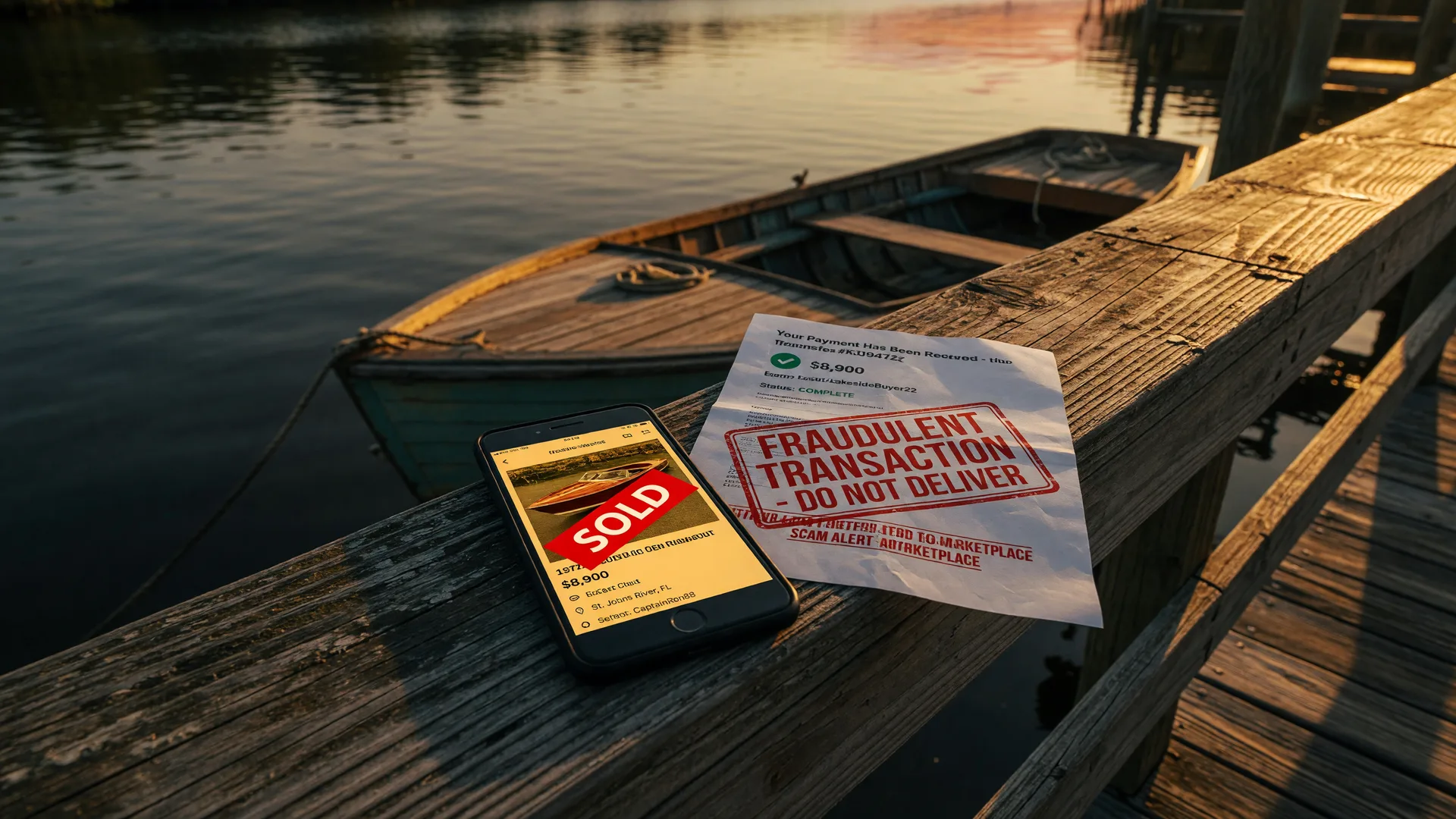
A retired couple in Sebastian listed their late father’s vintage boat on Facebook Marketplace for $4,500. Within an hour, a buyer messaged, eager to pay the full price right away, and said a courier would pick the boat up. The buyer asked for their email to “send payment,” and an email arrived that looked exactly like a Zelle payment confirmation. Then the funds were “held” until the seller upgraded to a “business account” by paying a $300 fee first, which would be refunded. The couple paid the fee, then a “shipping insurance” fee, then a “release” fee. The boat was never picked up, the payments were never real, and the couple was out $1,400. They are a composite of the Florida families I work with every day, an illustrative example, not a real client, and their story is exactly how this ends when you do not yet know the script.
The quick answer
Social media marketplace fraud is when criminals use buy-sell groups on Facebook Marketplace and other community platforms to run scams, either as fake buyers who overpay with a fake payment portal and ask for a refund of the difference or a fee to release the money, or as fake sellers who take payment and never deliver the item. The listing, the payment confirmation, and the fees are all part of the same script, and the only real goal is your money.
This is the fake buyer and the fake portal, and the numbers behind it are staggering. Non-Payment/Non-Delivery was one of the highest-volume fraud categories reported to the FBI IC3 in 2024, with over $785 million in reported losses. The FBI IC3 received 859,532 total complaints in 2024 with reported losses topping $16.6 billion, a 33% increase from the year before, and cyber-enabled fraud accounted for nearly 83% of all reported losses in 2024. In Florida, a single woman in her 70s lost more than $200,000 in a marketplace-linked scam ring that took over $3.5 million from more than 40 elderly victims across the state.
The defense is simpler than the offense: a payment that never shows up in your real account is not a payment, and the senior who knows the script beats it every time.
The red flags, in one glance
If you recognize even one of these, you already know the script:
-
Red flag 01 A buyer who offers to pay the full price without seeing the item in person.
-
Red flag 02 A buyer who asks for your email to "send payment" instead of paying through the platform.
-
Red flag 03 An email or screenshot that claims payment is pending, but the money never appears in your real bank or payment app.
-
Red flag 04 A demand to pay a fee to "upgrade" your account or "release" funds.
-
Red flag 05 An overpayment with a request to refund the difference.
-
Red flag 06 A buyer who insists a courier or a relative will pick up the item, sight unseen.
-
Red flag 07 Requests to pay by Zelle, Venmo, CashApp, wire, gift card, or Bitcoin ATM.
-
Red flag 08 A too-good-to-be-true price on a big-ticket item.
-
Red flag 09 Any request for secrecy or urgency.
Read the full story
The full story lives in the Senior Scams series
This blog post is the companion to Story 7 of my Senior Scams series, published under the Senior Scams hub. In the full article you get the complete breakdown: the Sebastian story in full, the nine shapes the fake buyer and the fake portal take with their tells, the nine red flags, your twelve safe moves, the verified reporting numbers for Florida, and the answers to the seven questions seniors ask most.
Read the full Senior Scams series articleIf it happens to you, this is your plan
Twelve moves keep you calm, in control, and moving forward, no matter how convincing the buyer felt:
- 1
Stop all payments immediately. This is the single most powerful move.
- 2
Never pay a fee to receive money that is owed to you.
- 3
Never refund an overpayment. If the payment never landed in your real account, the refund is money out of your pocket.
- 4
Check your real bank or payment app independently, never through a link in the email.
- 5
Save every message, receipt and screenshot. Evidence is what investigators need.
- 6
Report to the FBI IC3 at ic3.gov, with screenshots and payment details.
- 7
Report to the FTC at reportfraud.ftc.gov.
- 8
Report the listing and the profile to the platform, such as Facebook Marketplace.
- 9
Call the Florida Attorney General fraud hotline at 1-866-963-7226.
- 10
Call the Florida Elder Affairs SHINE Helpline at 1-800-963-5337.
- 11
Contact your bank or the payment app right away and ask about stopping any payment.
- 12
Freeze your credit with Equifax, Experian, and TransUnion.
And one more thing, said with all the warmth I can put on this page: the shame you feel right now is exactly what the scammer counted on, and you are never at fault. Reporting it is not weakness; it is the strongest thing you can do, for yourself and for the next person.

The honest truth about fake buyers and fake portals
The entire scam rests on one lie, so the entire defense rests on one fact: a real payment shows up in your real account, and no honest buyer ever charges you a fee to receive your own money:
-
The payment confirmation is a costume. The email, the screenshot, the "business account" upgrade, and the courier are all part of a script built to earn trust, and the only real goal is your money.
-
Real payment apps never hold your money behind a fee, and real buyers never need you to pay to receive what is owed to you. If a payment does not show up in your real account, it did not happen.
-
Victims are never at fault. A professional criminal rehearses every line, and the shame they count on is exactly what you release when you report it.
Where to report a marketplace scam in Florida
Reporting a scam is protection, not embarrassment. Every report helps stop the next message:
-
FTC Report any marketplace scam at reportfraud.ftc.gov.
-
FBI IC3 Report online marketplace fraud at ic3.gov, with screenshots and payment details.
-
Florida SHINE Free benefits and fraud counseling through the Elder Affairs Elder Helpline at 1-800-963-5337.
-
Florida AG Call the state fraud hotline at 1-866-963-7226.
-
Platform Report the listing and the profile to Facebook Marketplace or the buy-sell platform where the scam happened.
“The payment confirmation was a costume and the buyer was a script. The boat stayed in the driveway, the courier never arrived, and every ‘refundable’ fee was gone the moment it was sent. The only payment that ever exists is the one you can see in your real account.”
Frequently asked questions about social media marketplace fraud
Quick, honest answers to the questions Florida seniors and their families ask me most. Tap a question to open the answer.
01 What is social media marketplace fraud?
Social media marketplace fraud is a crime in which criminals use buy-sell groups on Facebook Marketplace and other community platforms to run scams, either as fake buyers who overpay with a fake payment portal and ask for a refund of the difference or a fee to release the money, or as fake sellers who take payment and never deliver the item. The listing, the payment confirmation, and the fees are all part of the same script, and the only real goal is your money.
02 How do marketplace scammers find victims?
Scammers scan buy-sell groups and marketplace listings for big-ticket items and for sellers who seem new or less experienced, then strike within minutes of a listing going live. They cast a wide net across Facebook Marketplace, community buy-sell groups, and other social platforms, and they focus on whoever responds fastest. The eager buyer is not an accident; it is the opening move of a rehearsed script that is run in volume.
03 Why do seniors get targeted on Facebook Marketplace and buy-sell groups?
Seniors get targeted because they often sell meaningful items from a lifetime of collecting, such as a late spouse’s boat, a classic car, or furniture, and because they are taught to be polite and to trust a friendly message. Scammers also use the excitement of a quick sale and the shame a senior may feel about not understanding payment apps to push urgency and secrecy. None of that makes a senior at fault; it makes them the exact target a rehearsed criminal looks for, which is why knowing the script is so powerful.
04 What are the biggest red flags of a fake buyer or seller?
The biggest red flags are a buyer who pays the full price without seeing the item, a buyer who asks for your email to "send payment," a payment confirmation that never appears in your real account, a demand to pay a fee to upgrade your account or release funds, an overpayment with a request to refund the difference, a courier or relative who will pick up the item sight unseen, payment by Zelle, Venmo, CashApp, wire, gift card, or Bitcoin ATM, a too-good-to-be-true price, and any request for secrecy or urgency. Hold any one of these and you are holding the script.
05 I already sent money on a marketplace, what do I do?
Stop all payments immediately and do not pay another fee, then act fast and without shame, because these scammers are professionals. Save every message, receipt and screenshot, report to the FBI IC3 at ic3.gov and the FTC at reportfraud.ftc.gov, report the listing and the profile to the platform, and contact your bank or the payment app right away to ask whether any payment can be stopped or reversed. Florida seniors can also call the SHINE Helpline at 1-800-963-5337 and the Attorney General fraud hotline at 1-866-963-7226, and freeze your credit if you shared personal details.
06 Can I get my money back after a marketplace scam?
It is possible, but it is never guaranteed, and speed matters because Zelle, Venmo, CashApp, and wire payments move fast and are hard to reverse. Report to the FBI IC3 at ic3.gov right away with screenshots and payment details, report to the FTC, report the buyer and the listing to the platform, and contact your bank or the payment app immediately. Be very careful: anyone who promises to recover your money for an upfront fee is running the follow-on recovery scam, and you should never pay them.
07 How do I sell items online safely?
Sell through the platform’s own payment system whenever the platform offers one, meet in person at a safe exchange location for local sales, and accept cash or a payment you can verify in your real account before handing anything over. Never pay a fee to receive money, never refund an overpayment, and never ship before the money is actually in your account, not just shown in an email. If a buyer wants a courier, wants your email, or wants to rush the sale, that is the moment to walk away.
Read the rest of the series
Every story in the Senior Scams series
Bookmark the Senior Scams hub and check it daily. Story 6 covered cryptocurrency investment fraud, and Story 5 covered romance scams. Each new story adds a new layer of armor, and the whole series is written for the families of Florida seniors, because the senior who knows the script is the one who beats it.
Beat the fake buyer and the fake portal
The senior who knows the scam is the one who beats it, and knowledge is your armor. Print the red flags, keep ic3.gov and reportfraud.ftc.gov where you can see them, and practice the habit that ends this scam: a payment only exists when it is in your real account, and no honest buyer ever charges you a fee to receive your own money. Then share what you know, at the dinner table and in the family group chat, because the senior who teaches the script protects a whole family. The families who talk about it are the ones who never become a number on the loss report.
Before the next “quick sale” comes
Arm your family with one free call
Michael “Wiz” Wisniewski is a Certified Real Estate Planning Advisor who works with Florida seniors and their families every day. Bring any listing, message, or payment email that felt off, and leave with a clear next step for your family. Free 15-minute strategy call, no pressure, no obligation.

About the Author
Michael "Wiz" Wisniewski
Michael "Wiz" Wisniewski is The Life Transition Specialist with The Complete Real Estate Team, powered by Dalton Wade Real Estate, serving clients from the Treasure Coast to South Florida. A Certified Real Estate Planning Advisor, Certified Life Transition Specialist, and Certified A.I. Real Estate Advisor, he has worked nearly every side of real estate: fix-and-flip investing, land development, home building, and property management, and guides families through life's transitions with care, honesty, and the Golden Rule.
Certified Real Estate Planning Advisor | Certified Life Transition Specialist | Certified A.I. Real Estate Advisor
Written by
Michael Wisniewski, The Wizard of Real Estate
Certified Real Estate Planning Advisor | Certified Life Transition Specialist | Certified A.I. Real Estate Advisor
Helping Florida families protect what matters most.
Talk Soon