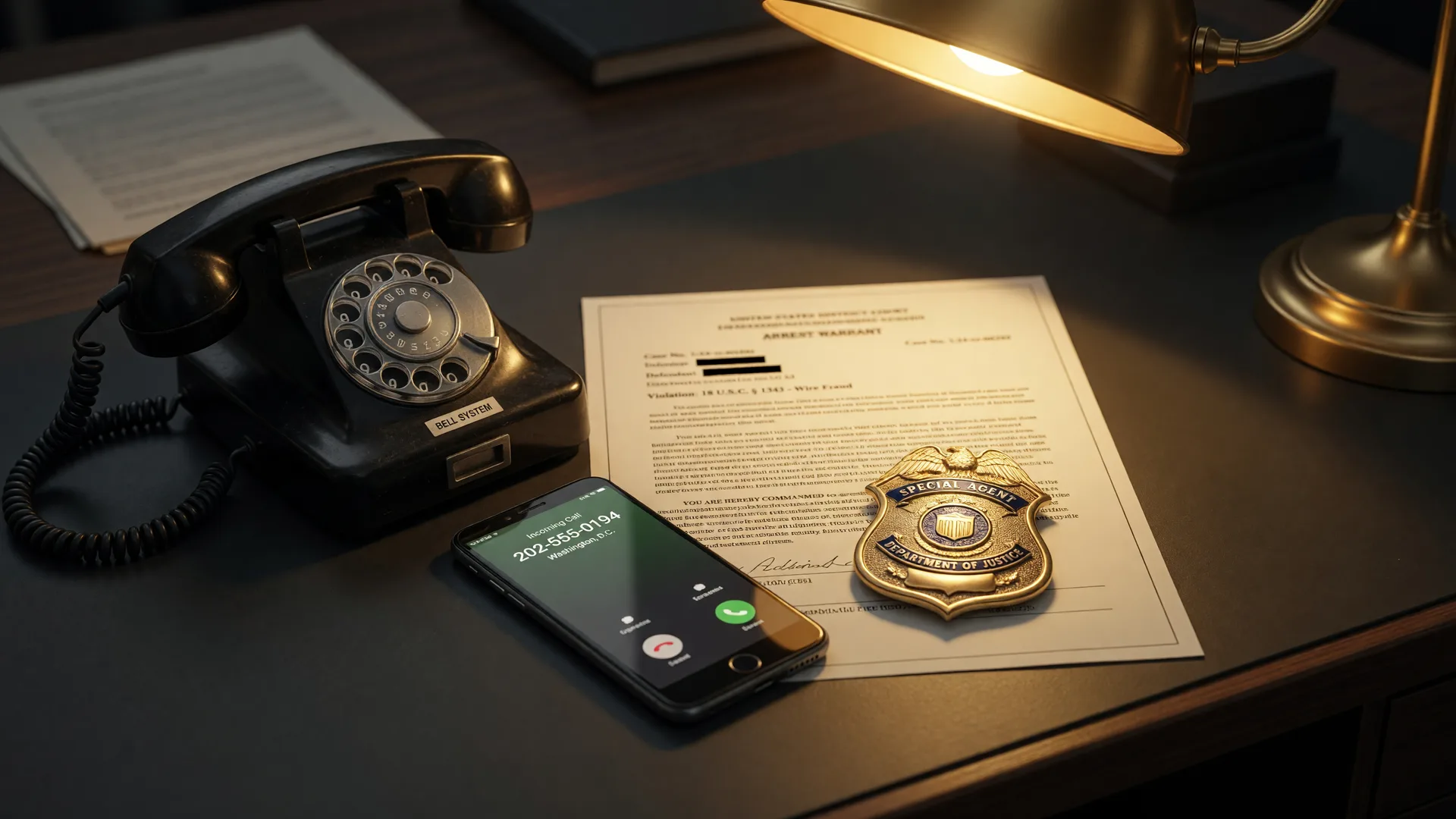
The story: a Vero Beach veteran, a real FBI number, and a warrant that was never real
This is a composite story, an illustration built from patterns I see in my work every day, and it is not the story of any single client of mine. It is the story Florida seniors need to know before the call arrives. The call came on a Tuesday afternoon in Vero Beach, and the caller ID showed the real FBI field office number, the exact one printed on the agency’s website. On the line was a man who called himself Special Agent, recited a badge number, and said a digital arrest warrant had been issued in the veteran’s name for money laundering tied to his identity. To prove he was real, the agent read back the veteran’s home address and the last four digits of his Social Security number.
Then a PDF arrived by email: an arrest warrant with the veteran’s name on it, a case number, and a signature block that read like it had been printed from a template. The instructions were simple and terrible: stay on the line, tell no one, and pay $6,500 in gift cards plus a cryptocurrency deposit to post bond and clear the warrant. The veteran, a retired serviceman who had spent a lifetime trusting the badge, emptied part of his savings into gift cards. He was at the register buying more when a bank teller quietly asked if he was okay, and that one question stopped the rest of the transfer.
He was out $6,500, and the personal details he had just confirmed, his address, his Social Security number, his banking habits, are now in the hands of criminals who will sell them to the next caller. Here is the truth at the end of every story in this series: the senior who knows the scam is the one who beats it. The veteran did not know the script yet, which is exactly why this story exists. Knowledge is your armor, and it never wears out.
The quick answer
An FBI or law enforcement imposter scam is when a criminal pretends to be a police officer, sheriff’s deputy, or federal agent, often spoofing a real agency phone number and reciting a fake badge number, and threatens arrest unless the victim pays by gift card, wire, or cryptocurrency. Real law enforcement never calls to demand payment, never asks for gift cards or crypto, and never threatens arrest over the phone.
Why the fake badge works: the numbers behind the script
Law enforcement impersonation is a multi-billion-dollar script, and Florida is squarely in its sights. The FBI warns that law enforcement impersonation scams have cost victims more than $1.6 billion since January 2025, and its Internet Crime Complaint Center received 39,949 government impersonation complaints in 2025, with victim losses exceeding $833 million. Americans over 60 reported about $7.7 billion in losses to the FBI’s IC3 in 2025, up 37% from 2024.
The payment methods are the tell. The FTC received more than 41,000 fraud reports tied to gift card and prepaid card scams in 2024, totaling $212 million in losses, because gift cards and crypto are the only ways this money can leave forever. When the demand is a gift card or a kiosk, the caller has already told you everything you need to know.
None of these numbers are a reason for fear, because the defense is simpler than the offense: one fact, real agents never demand payment by phone, and two habits, hang up and dial the published number yourself. The senior who knows those three things renders the whole script powerless before its first sentence lands.
The real numbers behind the fake badge
- $1.6B+
- lost to law enforcement impersonation scams since January 2025, the FBI warns
- 39,949
- government impersonation complaints the FBI’s IC3 received in 2025, with victim losses exceeding $833 million
- $7.7B
- in losses Americans over 60 reported to the FBI’s IC3 in 2025, up 37% from 2024
- 41,000+
- fraud reports tied to gift card and prepaid card scams the FTC received in 2024, totaling $212 million in losses
How the fake badge and digital arrest warrant scam works
The fake badge is not one trick; it is a machine with nine moving parts, and each one has a tell. Learn all nine now:
Angle 01
The caller who spoofs a real agency number and recites a fake badge number
The call can arrive with caller ID showing a genuine FBI field office number, the exact one printed on the agency’s website. Caller ID is a costume, and in this scam the costume is tailored to the one institution seniors trust to keep them safe.
Then comes the badge number, recited like a credential. No one has ever verified a badge number by listening to a stranger say it. The number on the screen and the number in the caller’s mouth are both props, and the only number that matters is the one you dial yourself.
Red flag: caller ID that shows a real agency number on a call you did not place, plus a recited badge number.
Angle 02
The "digital arrest warrant" or "bench warrant" threat
The hook is a fabricated crime: your identity was linked to money laundering, a federal case is open, and a digital arrest warrant has been issued in your name. The warrant is the pressure that is supposed to make payment sound urgent and legal at the same time.
There is no such thing as a digital arrest warrant you pay to clear. Real warrants are signed by a judge, served in person by sworn officers, and never emailed as a PDF with a payment instruction. The word "digital" exists only to make an emailed forgery sound official.
Red flag: an immediate threat of arrest or a "digital arrest warrant," delivered by phone or email.
Angle 03
The demand for payment by gift card, wire, or crypto to "post bond" or "clear the warrant"
Once the fear is set, the fee appears: post bond, clear the warrant, cover the fine, all payable by gift card, wire transfer, or cryptocurrency. Every one of these payment methods is irreversible, and that is the entire point.
No court or law enforcement agency on earth accepts gift cards or crypto for a bond. A "bond" you can buy at a pharmacy is not a legal process; it is a stranger naming the only ways your money can leave and never come back.
Red flag: any demand for payment by gift card, wire, or cryptocurrency, whatever the official-sounding reason.
Angle 04
The "don’t tell anyone or you’ll be arrested" gag order
The script then seals itself: stay on the line, tell no one, do not call a lawyer or a banker, because the case will be compromised. The gag order is the single loudest alarm in any scam script.
Secrecy is not a side effect of this scam; secrecy is the scam. Real law enforcement never orders you to hide a conversation from your own family. The moment a caller asks you to keep it secret is the moment you should do the opposite and tell someone you trust.
Red flag: a "don’t tell anyone" gag order, always a sign the call cannot survive a second opinion.
Angle 05
The fake second call from a "supervisor" or "detective" to add pressure
If you hesitate, a second voice joins the call: a supervisor, a detective, a sergeant, someone with a higher rank and a louder tone. The tag team is choreographed, one voice scolds while the other "helps," and the combined pressure is meant to wear you down.
A second caller is not corroboration. Anyone can hand the phone to anyone, and the "supervisor" is the same criminal reading the same script. More voices do not make the story more real; they make the pressure stronger, which is exactly their job.
Red flag: a second caller who arrives as a "supervisor" or "detective" the moment you hesitate.
Angle 06
Real agent names and case numbers found online
The script borrows authenticity from the internet: a real FBI or sheriff’s office agent’s name, a case number format that looks official, a badge photo pulled from a public page and sent by text or email. It is all sourced from public information and nothing about it is verification.
A real case number in an email proves nothing, because the sender is not the agency. Scammers collect agent names, office numbers, and case formats the way actors collect props, and they wear them to make the costume fit.
Red flag: a real agent’s name or a case number used to sound legitimate, when the call itself came to you unsolicited.
Angle 07
The threat to freeze bank accounts or seize property
Next comes the escalation: your bank accounts will be frozen, your home seized, your assets locked until the case is cleared. The threat is aimed at the two things seniors work a lifetime to build, and it is designed to make the payment feel like the only way to protect them.
No agency freezes accounts or seizes property because of a phone call, and no agency unfreezes them for a gift card. Banks act on court orders and paperwork, never on a caller’s word, and the only "freeze" in this script is on your judgment, under pressure.
Red flag: a threat to freeze your accounts or seize your property, delivered with a payment demand.
Angle 08
The follow-on recovery scam that appears after a victim reports a loss
The cruelty does not end with the loss. After a victim reports what happened, a second scammer often appears, posing as a recovery agent, a fraud investigator, or a government official, offering to get the money back for a fee or a "verification" payment. It is the same criminal network, or a buyer of the victim list, and it feeds on the hope the first scam created.
No legitimate agency charges a fee to return stolen money, and no real investigator needs your card number to unlock a refund. Anyone who asks you to pay to recover your losses is running the second act of the same fraud, and the correct reply is the same: hang up and report.
Red flag: anyone who promises to recover your lost money for an upfront fee. That is the follow-on recovery scam.
Angle 09
The Florida angle: real law enforcement never calls to demand payment, and you can always verify
Here is the truth that ends this whole script in Florida: real police officers, sheriff’s deputies, and federal agents never call to demand payment, never ask for gift cards or crypto, and never threaten arrest by phone. When the story turns to money, the call has already turned into a crime.
You can always hang up and call the agency yourself using its published non-emergency number from the official website. Then report what happened to the FBI Internet Crime Complaint Center at ic3.gov, to the FTC at reportfraud.ftc.gov, and to the Florida Attorney General fraud hotline at 1-866-9-NO-SCAM. Every report feeds the enforcement that stops the next call.
The move that ends it: hang up, dial the published non-emergency number yourself, and report to ic3.gov, reportfraud.ftc.gov, and 1-866-9-NO-SCAM.
Red flags checklist: ten tells that give the fake badge away
Scams do not thrive on cleverness; they thrive on speed and shame. If you hear one of these, you already know the script:
-
Red flag 01 Caller ID that shows a real agency number, but the call is unsolicited.
-
Red flag 02 A recited badge number, or a badge photo sent by text or email.
-
Red flag 03 An immediate threat of arrest, or a "digital arrest warrant."
-
Red flag 04 Any demand for payment by gift card, wire, or cryptocurrency.
-
Red flag 05 A "don’t tell anyone" gag order.
-
Red flag 06 Pressure to stay on the line and obey right now.
-
Red flag 07 A fake warrant PDF or case file sent by email.
-
Red flag 08 Real agent names and case numbers used to sound legitimate.
-
Red flag 09 A threat to freeze your bank accounts or seize property.
-
Red flag 10 Any request for your Social Security number, bank account, or personal details to "verify" your identity.
The honest truth: real law enforcement never does this
The entire scam rests on one lie, so the entire defense rests on one fact: real police officers, sheriff’s deputies, and federal agents never call to demand payment, never ask for gift cards or crypto, and never threaten arrest over the phone. Everything after that is costume and pressure. Here is what real law enforcement actually does and never does:
Real agents do not collect money by phone
No police department, sheriff’s office, or federal agency calls to demand payment, and none of them accept gift cards, wire transfers, or cryptocurrency for fines, bonds, or warrants. Money demanded over the phone in gift cards or crypto is the definition of the crime, not a government service.
There is no digital arrest warrant you can pay to clear
A warrant is a court document signed by a judge and served in person by sworn officers, never a PDF emailed with a payment link. The "digital arrest warrant" is a forgery with your name typed onto it, and its only purpose is to make fear look legal.
Your personal details on the phone prove nothing
Scammers buy stolen personal data by the list. Your address, your age, and even part of your Social Security number are merchandise on the criminal market, not proof that the caller is an agent. Real verification never starts with the person who called you.
Verification is a hang-up and a dial
The only number that matters is the one you dial yourself from the agency’s official website, never the number on the screen and never the one the caller gave you. Real agencies answer their published non-emergency lines, confirm whether anything is real, and never punish you for checking.
What to do if it happens
If the call finds you, this is your plan. Nine moves keep you calm, in control, and one step ahead, no matter how official the voice sounds:
- 01
Hang up immediately, and do not send a single dollar
You owe a stranger nothing, not a conversation, not an explanation, not a goodbye. The entire first move of this scam is defeated by the first move of this plan: ending the call with your money still in your accounts.
- 02
Do not buy gift cards, and do not visit a cryptocurrency kiosk, for anyone who calls you
No real agency is paid in gift cards or crypto, ever. If a caller steers you toward a pharmacy gift card rack or a crypto kiosk, the caller is the crime, and every dollar you load is a dollar that can never be recovered.
- 03
Call the agency yourself using its published non-emergency number
Look up the agency on its official website, dial the published non-emergency number from your own phone, and ask. A real representative will confirm whether any case or warrant exists, and will never treat your check as an insult.
- 04
Tell a trusted family member or friend what happened
A spouse, a child, a neighbor, or a banker sees the script from the outside. Sharing the story is the fastest way to see the truth, and it protects you from the shame this scam runs on.
- 05
Report it to the FBI Internet Crime Complaint Center at ic3.gov
File a report at ic3.gov with the caller’s number, the badge number they used, the email address the warrant PDF came from, and everything they asked you to do. IC3 feeds federal investigations into exactly these networks.
- 06
Report it to the FTC at reportfraud.ftc.gov
Then file with the Federal Trade Commission at reportfraud.ftc.gov. Every report feeds national enforcement and pattern-spotting that helps shut the script down.
- 07
Report it to the Florida Attorney General fraud hotline at 1-866-9-NO-SCAM
Call 1-866-9-NO-SCAM to report the fraud to the state and get guidance from trained specialists. Florida takes elder fraud seriously, and your report becomes part of the state’s case.
- 08
Contact your bank or card issuer right away if you already paid
If any money moved, call your bank or card issuer immediately to try to stop or reverse the payment, and freeze anything that is still pending. Speed matters, and your bank has fraud teams whose entire job is helping you.
- 09
Remember that the fear and the shame are part of the trick
The fear of arrest and the shame of "being fooled" are planted by the scammers on purpose, to keep you quiet and keep you compliant. Victims are never at fault, the criminals are, and reporting takes the power back.
Where to report a fake badge or digital arrest warrant in Florida
Reporting a scam is protection, not embarrassment. Every report helps stop the next call:
“The badge photo, the warrant PDF, the real field office number on caller ID, none of it was proof. The only thing real in that whole call was the fear, and the fear is exactly what the scammer is selling. You are allowed to hang up on a badge. You are allowed to check. Real officers will thank you for it.”
Frequently asked questions about FBI and law enforcement impostor calls
Quick, honest answers to the questions Florida seniors and their families ask me most. Tap a question to open the answer.
01 What is an FBI or law enforcement imposter scam?
An FBI or law enforcement imposter scam is when a criminal pretends to be a police officer, sheriff’s deputy, or federal agent, often spoofing a real agency phone number and reciting a fake badge number, and threatens arrest unless the victim pays by gift card, wire, or cryptocurrency. Real law enforcement never calls to demand payment, never asks for gift cards or crypto, and never threatens arrest over the phone.
02 Do real police or FBI agents ever call to demand money?
No. No real police department, sheriff’s office, or federal agency calls to demand payment, and none of them accept gift cards, wire transfers, or cryptocurrency for fines, bonds, or warrants. Real law enforcement work happens with official paperwork and in-person process, and real agents never threaten you, pressure you, or order you to keep a call secret.
03 What is a digital arrest warrant?
A digital arrest warrant is not a real thing you can pay to clear. There is no process where a law enforcement agency emails you a warrant PDF and accepts gift cards or crypto to make it go away. An emailed "warrant" with your name on it is a forged document, and its only purpose is to scare you into paying.
04 Why do these scams work on smart people?
Because they are rehearsed by professionals who load every detail: your real address, part of your Social Security number, a real agency phone number on caller ID, a real agent’s name found online. The scam is not a test of intelligence; it is a test of whether you have seen the script before. Seniors who learn the script beat it, which is the whole point of this series.
05 I already sent money, what do I do?
Act fast, and act without shame, because victims are never at fault. Contact your bank or card issuer immediately to try to stop or reverse the payment, tell a trusted family member, and report the loss to the FBI IC3 at ic3.gov, to the FTC at reportfraud.ftc.gov, and to the Florida Attorney General fraud hotline at 1-866-9-NO-SCAM. And beware of anyone who promises to recover your money for a fee; that is the follow-on recovery scam.
06 How do I verify a real law enforcement call?
Hang up first, then call the agency yourself using the published non-emergency number from its official website. You dial the number; you never call back the number on the screen or the one the caller gave you. If the agency confirms the call was real, you can proceed with confidence, and if it confirms nothing, you have just stopped a scam cold.
07 Who do I report this to in Florida?
Report it to the FBI Internet Crime Complaint Center (IC3) at ic3.gov, to the Federal Trade Commission at reportfraud.ftc.gov, and to the Florida Attorney General fraud hotline at 1-866-9-NO-SCAM. You can also file with your local sheriff’s non-emergency line, and if you are in immediate danger, call 911 first.
Follow the full Senior Scams series
This is Story 11 of the Senior Scams series: a new, real-world scam warning for Florida seniors and the families who love them. Every story names the trick, shows how it plays out, and ends with the move that stops it. The impostor scripts stack on each other, so the more you read, the harder every caller has to work.
Bookmark the hub and check it daily. Story 3 covered Social Security impostors, Story 4 covered IRS and tax agency threats, and this fake badge and digital arrest warrant story is Story 11. Each new story adds a new layer of armor.
The suspended-SSN script, the Washington, D.C. caller ID, and why the SSA never suspends numbers: the companion impostor story every family should read next.
The fake agent call, the fake badge number, and the wire transfer due within the hour: how the same government-costume script plays out against taxpayers.
Before the next call comes
Arm your family with one free call
Michael “Wiz” Wisniewski is a Certified Real Estate Planning Advisor who works with Florida seniors and their families every day. Bring any call, text, or visit that felt off, and leave with a clear next step for your family. Free 15-minute strategy call, no pressure, no obligation.

About the Author
Michael "Wiz" Wisniewski
Michael "Wiz" Wisniewski is The Life Transition Specialist with The Complete Real Estate Team, powered by Dalton Wade Real Estate, serving clients from the Treasure Coast to South Florida. A Certified Real Estate Planning Advisor, Certified Life Transition Specialist, and Certified A.I. Real Estate Advisor, he has worked nearly every side of real estate: fix-and-flip investing, land development, home building, and property management, and guides families through life's transitions with care, honesty, and the Golden Rule.
Certified Real Estate Planning Advisor | Certified Life Transition Specialist | Certified A.I. Real Estate Advisor
Written by
Michael Wisniewski, The Wizard of Real Estate
Certified Real Estate Planning Advisor | Certified Life Transition Specialist | Certified A.I. Real Estate Advisor
Helping Florida families protect what matters most.
Talk Soon