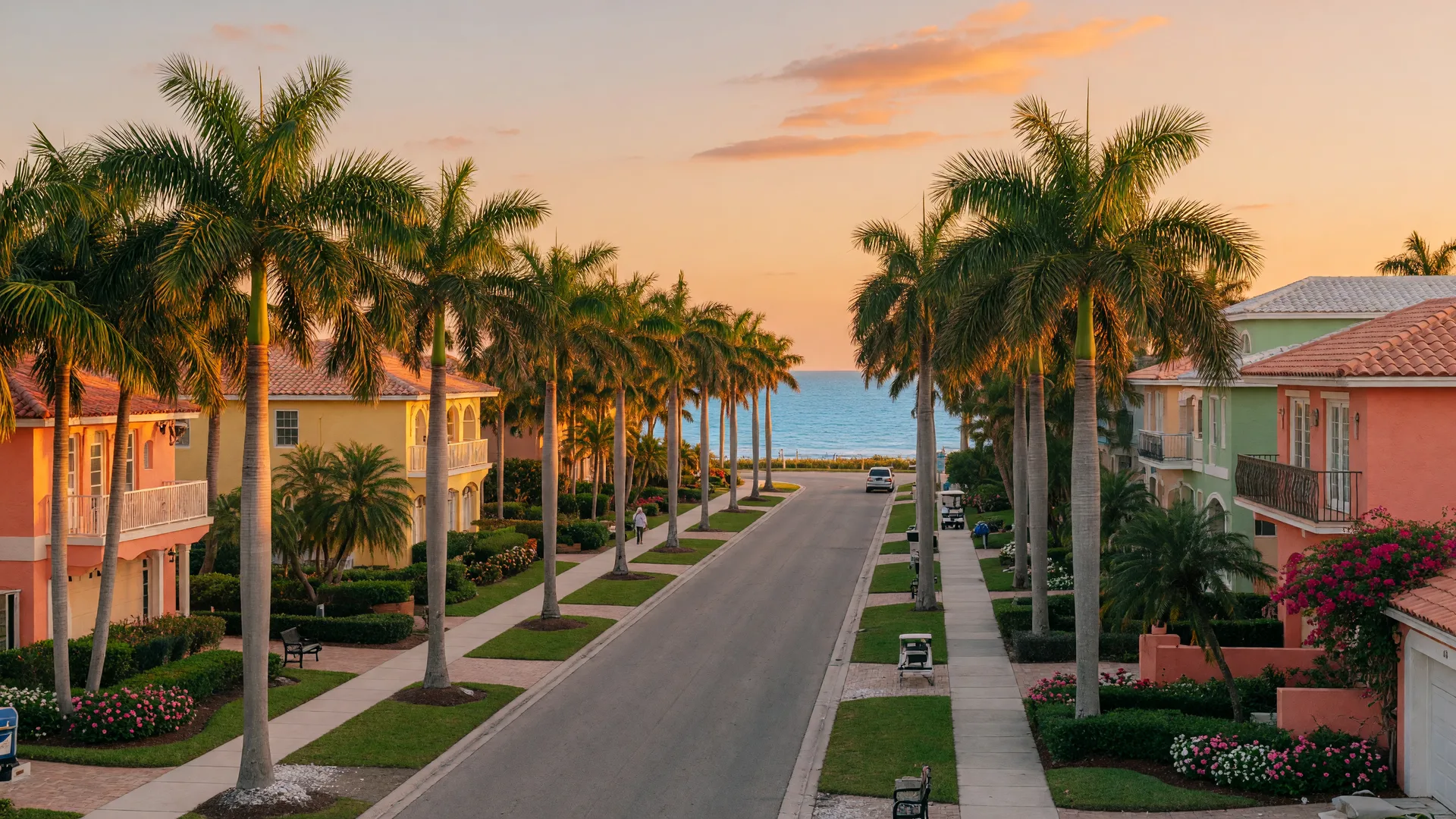
Here is the honest headline: Florida is the number one destination for New Yorkers leaving the state, and the draw is not mystery, it is math. No state income tax against a top New York rate of 10.9%, county medians from about $367,000 to $682,000 against a New York City median that hit $800,000, and a three-hour flight that keeps the city a long weekend away. The same honest section that every state guide carries: insurance, heat, and pace of life are real, they are planable, and nobody should move south without knowing them first.
Why New Yorkers keep landing in Florida
I talk to New Yorkers on nearly every strategy call. Sometimes it is a Brooklyn couple with a baby and a condo that has no elevator and no second bedroom. Sometimes it is a Long Island empty-nester staring at a property tax bill that has quietly become a second mortgage. And sometimes it is a Westchester family who simply realized they are paying New York prices for New York winters.
The numbers say they are not alone. Relocation research from MovingPlace, reported by ClickOrlando in November 2025, found Florida is the top destination for departing New York City residents, with roughly 17% of all NYC moves heading here. The Palm Beach Post's 2023 reporting on the same migration pointed to the same drivers the state has drawn on for decades: warmer weather and the Florida lifestyle, no state personal income tax, lower cost of living, larger homes for less money, and family ties in the same time zone.
None of that is a judgment on New York. New York holds some of the best jobs, culture, and schools in the world, and it made many of these families wealthy. The question this guide answers is simpler and more practical: if you are moving, what does the move really look like, financially and day to day? That is the part the headlines skip.
Climate and lifestyle: the honest contrast
New York gives you four real seasons, and the two you feel most are the ones you wait for. Florida gives you a trade: the year is divided into a mild dry season and a hot, humid one, and the beach, the boat, and the outdoor dinner run all year. The honest part is that the Florida summer is genuinely hot, afternoon thunderstorms are part of the daily rhythm from about June through September, and your air conditioner will work months that would be sweater weather in New York.
Lifestyle-wise, the big change is how much of life moves outdoors. Golf in January, a beach walk in February, kayaking on the St. Lucie River after work in March. Families from the Treasure Coast to South Florida tell me the trade they feel most is not the heat, it is the pace: slower here, more neighborly, with the city a flight away instead of a train ride. Some New Yorkers love that immediately. Others need a year to exhale. Both are normal, and both are worth knowing before you sign anything.
The distance, and the logistics of getting here
The move is a long weekend by air, not an expedition. Nonstop flights from JFK or LaGuardia reach Palm Beach International, Fort Lauderdale-Hollywood, or Miami in about three hours, and about 1,280 miles of road separate New York City from Miami, roughly an 18.5 to 20 hour drive nonstop (Trippy driving estimates). West Palm Beach sits closer, about 1,224 miles, about 17.5 to 18 hours. That is why relocating New Yorkers keep their ties and come home for the holidays, the weddings, and the occasional Broadway weekend.
~3 hrs
Nonstop flight
JFK or LaGuardia to PBI, FLL, or MIA, year-round service
~1,280 miles
Road, NYC to Miami
About 18.5 to 20 hours of driving, nonstop
~1,224 miles
Road, NYC to West Palm
About 17.5 to 18 hours of driving, nonstop
~45-55 min
PBI to Treasure Coast
Palm Beach International to Stuart and Port St. Lucie
The paperwork side is where most moves get sticky, and it is the same list for every state: Florida driver's license and vehicle registration, insurance rewrites, utility start dates, school enrollment, mail forwarding, and the address changes you always forget (passport, payroll, banks, investments). The Moving to Florida Checklist walks through all of it step by step, and families tell me printing it is the single most useful thing they did. Start there, and use the Relocation Hub as your map for the whole process.
If you are still working for a New York employer, talk to your HR and your CPA about residency, workdays, and withholding before you move, because New York taxes workdays performed in New York and the rules differ for remote employees. Get that sorted on the front end and you will not be chasing it at tax time.
The money: taxes and cost of living, side by side
This is where the move changes a family's trajectory, and it is also where I want to be exact. Every figure below carries a named source and an as-of date. Your real numbers come from your income, your home value, and your county, and that is exactly what a strategy call is for.
10.9%
New York State top marginal income tax rate
The highest NY bracket, on taxable income over $25 million. Nine brackets run from 4.0% up to 10.9%.
NerdWallet / Tax Foundation · 2026 rates
3.876%
New York City's separate local income tax top rate
On top of the state tax for city residents, and the top rate kicks in at a surprisingly ordinary income level.
SmartAsset / NYC Comptroller · May 2023 study
$800,000
New York City median home sales price
A record high as of the third quarter of 2025, in a metro where the statewide median is far below what the city itself costs.
PropertyShark study · Q3 2025
~$600,300
New York State median home price
The statewide number as of January 2026. Your street in Westchester, Long Island, or the city is its own market.
Redfin data · January 2026
~$6,500
Median annual New York property tax bill
Roughly double the national average, with effective rates around 1.45% to 1.55% of home value.
SmartAsset / PropertyTaxByState · 2023-2026 data
$12K-$22K+
Illustrative annual combined tax savings
A typical NY-metro family moving to Florida, built from the sourced income and property tax figures above.
The Complete Real Estate Team · September 2026 estimate
| Category | New York | Florida | The difference |
|---|---|---|---|
| State income tax | Up to 10.9% (NYC adds its own local tax up to ~3.876%) | 0% (no state income tax) | Full elimination |
| Property tax | ~$6,500 median bill; ~1.45%-1.55% effective rate | ~$3,500-$5,500 on a typical home; ~0.71%-0.96% effective | $2,000-$5,000+ lower |
| Median home price | ~$600,300 statewide; ~$800,000 in NYC | ~$367K-$682K by county | Dramatically more home for the money |
| Sales tax | 4% state plus local; 8.875% in NYC | 6% state; about 6.5%-7% typical with county surcharges | Lower on most purchases |
Sources: New York State income tax brackets, NerdWallet and Tax Foundation, 2026 rates; NYC local income tax, SmartAsset and the NYC Comptroller, May 2023; NY median home price, Redfin via Innago, January 2026; NYC median sales price, PropertyShark, Q3 2025; NY property tax, SmartAsset, 2023 and PropertyTaxByState, 2026. Florida figures reflect state law and county medians for the 2026 market as reported in the Relocation Hub's county data.
What the tax math actually looks like
Take a typical relocating couple: good incomes, a home in the New York metro, and a plan to buy in Palm Beach or Martin County. Their New York State income tax disappears entirely, and New York City's local income tax, which reaches 3.876% even at ordinary income levels, disappears with it. The median New York property tax bill around $6,500 a year (SmartAsset, 2023; PropertyTaxByState, 2026) becomes roughly $3,500 to $5,500 on a typical Florida home, and Florida's Homestead Exemption shields up to $50,000 of assessed value while the Save Our Homes cap holds annual assessment growth near 3%.
Line those up and the illustrative total is about $12,000 to $22,000+ saved per year, $120,000 to $220,000+ over a decade, before counting the value of a warmer, more active life. The honest caveats: Florida's sales tax runs about 6.5% to 7% in most counties and clothing is fully taxed, so everyday spending is not tax-free, and your exact savings depends on your numbers. For the full breakdown, including estates, Social Security, and pensions, read the Florida Tax Guide for New Residents.
What your home-buying dollar buys here
New York's statewide median of about $600,300 (Redfin, January 2026) typically buys a compact condo, a starter home in the Capital Region, or a small co-op in a mid-tier neighborhood, and buyers in the city itself are facing a median of $800,000 (PropertyShark, Q3 2025). In our six counties, current medians run from about $367,000 in Indian River County to about $682,000 for single-family homes in Miami-Dade, with the Treasure Coast counties clustered in the middle.
In practice: at $450,000 to $500,000, Port St. Lucie and Fort Pierce offer 3 and 4 bedroom single-family homes, many with pools, and Vero Beach's mainland side offers roomy family homes a fraction of the island's beachfront prices. At $650,000 to $750,000, options widen to newer construction in St. Lucie and Martin Counties, townhomes and condos in Boca Raton and Delray Beach, and gated-community homes in Wellington. Water access is the wildcard: canal, river, and Intracoastal homes carry premiums and insurance reality, and we price both before you fall in love.
The buying process for an out-of-state buyer is well-worn now: pre-approval from a lender who writes Florida loans, video tours and live walkthroughs, a local inspection, and even remote closings. The Buying from Out of State guide under the Relocation Hub walks through each step, and the calculators below let you build the true monthly number before you ever book a flight.
Affordability Calculator
Find the top of your price range from your income, debts, down payment, rate, taxes, and insurance.
Open the calculatorMortgage Payment Calculator
Estimate the full monthly payment: principal, interest, taxes, insurance, and HOA for a South Florida home.
Open the calculatorRent vs Buy Calculator
Compare renting versus owning over time and find your break-even year, not your gut.
Open the calculatorDown Payment Calculator
See how much you need to save and how long it takes to hit your goal without emptying your reserves.
Open the calculatorThe honest Florida surprises
I have moved enough clients south to know exactly where the sticker shock lives, and I would rather put it in writing than have you discover it at closing.
- Insurance is the biggest number nobody budgets. Florida's average annual homeowners premium runs about $3,800 to $3,900 including wind (Florida OIR / Insurance Information Institute, 2025-2026 data), and some national estimates run considerably higher, near $8,000 a year. Flood insurance is separate when the map says so. We get real quotes for the exact home before any offer, and we check the flood map on the first call, not the last.
- The heat is real, and the air conditioning becomes a lifestyle. The hot, humid season runs about May through October. Budget for higher summer electric bills, and buy a home with a heat pump or efficient AC, because it will run more than any New York system ever did. Afternoon storms are a daily rhythm in summer, and hurricane season, June 1 to November 30, is a planning habit, not a scare tactic.
- The pace of life is genuinely slower. The city energy you love does not follow you down. Some New Yorkers exhale and never look back; others feel the quiet for a year. Know yourself before you move, and pick a community with the pulse you want, from Stuart's old-Florida riverfront to West Palm's walkable downtown to Boca's golf-and-country-club rhythm.
- The extras add up: HOA fees, CDD assessments, and sales tax on everything. Many Florida communities carry HOA dues and Community Development District assessments on top of the mortgage, and clothing is taxed at about 6.5% to 7%. None of these are deal-breakers, but they belong in the monthly number, and they always make it into ours.
The goal is not to talk you out of anything. It is so that the Florida you arrive in is the Florida you expected, and the first year is a celebration instead of a series of surprises.
“The families who do best in this move run the real numbers on taxes, insurance, and the true monthly cost before they ever book movers. The ones who struggle were sold a postcard instead of a plan.”
Michael “Wiz” Wisniewski
The questions New Yorkers ask me most
Honest, specific answers to the questions I hear on every strategy call with New York families. Same facts, same plain talk, no sales script.
01 How much can I save on taxes by moving from New York to Florida?
Illustrative math for a typical NY-metro family: New York State income tax up to 10.9% and New York City's local tax up to 3.876% both disappear, because Florida has no state income tax at all. The property side reverses, too: a median NY bill around $6,500 a year (at roughly 1.45% to 1.55% effective rates) becomes roughly $3,500 to $5,500 on a typical home here. That combination pencils to about $12,000 to $22,000+ saved per year, $120,000 to $220,000+ over a decade. The honest fine print: Florida sales tax runs about 6.5% to 7% in most counties and clothing is taxed, and your actual number depends on your income, your home value, and your ZIP code.
02 Can I keep my New York job while living in Florida?
Yes, and thousands of relocating New Yorkers do exactly that. Nonstop flights from JFK or LaGuardia reach Palm Beach, Fort Lauderdale, or Miami in about three hours, which makes a long-weekend or hybrid commute genuinely practical. Keep accurate records of the days you work in each state, because New York taxes workdays performed in New York even for Florida residents, and have a CPA review your setup before you file. If your company allows remote work, your take-home stretches further here with no state income tax.
03 What does my budget actually buy in Florida?
New York's statewide median of about $600,300 (Redfin, January 2026) buys a compact condo, a starter home upstate, or a small co-op in a mid-tier neighborhood. In Florida, county medians run from about $367,000 in Indian River County to about $682,000 for single-family homes in Miami-Dade, so the same money, or less, gets a 3 to 4 bedroom single-family home with a pool in Port St. Lucie or Vero Beach, a newer four-bedroom in Palm City, or a water-view condo along the Gold Coast.
04 How do I buy a Florida home while I am still in New York?
We do it every week: video tours, virtual neighborhood walks, and remote closings are standard for out-of-state buyers now. Start with a pre-approval from a lender who writes Florida loans, then we run the true monthly number for the exact town, taxes, insurance, and HOA dues before you ever board a plane. See the Buying from Out of State guide under the Relocation Hub for the full process.