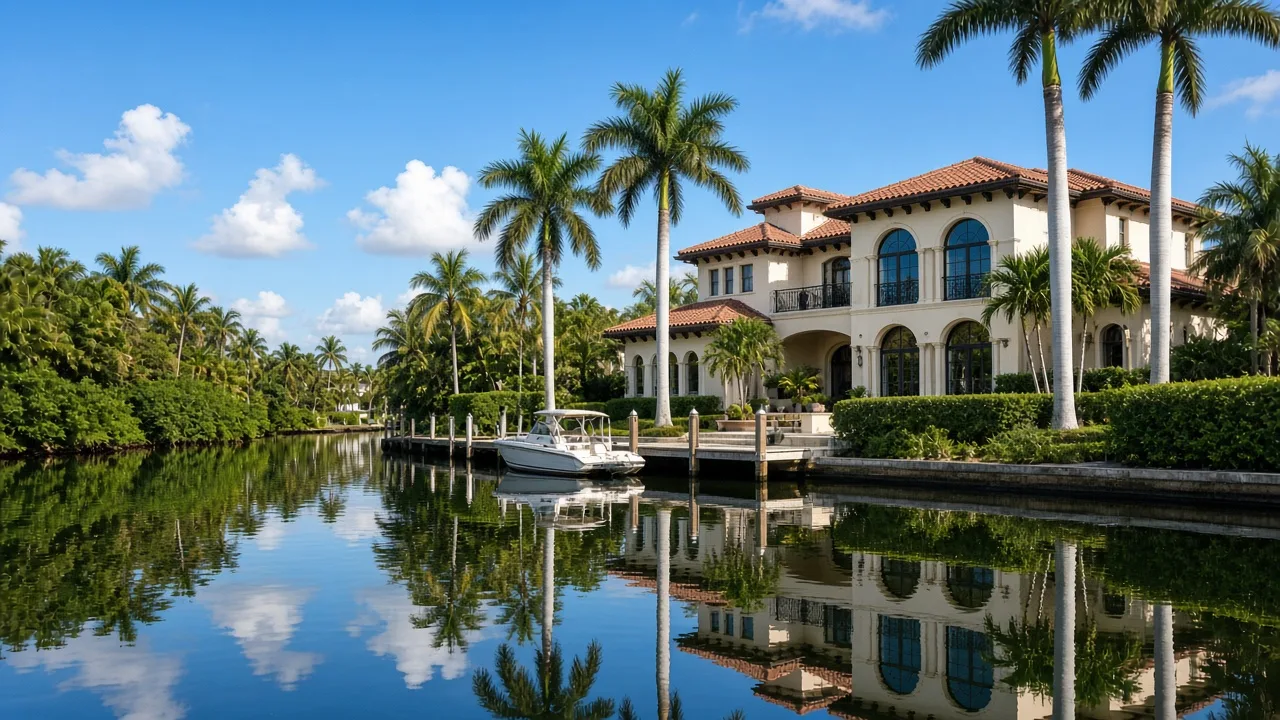
Here is the honest headline: Maryland taxes income twice, a state rate up to 6.5% for 2025 plus a county income tax up to 3.3%, and both disappear the day you land in Florida. Property tax is roughly a wash, your ~$431,000 median home stacks up well against county medians of about $367,000 to $682,000, and the move itself is the shortest of the big Northeast jumps, about 1,097 miles from Baltimore to Miami. Marylanders are already coastal people, and the question is rarely whether to leave, it is how to land well. This guide is the how.
Why Marylanders keep landing in Florida
Maryland families do not come to my strategy calls fleeing blizzards the way New Englanders do. They come with a different, quieter urgency: the taxes, the cost of living, the gray half of the calendar, and a growing sense that the house they own is worth a lot on paper but the life around it costs more every year. The Chesapeake and the Bay are wonderful, and then comes the winter that keeps the boats dry for months, and the strategy call.
The numbers confirm a steady pull. The U.S. Census Bureau’s 2023 State-to-State Migration Flows counted 17,439 Maryland-to-Florida moves, ranking Florida third among out-of-state destinations behind Virginia and Pennsylvania, and the 2024 flows put Florida just outside the top three (USAFacts, citing Census data), with the flow still running in the tens of thousands every year. About 159,100 Marylanders left the state in 2024 alone; Florida is reliably one of the top places they go.
The honest drivers: the double income tax, a cost of living about 14% to 15% above the national average, housing that costs as much as Florida’s with a shorter outdoor season, and family already on the coast. The part of the move no headline captures is the one this guide exists for: what changes day to day, what costs more, and what the first year honestly feels like.
Climate and lifestyle: the honest contrast
Maryland winters are not Maine winters, but the difference that matters is the same one: the calendar. The freeze line rarely owns Maryland the way it owns the north, but the gray, damp stretch from December into March keeps the boat covered and the outdoor life indoors, and the Chesapeake’s spring takes its time arriving. On the Treasure Coast and in South Florida the freeze line stays far north, winter highs sit in the mid-70s, and the beach works in January. For a family that has winterized one last time, this is the entire point of the move.
The trade is the heat. Florida summers run hotter, longer, and more humid than anything Maryland serves up, roughly May through October, with afternoon thunderstorms as a daily rhythm, and hurricane season, June 1 to November 30, is a planning habit here: insurance, shutters or impact glass, and a real evacuation plan. Marylanders who already respect tide, storm surge, and the Bay’s own weather drama adapt fast. The lifestyle reward is the twelve-month outdoor calendar: boating, fishing, walking the beach in February, and a coast that keeps going all year.
The distance, and the logistics of getting here
This is the shortest long move in the Northeast set. Baltimore to Miami is about 1,097 miles, roughly 15 hours and 45 minutes of driving (Trippy), and Baltimore to West Palm Beach runs about 1,022 to 1,036 miles, roughly 15 to 16 hours. Many Maryland families do the one-day marathon once with a rental truck or a second car, and most fly from then on: Baltimore/Washington (BWI) has nonstops to Miami in about 2 hours 40 minutes to 3 hours and to West Palm Beach in about 2 hours 45 minutes (posted schedules via FlightsFrom and Southwest), and DC-area families can also use Dulles and Reagan.
~2h 45m
Nonstop, BWI to PBI
Southwest and others from Baltimore/Washington to Palm Beach International; BWI to Miami about 2 hours 40 minutes to 3 hours
~1,022-1,036 mi
Road, Baltimore to West Palm
Roughly 15 to 16 hours of driving down I-95, nonstop
~1,097 mi
Road, Baltimore to Miami
About 15 hours 45 minutes of driving, nonstop
~45-55 min
PBI to Treasure Coast
Palm Beach International to Stuart and Port St. Lucie
The paperwork side is the same list for every state: Florida driver’s license and vehicle registration, insurance rewrites, utility start dates, school enrollment, mail forwarding, and the address changes you always forget (passport, payroll, banks, investments). The Moving to Florida Checklist walks through all of it step by step, and families tell me printing it is the single most useful thing they did. Start there, and use the Relocation Hub as your map for the whole process.
One Maryland-specific note: your car insurance changes the minute you register in Florida, and so does your homeowners coverage, with wind and flood in the mix. Shop those quotes in the same week you shop houses, because they belong in the same budget meeting.
The money: taxes and cost of living, side by side
This section is the strongest part of the Maryland story. Every figure below carries a named source and an as-of date. The double income tax disappears, the property tax is a wash, the sales tax steps up slightly, and your real numbers come from your income, your home sale, and your county. That is exactly what a strategy call is for.
~17,400
Marylanders who moved to Florida in 2023
The U.S. Census Bureau counted 17,439 Maryland-to-Florida moves in its 2023 State-to-State Migration Flows, making Florida the third most common out-of-state destination behind Virginia and Pennsylvania. In the 2024 flows Florida sat just outside the top three (USAFacts, citing Census data), with the flow still running in the tens of thousands each year.
U.S. Census Bureau, State-to-State Migration Flows / USAFacts · 2023-2024
6.5%
Maryland top income tax rate, 2025
Maryland’s progressive rate runs 2% to 6.5%, with new 6.25% and 6.5% high-income brackets added for 2025, and counties add their own income tax on top, up to 3.3% (Maryland Comptroller). The whole structure disappears in Florida, which has no state income tax.
Maryland Comptroller · 2025
~$431,000
Maryland median home price, full year 2025
The statewide median sales price for all of 2025, up 2.6% from 2024 (Maryland REALTORS), with the Baltimore metro running about $444,000 late in the year. Florida county medians run about $367,000 to $682,000, so for once the price ranges genuinely overlap.
Maryland REALTORS · 2025
~0.94%
Maryland effective property tax rate
Roughly 0.92% to 0.97% of home value, near the middle of the national range, with a median bill around $4,093 (Tax Foundation, 2024-2026 data). Florida runs about 0.71% to 0.96%, softened by the Homestead Exemption and the Save Our Homes cap.
Tax Foundation · 2024-2026
~1,097 miles
Baltimore to Miami by road
Roughly 15 hours 45 minutes of driving nonstop (Trippy), with Baltimore to West Palm Beach about 1,022 to 1,036 miles, roughly 15 to 16 hours. Most Maryland families fly and either bring the car once or sell it and start fresh.
Trippy driving estimates · Current routes
~2h 45m
Nonstop, BWI to West Palm Beach
Southwest and others run nonstops from Baltimore/Washington (BWI) to Palm Beach International in about 2 hours 45 minutes; BWI to Miami runs about 2 hours 40 minutes to 3 hours (posted schedules via FlightsFrom and Southwest).
Posted schedules, Southwest / FlightsFrom · Current schedules
| Category | Maryland | Florida | The difference |
|---|---|---|---|
| State income tax | Graduated 2% to 6.5% for 2025, with new 6.25% and 6.5% brackets, plus county income taxes up to 3.3% | 0% (no state income tax) | State plus county disappears |
| Property tax | ~0.92%-0.97% effective rate, with a ~$4,093 median bill | ~0.71%-0.96% effective; Homestead Exemption up to $50,000 of assessed value; Save Our Homes caps growth near 3% | A wash to slightly lower, with homestead protections |
| Median home price | ~$431,000 statewide, full year 2025 (Maryland REALTORS) | ~$367K-$682K by county | Comparable at the median; far more inventory |
| Sales tax | 6% state sales and use tax, no local additions | 6% state; about 6.5%-7% typical with county surcharges | Slightly higher in Florida |
Sources: Maryland income tax brackets and county add-ons, Maryland Comptroller, 2025; migration flows, U.S. Census Bureau State-to-State Migration Flows, 2023-2024, via USAFacts; Maryland median home price, Maryland REALTORS, full-year 2025; Maryland effective property tax rate, Tax Foundation, 2024-2026 data; driving distances, Trippy; posted flight schedules, Southwest and FlightsFrom. Florida figures reflect state law and county medians for the 2026 market as reported in the Relocation Hub’s county data.
What the tax math actually looks like
Take a typical relocating family: both partners working, a home in the Baltimore metro or a DC suburb, and a plan to buy in St. Lucie or Martin County. Their Maryland state income tax, with its 2025 top rate of 6.5%, plus a county income tax of up to 3.3%, disappears entirely: for a household earning $150,000, the two lines together run near $11,000 to $12,000 a year (Maryland Comptroller brackets, 2025, with a typical county rate), and the number climbs toward $15,000 and beyond as income rises. Property tax is roughly a wash, Maryland’s near 0.94% effective rate against Florida’s 0.71% to 0.96% softened by the Homestead Exemption, up to $50,000 of assessed value, and the Save Our Homes cap near 3%. Sales tax runs the other way, 6% in Maryland against about 6.5% to 7% in Florida, a modest step up.
Line those up and the honest total is a real multi-thousand-dollar yearly gain before the coastline, the calendar, and the pace even enter the conversation. I will show you exactly what this particular move is worth to your family, and whether the numbers support it. For the full breakdown, including retirement income, estates, and pensions, read the Florida Tax Guide for New Residents.
What your home-buying dollar buys here
This is the rare move in the series where the price ranges genuinely overlap. Maryland’s statewide median was about $431,000 for full-year 2025 (Maryland REALTORS), while Florida’s county medians run about $367,000 to $682,000. The difference is supply and choice: our six counties have far more inventory in every price tier, and the buying process is built around out-of-state buyers.
In practice: at $400,000 to $500,000, Port St. Lucie and Fort Pierce offer 3 and 4 bedroom single-family homes, many with pools. At $550,000 to $700,000, options widen to newer construction in St. Lucie and Martin Counties, waterfront townhomes along the Intracoastal, and the newer communities of Palm City and Tradition. At $700,000 and up, the Gold Coast opens up: gated communities in Wellington, townhomes and condos in Boca Raton and Delray Beach, and canal homes with deep-water access from Jupiter down through Fort Lauderdale.
The buying process for an out-of-state buyer is well-worn now: pre-approval from a lender who writes Florida loans, video tours and live walkthroughs, a local inspection, and even remote closings. The Buying from Out of State guide under the Relocation Hub walks through each step, and the calculators below let you build the true monthly number before you ever book a flight.
Affordability Calculator
Find the top of your price range from your income, debts, down payment, rate, taxes, and insurance.
Open the calculatorMortgage Payment Calculator
Estimate the full monthly payment: principal, interest, taxes, insurance, and HOA for a South Florida home.
Open the calculatorRent vs Buy Calculator
Compare renting versus owning over time and find your break-even year, not your gut.
Open the calculatorDown Payment Calculator
See how much you need to save and how long it takes to hit your goal without emptying your reserves.
Open the calculatorThe honest Florida surprises
Marylanders from the Bay know water, tide, and coastal weather, so the ocean will not be the surprise. The surprises are the specific numbers, and I would rather put them in writing than have you discover them at closing.
- Insurance is the biggest number nobody budgets. Florida’s average annual homeowners premium runs about $3,800 to $3,900 including wind (Florida OIR / Insurance Information Institute, 2025-2026 data), and some national estimates run considerably higher, near $8,000 a year. Maryland premiums do not prepare you for this. Flood insurance is separate when the map says so. We get real quotes for the exact home before any offer, and we check the flood map on the first call, not the last.
- The summer is longer and the AC runs harder. Expect the hot, humid season to stretch about May through October, and buy a home with an efficient AC, because it will run months that simply do not exist in Maryland’s cooling season. Afternoon thunderstorms are a daily rhythm in summer, and hurricane season, June 1 to November 30, is a planning habit, not a scare tactic.
- The pace slows down where you choose it to. The Treasure Coast runs on its own deliberately quiet clock, close in spirit to the Chesapeake’s coastal towns, while the Gold Coast carries the busier energy of a working metro. And the water is different: the Bay’s brackish seasons give way to warm, year-round ocean and lagoon water. Know yourself before you move, and pick the pulse you want, from Stuart’s old-Florida riverfront to Delray’s walkable downtown.
- The extras add up: HOA fees, CDD assessments, and a different home code. Many Florida communities carry HOA dues and Community Development District assessments on top of the mortgage, and newer construction carries impact-glass and wind-mitigation costs built into the price. None of these are deal-breakers, but they belong in the monthly number, and they always make it into ours.
The goal is not to talk you out of anything. It is so that the Florida you arrive in is the Florida you expected, and the first year is a celebration instead of a series of surprises.
“The Maryland families who do best in this move treat the double income tax like what it is, a five-figure yearly raise that shows up on day one, and then buy for the life, not for the vacation. The ones who struggle skipped the insurance and flood conversation and found it at closing.”
Michael “Wiz” Wisniewski
The questions Maryland families ask me most
Honest, specific answers to the questions I hear on every strategy call with Maryland families. Same facts, same plain talk, no sales script.
01 Is moving from Maryland to Florida actually a tax win?
Yes, and it is one of the cleaner wins in the series because Maryland taxes income twice. The state graduated tax runs 2% to 6.5% for 2025 (Maryland Comptroller), and every county adds its own income tax on top, up to 3.3%. For a household earning $150,000, the two lines together run near $11,000 to $12,000 a year, and they disappear entirely in Florida. Property tax is roughly a wash, about 0.92% to 0.97% in Maryland against Florida's 0.71% to 0.96% with the Homestead Exemption and Save Our Homes cap. Sales tax runs slightly up, 6% in Maryland against about 6.5% to 7% in Florida. Net, a typical Maryland working family comes out meaningfully ahead before the coastline even enters the conversation.
02 Maryland winters are milder than New England's. Is the weather still the point?
The honest answer: the weather is a driver, but a different kind than in the northern states. Maryland winters are short and gray rather than brutal, and the Chesapeake freeze matters on the water. What Florida changes is the calendar: winter highs in the mid-70s, a beach that works in January, and a twelve-month outdoor season for the boating and fishing culture Marylanders already live. The trade is real, summers run hotter, longer, and more humid, roughly May through October, with afternoon thunderstorms as a daily rhythm, and hurricane season, June 1 to November 30, is a planning habit with insurance, shutters or impact glass, and an evacuation plan. Marylanders who already respect tide, weather, and the water adapt fast.
03 My Maryland home is worth around $431,000. What does that buy in Florida?
This is the rare move in the series where the price ranges genuinely overlap. Maryland's statewide median was about $431,000 for full-year 2025 (Maryland REALTORS), while Florida's county medians run about $367,000 to $682,000. At $400,000 to $500,000, Port St. Lucie and Fort Pierce offer 3 and 4 bedroom single-family homes, many with pools; at $550,000 to $700,000, the Treasure Coast opens up to newer construction in St. Lucie and Martin Counties, waterfront townhomes along the Intracoastal, and the newer communities of Palm City and Tradition; at $700,000 and up, the Gold Coast from Wellington down through Boca Raton and Fort Lauderdale enters, with gated communities and deep-water canal homes from Jupiter south. Your Maryland equity carries further than you might expect, and the inventory is far deeper.
04 We are a Chesapeake and DC-area family. Will Florida feel like a different planet?
Less than you might think, and that is the part that surprises most Maryland families. You already live with tide, salt water, fishing, and boats, and that coastal DNA translates directly here. The Treasure Coast, in particular, has a slow, maritime, small-town pace that many Chesapeake families tell me feels closer to the Eastern Shore than they expected, with the fishing, the boating, and the water culture all present. The Gold Coast is a different energy entirely, closer to the busy pulse of the DC metro. The one honest shift is the pace: the Treasure Coast deliberately slows after sunset in a way the Beltway never does. Plan a week between seasons, walk the towns with a buyer's eye, and call me when you are ready to talk real numbers.