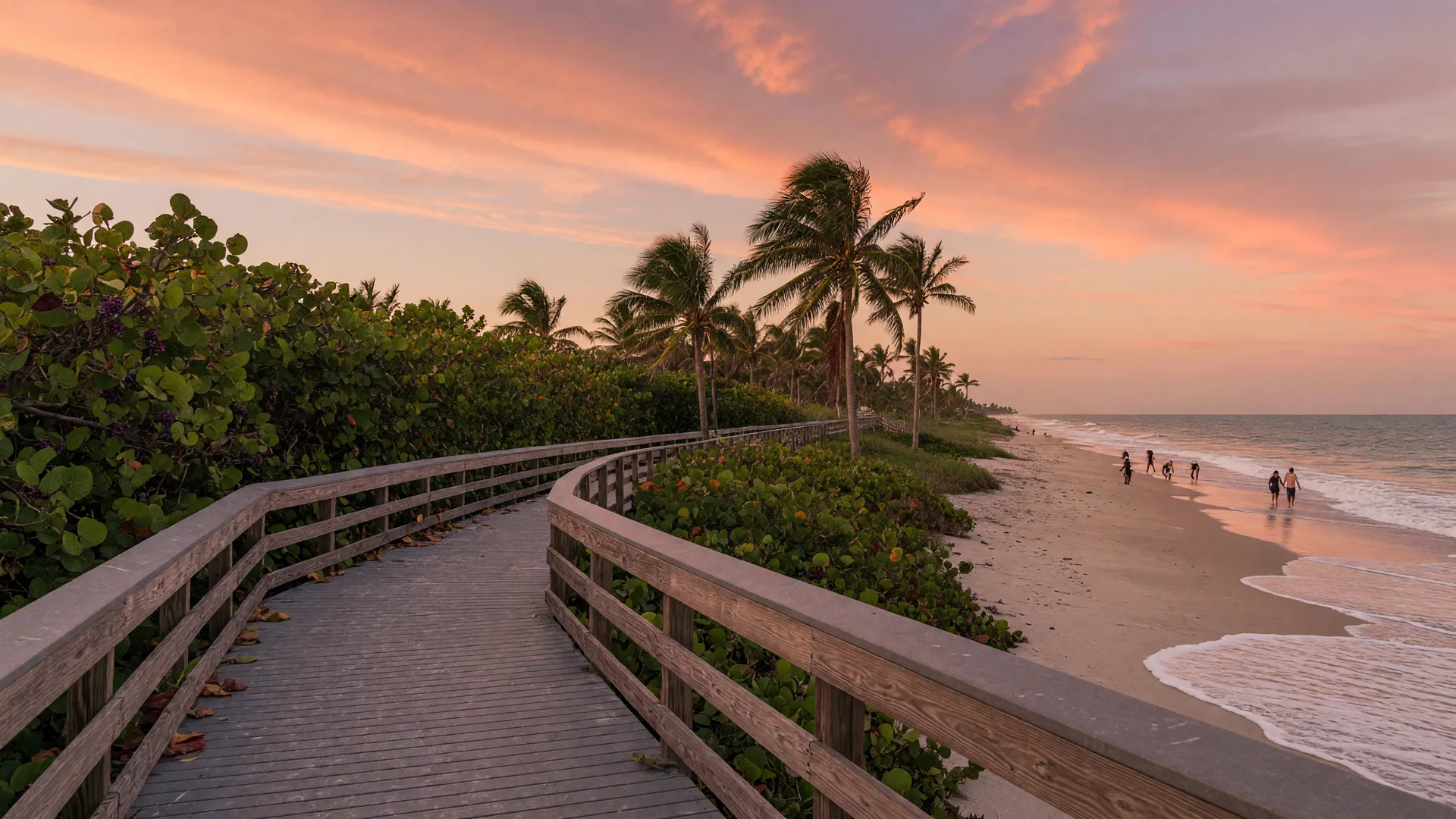
Here is the honest headline: Kansas is big-sky, hardworking, and genuinely good, so the Kansans who leave are choosing, not fleeing. The draw to Florida is a clean trade: the 5.2% to 5.58% income tax disappears, the property tax that runs near the national top falls, and the plains become a year-round coast. The same honesty that starts every guide in this series applies: Florida homes cost a bit more on the sticker, insurance is a real budget line, and heat is not a rumor. Know all of it before you go.
Why Kansas families keep landing in Florida
The first call I take from Kansas usually starts with the weather and ends with the tax bill. Kansas is a wonderful state, big skies, low cost of living, and genuine neighborliness, and I have clients who love it and stay. The families who call me are making a choice, and the conversation is usually about the tax code and the pull of water.
The migration data shows the numbers honestly. About 4,700 Kansas residents moved to Florida in 2024, putting Florida among the top Kansas out-migration destinations, behind Missouri and Texas, out of roughly 83,800 Kansans who left the state that year (U.S. Census ACS, 2024 state-to-state flows, via USAFacts). It is not the biggest flow in the series, and I will not pretend it is. But the families who make the trip tend to be the ones for whom the income tax, the property tax, and the lifestyle tip the scale, and they tell a very consistent story once they are here.
This guide is for the families who have already decided, or are close to deciding, and want the real numbers and the real trade-offs, not a brochure. Here they are.
Climate and lifestyle: the honest contrast
Kansas’s identity is built on the plains: skies that go forever, wheat and corn turning gold, real winters, and a spring when tornado season is part of everyone’s vocabulary. Florida is built on the opposite of the winter part. The year splits into a mild dry season and a hot, humid one, and the water is not something you drive to reach, it is the neighborhood you live in, ocean, river, or Intracoastal.
The honest part of the contrast: Florida’s summer is hot in a way Kansas summers rarely are, with humidity that makes the air feel heavy from about May through October, and the afternoon thunderstorm is a daily rhythm most of that stretch. The air conditioner runs many months of the year and the electric bill follows. What you get for it is an outdoor life that never closes: paddleboarding after work in February, a beach walk in December, a boat on the St. Lucie or Indian River whenever the mood strikes. For big-sky, outdoors Kansas families, that trade is usually the easiest yes of the whole decision.
The distance, and the logistics of getting here
This is a long move, and it deserves respect. Kansas City to Miami is about 1,460 miles by road, roughly 22 to 27 hours of driving nonstop (distance.to and TravelMath), with West Palm Beach about 75 miles closer. Nonstop flights from Kansas City to Miami run about 3 hours 10 minutes, which keeps visits back to family, football weekends, and Kansas sunsets entirely practical.
~1,460 mi
Kansas City to Miami (road)
About 22 to 27 hours of driving, nonstop
~1,380 mi
Kansas City to West Palm (road)
About 21 to 25 hours of driving, nonstop
~3 hrs 10 min
Nonstop flight MCI to MIA
Nonstop from Kansas City to Miami, year-round service
~45-55 min
PBI to Treasure Coast
Palm Beach International to Stuart and Port St. Lucie
Because the distance is long, the planning list matters more. Florida driver’s license and vehicle registration, insurance rewrites, utilities, school enrollment, mail forwarding, and the address changes at your bank, payroll, and investments all need a deadline, and the Moving to Florida Checklist gives them one. Families who print it early tell me the move runs on rails; families who wing it run into registration lines in two states.
If you still work for a Kansas employer, ask HR and your CPA about residency and withholding before you move, since Kansas taxes income earned by residents. Remote workers are common along the Florida coast, and the no-income-tax math makes a remote salary stretch further the moment your residency officially changes.
The money: taxes and cost of living, side by side
Kansas’s tax code is genuinely mixed: a real income tax, a property tax near the national top, and a sales tax that climbs with local add-ons. The savings in this move come from all three lines. Every figure below carries a named source and an as-of date, and your personal number comes from your income, your home, and your county.
5.2%-5.58%
Kansas income tax brackets, 2025
Two brackets: 5.2% up to $23,000 single, then 5.58% above, and both disappear entirely in Florida.
TaxAct / TurboTax / AARP · 2025 rate schedule
~1.21%
Kansas effective property tax rate
One of the higher rates in the country, with a median annual bill around $2,794, versus Florida\u2019s ~0.76%.
Tax Foundation · 2024 data
~$304,000
Kansas median home sale price
Redfin data, up about 4.8% year over year.
Redfin · June 2026
~4,700
Kansans who moved to Florida in 2024
Florida placed among the top Kansas out-migration destinations, behind Missouri and Texas.
U.S. Census ACS via USAFacts · 2024 state-to-state flows
~1,460 mi
Kansas City to Miami by road
About 22 to 27 hours of driving nonstop, with the flight at roughly 3 hours 10 minutes.
distance.to / TravelMath / AirmilesCalculator · 2026
6.5%
Kansas state sales tax
Typical combined rate near 7.5% with local add-ons, versus Florida\u2019s 6% plus county surcharge.
Stripe / TaxCloud · 2026
| Category | Kansas | Florida | The difference |
|---|---|---|---|
| State income tax | 5.2% up to $23K, 5.58% above (2025) | 0% (no state income tax) | Full elimination |
| Property tax | ~1.21% effective; ~$2,794 median bill | ~0.76% effective; ~$2,730 median bill | Lower rate and bill in Florida |
| Median home price | ~$304,000 statewide | ~$367K-$682K by county | Comparable, with water and warmth included |
| Sales tax | 6.5% state; ~7.5% typical combined | 6% state plus county surtax (~6.5%-7%) | Lower in most Florida counties |
Sources: Kansas income tax brackets, TaxAct, TurboTax, and AARP, 2025 rate schedule; Kansas effective property tax rate and median bill, Tax Foundation, 2024 data; Kansas median home price, Redfin, June 2026; Kansas-to-Florida migration, U.S. Census ACS 2024 state-to-state flows via USAFacts; Kansas sales tax, Stripe and TaxCloud, 2026; Kansas City to Miami distance and flight time, distance.to, TravelMath, and AirmilesCalculator, 2026. Florida figures reflect state law and county medians for the 2026 market as reported in the Relocation Hub’s county data.
What the tax math actually looks like
For a working family, Kansas’s income tax is a two-bracket progressive system for 2025: 5.2% on taxable income up to $23,000 single (or $46,000 married filing jointly) and 5.58% above that (TaxAct, TurboTax, AARP). Move to Florida and the whole thing disappears, since Florida has no state income tax at any income level. That alone is worth about $3,200 a year on $60,000 of taxable income, and more as income rises.
The property side is where Kansas families get a second, rarer win. Kansas’s effective property tax rate is about 1.21%, among the higher rates in the country, with a median annual bill near $2,794 (Tax Foundation, 2024), while Florida’s effective rate is about 0.76% with a median bill near $2,730. The sales tax eases too: Kansas’s 6.5% state rate typically lands near 7.5% with local add-ons, while Florida runs about 6.5% to 7% combined. For most Kansas families the income tax, the property tax, and the sales tax all fall in this move, which is the most complete tax win in the 50-state series. The complete breakdown is in the Florida Tax Guide for New Residents.
What your home-buying dollar buys here
Kansas’s median home sale price was about $304,000 in June 2026 (Redfin), while our Florida county medians run from about $367,000 in Indian River County to about $682,000 for single-family homes in Miami-Dade. The honest translation:
- Around $350,000 to $450,000: the honest sweet spot for Kansas budgets, where the same money that buys a good-size Kansas home buys a three-bedroom home in Port St. Lucie or Fort Pierce, a canal-front townhome, or a condo with water views on the Treasure Coast.
- At $450,000 to $600,000: newer construction in St. Lucie and Martin Counties, gated-community homes in Palm Beach County, or waterfront with a dock on the Treasure Coast, the tier where most Kansas move-up buyers land.
The buying process for Kansas buyers is well-worn: pre-approval from a lender who writes Florida loans, video tours and live walkthroughs, a local inspection, and remote closings when the calendar needs them. The Buying from Out of State guide walks through each step, and the calculators below build the true monthly number before you book a flight.
Affordability Calculator
Find the top of your price range from your income, debts, down payment, rate, taxes, and insurance.
Open the calculatorMortgage Payment Calculator
Estimate the full monthly payment: principal, interest, taxes, insurance, and HOA for a South Florida home.
Open the calculatorRent vs Buy Calculator
Compare renting versus owning over time and find your break-even year, not your gut.
Open the calculatorDown Payment Calculator
See how much you need to save and how long it takes to hit your goal without emptying your reserves.
Open the calculatorThe honest Florida surprises
Kansas families are well prepared for most moves, with serious experience in weather and hard work. The Florida surprises are the costs and rhythms that do not exist on the plains, and they are all planable if you know them in advance.
- Insurance is a budget line, not a footnote. Florida’s average annual homeowners premium runs about $3,800 to $3,900 including wind (Florida OIR / Insurance Information Institute, 2025-2026 data). Flood insurance is separate where the map requires it. We pull the flood map and get real quotes for the exact home before any offer, full stop.
- The hot season is long and humid. Kansas summers are hot but they end; Florida’s May through October runs hot and sticky, with afternoon storms as a near-daily rhythm and higher summer electric bills. Hurricane season, June 1 to November 30, is a real planning habit for families here, and it is manageable, but it is not optional. Kansans who thrive are the ones who treat preparedness as a checklist item, which is exactly their strength.
- The pace of life is slower, and the trade is the point. Kansas runs on schedule; Florida runs on a warmer clock. The first year can feel loose to a family used to plains order, and the second year is usually when the shoulders come down. It is a feature of the place, not a bug.
- HOA dues and CDD assessments. Many Florida communities add HOA fees and Community Development District assessments on top of the mortgage, a cost Kansas homeowners rarely carry. None of it is a deal-breaker. All of it belongs in the monthly number, and all of it goes into ours.
Every one of these is planable, and every Kansas family I have guided through them says the same thing a year in: the surprises were the part I could plan for, and the life is the part I could not have imagined.
“Kansas families already love the outdoors and the open sky. Florida hands them the water, the warmth, and a tax bill that falls on the income, the property, and the sales lines. That is the honest trade, and it is a good one.”
Michael “Wiz” Wisniewski
The questions Kansas families ask me most
Honest, specific answers to the questions I hear on every strategy call with Kansas families. Same facts, same plain talk, no sales script.
01 How much can I save on taxes moving from Kansas to Florida?
Kansas\u2019s income tax runs in two brackets for 2025: 5.2% on taxable income up to $23,000 single (or $46,000 married filing jointly) and 5.58% above that (TaxAct, TurboTax, AARP). Florida has no state income tax at any income level, so the entire bill disappears. Kansas also carries a property tax near the higher end of the country, an effective rate around 1.21% with a median annual bill near $2,794 (Tax Foundation, 2024), while Florida\u2019s effective rate runs about 0.76% with a median bill near $2,730. For most Kansas families both sides of the tax bill fall in this move, and the sales tax eases too, from a typical 7.5% combined rate in Kansas to Florida\u2019s roughly 6.5% to 7%.
02 How does housing compare between Kansas and Florida?
Kansas\u2019s median home sale price was about $304,000 in June 2026 (Redfin), while our Florida county medians run from about $367,000 in Indian River County to about $682,000 for single-family homes in Miami-Dade. The honest translation: the budgets are genuinely close, which is rarer in this series. The same money buys a comparable-size home, and in Florida it comes with water access, year-round warmth, and an outdoor life that never closes, while the tax bill falls on both the income and the property lines.
03 How long is the move from Kansas?
Kansas City to Miami is about 1,460 miles by road, roughly 22 to 27 hours of driving nonstop (distance.to and TravelMath), with West Palm Beach about 75 miles closer. The way Kansas families actually make the trip is the nonstop from Kansas City to Miami, about 3 hours 10 minutes, which keeps visits back to family, football weekends, and Kansas sunsets entirely practical. Because the distance is long, the planning list matters: Florida driver\u2019s license and registration, insurance rewrites, utilities, school enrollment, and mail forwarding all need a deadline, and the Moving to Florida Checklist gives them one.
04 What is the lifestyle change from Kansas?
Kansas is plains country: big skies, four true seasons, tornado-season vigilance in the spring, and a pace built on hard work and neighborliness. Florida is coast country, and here is the part that lands well for Kansans: the big-sky, open-country love of outdoors travels perfectly. The honest trade is that Florida\u2019s summer is hot and humid in a way Kansas summers rarely are, with afternoon storms and a longer air-conditioning season, and the hurricane season from June 1 to November 30 is a real planning habit. What you get is an outdoor life that never closes: a beach walk in December, a boat on the St. Lucie or Indian River whenever the mood strikes.