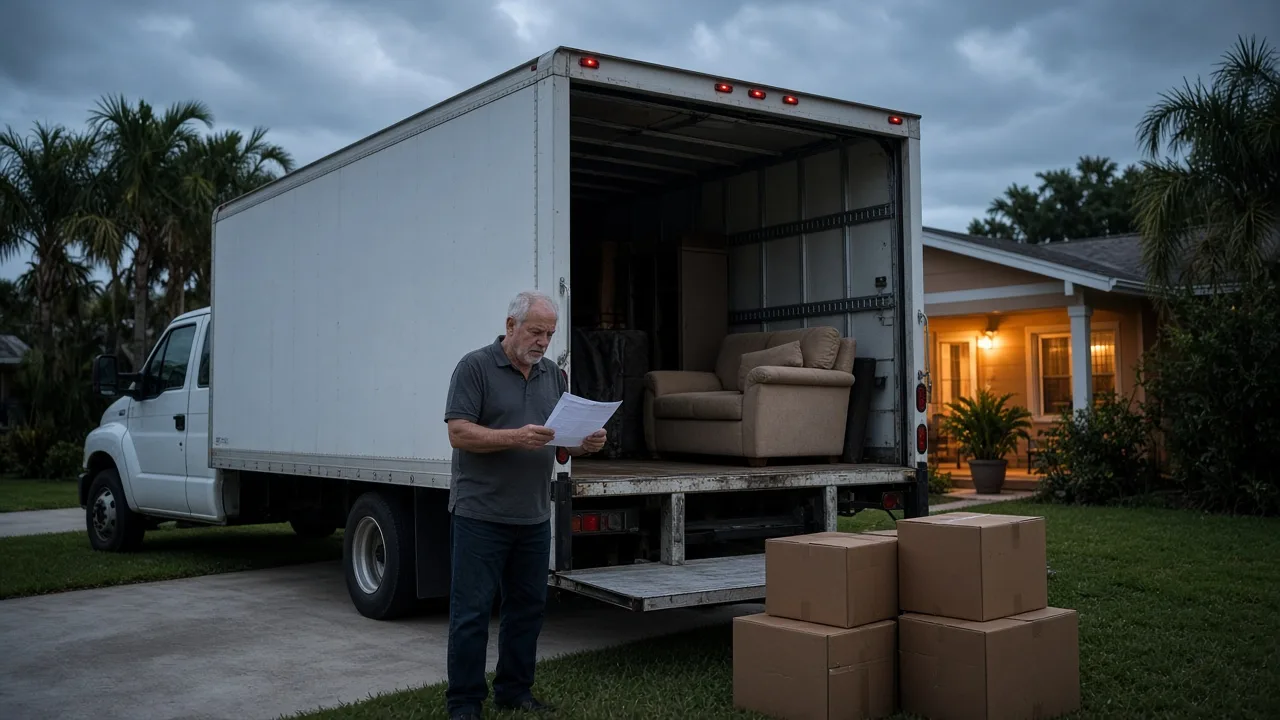
Moving is one of the most stressful transitions in life, and that stress is exactly where the moving company hostage scam hides. A mover wins the job with a lowball quote, loads your entire household onto a truck, and then the foreman presents a bill that is double or triple the original estimate and refuses to unload until it is paid. With your whole life sitting in a truck on your driveway, the pressure is engineered to feel unbearable, and the law that protects you is the last thing on your mind. It should be the first.
The quick answer
A mover cannot legally demand more than 110 percent of a non-binding estimate at delivery, must deliver your goods, and can defer the remaining balance at least 30 days. Holding your household goods hostage is illegal under 49 U.S.C. 14915, with a civil penalty of at least $10,000 per violation. You do not have to pay a double or triple bill on the doorstep.
This is the moving company hostage scam, and it targets people mid-move, when their guard is down, their home is in boxes, and their leverage has just been loaded onto the back of a truck. Florida seniors and the families helping them are a prime target because a big enough ask at the worst possible moment can feel impossible to refuse. It is not. The goods may be on the truck, but the law is on the side of the person holding a signed estimate.
Read the full story
The full story lives in the Senior Scams series
This blog post is the companion to the Moving Company Hostage Scams story in my Senior Scams series, published under the Senior Scams hub. In the full article you get the complete breakdown: how the scam runs step by step, the federal law and the 110 percent rule that protect you, the verified numbers behind it, the full real story, the prevention checklist, the numbered what-to-do plan, and answers to the questions Florida families ask most.
Read the full Senior Scams articleHow the scam works, one step at a time
Every hostage scam follows the same five moves. Learn them now, because the pattern only works when you do not see it coming:
Step 01
The lowball bait
The mover quotes a price 30 to 50 percent below legitimate competitors, low enough to win the job and low enough to raise a quiet flag. Legit movers cannot undercharge everyone by half and stay in business, so the too-good quote is the first tell.
Red flag: an interstate quote 30 to 50 percent below other written estimates.
Step 02
The unmarked truck
On moving day the crew often arrives in an unmarked rental truck with no company branding, a USDOT number you can check, or the paperwork you were promised. The vehicle is part of the costume, just like spoofed caller ID in a phone scam.
Red flag: a crew arriving in an unmarked rental truck.
Step 03
Loaded and then locked
The crew loads your entire household goods onto the truck, which is the moment your leverage disappears. Once your life is on the truck, the foreman presents a bill that is double or triple the original quote, claiming the load was bigger than anticipated.
Red flag: a new, much higher bill presented only after your goods are loaded.
Step 04
The hostage hold
The mover refuses to unload the truck until the inflated bill is paid, and sometimes demands cash on the spot. With your belongings and, in many cases, your whole life sitting in a truck on your driveway, the pressure is engineered to feel unbearable.
Red flag: a refusal to unload your goods until a new, inflated bill is paid.
Step 05
The non-binding estimate catch
The signed estimate is almost always a "non-binding estimate," which is the catch the movers rely on. Under that kind of estimate, the final price can legally change based on final weight or cubic footage, and the scammers bend that flexibility into a hostage demand.
Red flag: the word "non-binding" on the estimate, and a price that keeps climbing.
The law that protects you
This is not a gray area, and the fear a foreman is selling you is not the law. Holding your household goods hostage is illegal, and the protections are written out in black and white:
Hostage loads are illegal
Holding your household goods hostage is illegal under 49 U.S.C. 14915, and it is also prohibited under 49 CFR 375.901. This is not an awkward collection dispute, it is the law moving against the mover, not against you.
Real civil penalties
The statute carries civil penalties of at least $10,000 per violation, about $16,000 after the Surface Transportation Board’s 2026 inflation adjustment. Scammers count on you not knowing the penalty, so knowing it is already an advantage.
The federal 110 percent rule
With a non-binding estimate, the carrier cannot demand more than 110 percent of the estimate at delivery, must deliver the goods, and can defer the remaining balance at least 30 days. You do not have to pay a double or triple bill on the doorstep.
Deliver upon payment of the original estimate
The law requires movers to deliver your goods upon payment of the original estimate. When the foreman suddenly asks for thousands more, that demand is not a lawful bill, it is the scam, and the law is on your side.
The rule that ends the hostage hold
Under a non-binding estimate, a mover cannot demand more than 110 percent of the estimate at delivery, must deliver the goods, and can defer the remaining balance at least 30 days.
The numbers behind the scam
The numbers explain why this scam keeps working. Hostage-load complaints jumped 189 percent from 2022 through late 2024 and now make up 31 percent of all moving complaints. In the December 2024 complaint mix, hostage loads led at 31 percent, followed by damaged goods at 24 percent, late delivery at 19 percent, overcharging at 15 percent, and lost items at 8 percent.
The FMCSA’s National Consumer Complaint Database processed 13,247 interstate mover complaints in 2024, up 23 percent from 2023, and a HireAHelper analysis of FMCSA data and BBB Scam Tracker reports projected about $32.2 million in 2024 moving-scam losses, self-reported. The FMCSA has answered with its Operation Protect Your Move sweeps, which covered 17 states in 2024 and 16 states in 2023, another sign that regulators treat hostage loads as the priority they are.
- jump in FMCSA hostage-load complaints from 2022 through late 2024
- 189%
- of all moving complaints, the share that were hostage loads (FMCSA)
- 31%
- interstate mover complaints processed by FMCSA in 2024, up 23% from 2023
- 13,247
- projected 2024 moving-scam losses in a HireAHelper analysis (self-reported)
- $32.2M

The real story: Beth Robinson, 83, and the $26,000 move
In July 2025, Beth Robinson, 83, was moving from California to Washington State. Based on her moving quote, she expected a move of about $6,000. After the crew loaded her belongings onto the truck, they raised the price by more than $20,000 and then demanded an extra $1,200 tip on top of it.
Alone and scared, with her belongings already on the truck and nowhere to turn in the moment, she gave them a $10,000 check and was ultimately scammed out of more than $26,000. She is the cautionary heart of this story, because nothing about her situation was rare: a lone senior, a loaded truck, a sky-high new figure, and a refusal to unload. In another reported case the same pattern played out at a smaller scale, when a customer’s quoted price jumped to $5,980, more than triple the original.
The difference between Beth’s loss and a senior who keeps every dollar is exactly the knowledge on this page. The signed written estimate, the 110 percent rule, a call to the police, and a complaint to the FMCSA turn a terrifying standoff at the tailgate into a move the law says the mover has to finish.
“Her belongings were on the truck, the figure in the man’s hand was triple the quote, and she was alone. The law says a mover must deliver upon payment of the original estimate. Knowing that one fact is what keeps a senior’s money off the tailgate.”
The prevention checklist
Every item on this list is a door a hostage scam needs you to leave open. Close them all before the truck ever arrives:
-
Check 01 Verify interstate movers at protectyourmove.gov and confirm the USDOT number before you sign anything.
-
Check 02 Get multiple written in-home estimates, not one lowball quote over the phone.
-
Check 03 Understand the difference between a binding and a non-binding estimate, and know the 110% rule before moving day.
-
Check 04 Demand weight tickets on weight-based moves so the final bill has proof behind it.
-
Check 05 Photograph everything, including the load, the truck, and the paperwork, before the crew even starts.
-
Check 06 Pay by credit card, never cash, so you have a way to dispute and a paper trail.
-
Check 07 Treat an unmarked rental truck or a demand for payment before loading as red flags that end the job.
The red flags that end the job
Treat an unmarked rental truck or a demand for payment before loading as red flags that end the job right there. A too-good quote, a crew with no company branding or checkable USDOT number, and any push to pay before the load is done are all reasons to stop and walk away while your goods are still in your driveway.
What to do if it happens to you
If the truck is already loaded and the foreman has a new number in his hand, you are not out of moves. This is your plan, and the law backs every step:
- 1
Do not pay the inflated bill in cash
Cash is how hostage scams are completed and it leaves no record. Refuse and keep your credit card out of it until you know your rights.
- 2
Pull out the signed written estimate and compare
The fight is one piece of paper: your signed estimate. Lay it against the new bill and show the crew the difference in writing.
- 3
Invoke the 110% rule
Under a non-binding estimate, a mover cannot demand more than 110 percent of the estimate at delivery and must deliver your goods. Say it plainly and offer the original estimate amount.
- 4
Call the police
Some departments call a hostage load a civil matter, and some will help on the spot. Either way, call, because the law on holding household goods hostage is on your side.
- 5
File a complaint with FMCSA
Report the mover at protectyourmove.gov. Every complaint feeds the National Consumer Complaint Database and national enforcement sweeps like Operation Protect Your Move.
- 6
Know the law
The law requires movers to deliver your goods upon payment of the original estimate, so the original estimate is your anchor, and their refusal is their problem, not yours.
If your family is mid-move, call first
If your parent or grandparent is mid-move and a mover suddenly demands thousands more, call or text me at (561) 441-8420 before sending a dime. I will help you talk them down.
A calm second pair of ears on the phone with the foreman changes the whole dynamic of the standoff, and it costs nothing and protects everything.
Frequently asked questions about moving company hostage scams
Quick, honest answers to the questions Florida seniors and their families ask me most. Tap a question to open the answer.
01 What is a moving company hostage scam?
A moving company hostage scam is a fraud where a mover wins a job with a lowball estimate, loads your household goods onto the truck, and then presents a bill that is double or triple the original quote, claiming the load was bigger than anticipated. The mover refuses to unload your belongings until the inflated bill is paid, sometimes demanding cash. Because the signed estimate is usually a "non-binding estimate" whose price can legally change with final weight or cubic footage, the scammers stretch that flexibility into a hostage demand.
02 Is a signed moving estimate binding?
It depends on the kind of estimate. A binding estimate locks in the final price, barring a real change you requested. A non-binding estimate lets the price change based on final weight or cubic footage, which is exactly the catch the moving company hostage scam exploits. Whatever you sign, read the words "binding" or "non-binding" on the paper, and remember that even with a non-binding estimate, the federal 110 percent rule caps what a mover can demand at delivery.
03 What is the federal 110 percent rule?
Under the federal 110 percent rule, when you move with a non-binding estimate, the carrier cannot demand more than 110 percent of the estimate at delivery, must deliver your goods, and can defer the remaining balance at least 30 days. So when a foreman refuses to unload until you pay double or triple the quote, they are breaking the law, not collecting a lawful bill, and their demand is not something you have to meet on the doorstep.
04 What should I do if a mover already has my goods and is demanding more money?
Do not pay the inflated bill in cash. Pull out your signed written estimate and compare it to the new bill, invoke the 110 percent rule and offer the original estimate amount, and call the police, even if some departments call it a civil matter. Then file a complaint with the FMCSA at protectyourmove.gov. The law requires movers to deliver your goods upon payment of the original estimate, so the original estimate is your anchor.
05 How do I avoid a moving company hostage scam before it starts?
Verify interstate movers at protectyourmove.gov and confirm the USDOT number, get multiple written in-home estimates, understand the difference between binding and non-binding estimates and the 110 percent rule, demand weight tickets on weight-based moves, photograph everything, and pay by credit card, never cash. Treat an unmarked rental truck or a demand for payment before loading as red flags that end the job right there.
Protect your belongings and your money
The senior who knows the pattern is the one who beats it. Print the checklist, put the verify-at-protectyourmove.gov and the credit-card-never-cash rules where you can see them, and share the 110 percent rule with everyone in your family who might ever move. A plan written down before the truck arrives is the difference between a stressful moving day and a $26,000 loss.
The scam works because moving is stressful and the pressure lands at the worst possible moment. Knowledge removes the pressure, because you already know the exact move that ends it: do not pay in cash, compare the estimate, invoke the 110 percent rule, call the police, and file with the FMCSA. Families who rehearse this plan are the families whose belongings arrive home and whose money stays where it belongs.
Before the truck arrives
Protect a stressful move with one free call
Michael “Wiz” Wisniewski is a Certified Real Estate Planning Advisor who works with Florida seniors and their families every day. Bring a suspect estimate, a mover’s name, or a call that felt off, and leave with a clear plan for protecting your belongings and your money. Free 15-minute strategy call, no pressure, no obligation.

About the Author
Michael "Wiz" Wisniewski
Michael "Wiz" Wisniewski is The Life Transition Specialist with The Complete Real Estate Team, powered by Dalton Wade Real Estate, serving clients from the Treasure Coast to South Florida. A Certified Real Estate Planning Advisor, Certified Life Transition Specialist, and Certified A.I. Real Estate Advisor, he has worked nearly every side of real estate: fix-and-flip investing, land development, home building, and property management, and guides families through life's transitions with care, honesty, and the Golden Rule.
Certified Real Estate Planning Advisor | Certified Life Transition Specialist | Certified A.I. Real Estate Advisor
Written by
Michael Wisniewski, The Wizard of Real Estate
Certified Real Estate Planning Advisor | Certified Life Transition Specialist | Certified A.I. Real Estate Advisor
Helping Florida families protect what matters most.
Talk Soon