Here is the honest headline: the #1 question seniors in transition ask is not about price, the market, or even the house. It is this: is it time to move, or should I stay in my home? It is the question underneath all the others, and most of the time it is being asked silently, late at night, by a person who has spent decades in the same house and now worries about the stairs, the yard, the money, the loneliness, and what the kids think. This article is the conversation I have when that question finally gets said out loud.
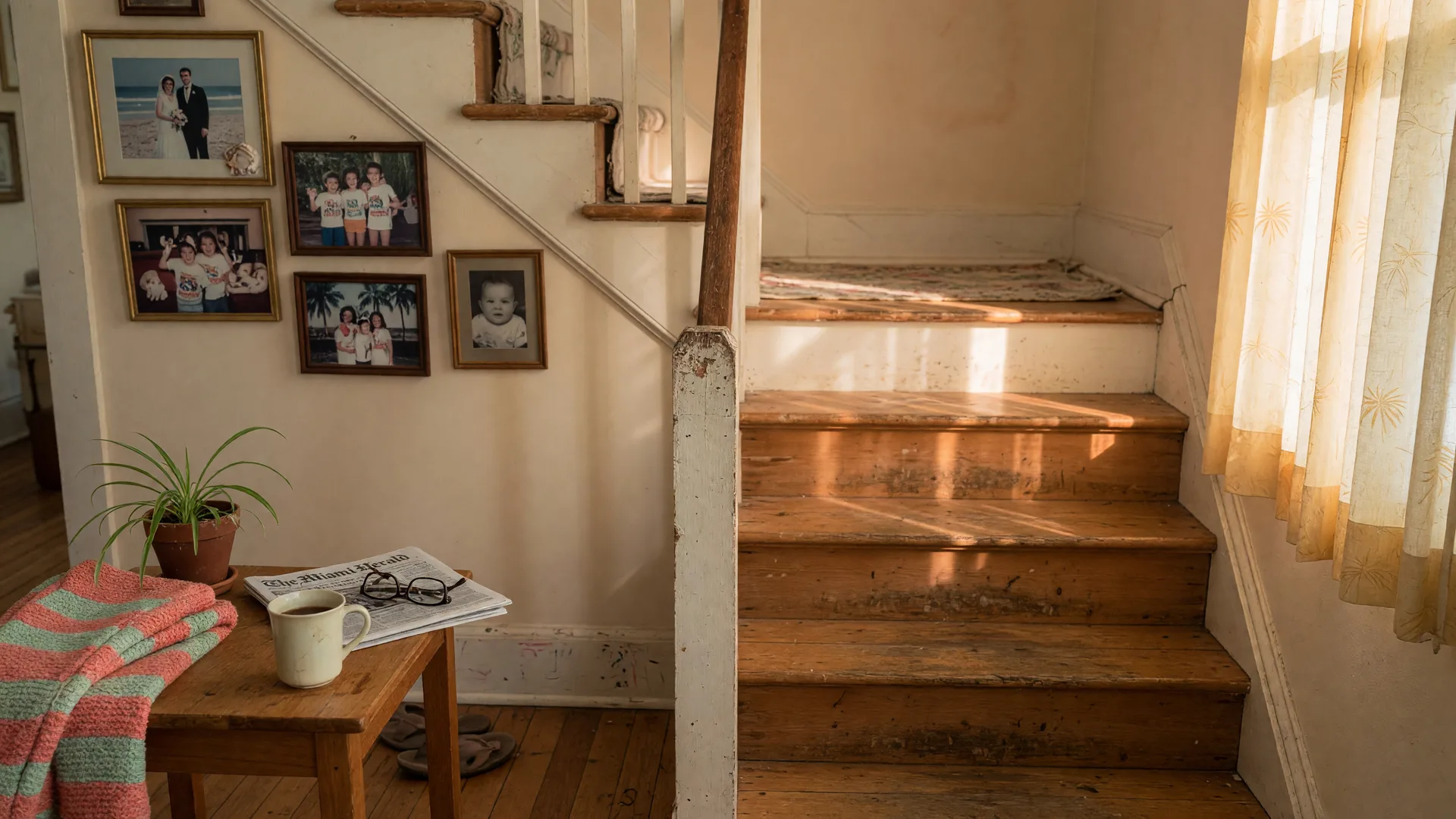
She was standing at the bottom of the stairs when the coffee went cold. Seventy-four years old, forty-one years in the same house on the Treasure Coast, three kids raised in it, a garden out back she planted the year the youngest started school. The stairs had never been anything to think about until recently, and now she stood at the bottom holding a mug that had gone cold while she counted the steps. Sixteen, in case you are wondering. She had counted them a hundred times by then. Do I stay, or is it time to go?
The question had been circling for months. It visited her at four in the morning, when the house was quiet enough to hear the refrigerator hum. It stood with her at the mailbox. It rode with her to the grocery store, where she held the cart a little harder after the fall last winter, the one she did not mention until her daughter heard it in her voice and asked. Not a big fall. A slip on the back step, a bruised hip, three days of moving slowly. Long enough for her to understand that a bad fall at her age is not a slip. It is a turning point.
The house knows her. It is where they celebrated every birthday, where the kids learned to ride bikes in the driveway, where the neighbors still wave from three driveways away, which is to say, almost never close enough for coffee. Her daughter is in Ohio, her son in Michigan, a thousand miles north, both of them, with lives and mortgages and children of their own. Their phone calls are long and their visits are short, and the house waits in between. She is not the only person in her neighborhood counting the stairs. Florida is home to one of the oldest populations in the nation now, and the question she is asking is being asked in a hundred thousand kitchens across this state.
So the question is not really about real estate. It never is. It is about the rest of her life, and she has been asking it alone. The cost of a move. The cost of staying. The fear of being a burden. The fear of being lonely. The fear of making the wrong call at an age when a wrong call feels permanent. She is a capable adult who has run a household, raised children, buried her husband, and balanced a checkbook through four decades of surprises. She is not looking for someone to decide for her. She is looking for someone to help her decide, with real information, real numbers, and no agenda.
On a Tuesday she finally said it out loud, first to her daughter, then to me, across a kitchen table in the kind of quiet that means a real question has been asked. “I don’t know if it’s time,” she said. “What do you think?” I have heard that sentence in a hundred variations, from Indian River to Miami-Dade, from people who have lived in their homes for four decades and from people weighing what is often the most examined decision of their later years. The details change. The weight does not. So here is how I answer it, honestly, the same way I answer it across a kitchen table. Sometimes the answer is stay. Sometimes it is go. Most of the time the real answer is a plan.
The question underneath the question
The #1 question seniors in transition ask is “is it time to move, or should I stay?” It is usually a question about fear, control, independence, money, and love, wearing a real-estate costume. The house rarely fits that badly. What fits badly is the life around it, or the worry about what happens next. And before anyone can answer the house question well, the fears underneath it get to be named. Every single one of them is legitimate:
- Losing independence. A move can feel like surrendering the steering wheel of your own life. It does not have to, and planning is how it does not.
- Losing the memories. The house holds every birthday, every Christmas, every person who ever walked through the front door. Leaving it feels like leaving them.
- The cost of the move. Selling, moving, buying again, paying more for less house, or paying dues in a community. The math feels like it works against you, until someone actually runs it.
- The physical risk of staying. The stairs, the shower, the distance from help, the fall that changes everything. Staying has risks too, and they are the ones nobody wants to price.
- Being a burden. To the children, to the grandchildren, to anyone who would have to drop their life to help with yours. Most seniors carry this one quietest.
- Ending up lonely. A smaller place with fewer stairs can still be lonelier than a big house with a familiar street, and people worry the move speeds that up.
- Making a mistake at an age when a wrong move feels permanent. This is the quietest fear of all, and the most reasonable. The way to answer it is with information, not with a decision.
None of these fears is foolish. All of them deserve a straight answer. And the straightest answer I can give is that the decision gets easier the more real it becomes, because most of what makes it terrifying is the fog, not the facts.
The honest framework: five things that actually decide it
Here is the framework I use with every client, whether they are seventy-four or their children are calling on their behalf. Five factors, looked at plainly, in order. The deeper walkthrough of the whole decision lives on my is it time to move guide, and the version below is the honest first pass.
1. Safety and health, without flinching
The place to start is the one nobody wants to start with. About 1 in 4 adults 65 and older reports falling each year, and falls are the leading cause of injury and injury-related death among older adults (CDC, Older Adult Falls Data). The stairs you have climbed for twenty years are not the same stairs at seventy-eight. The shower, the step out of the tub, the distance from the bedroom to the bathroom, the minutes it takes to reach the nearest emergency room: these are not character questions, they are engineering questions, and bodies change whether we negotiate with them or not.
The honest question is not “can I still climb these stairs?” It is “what happens when I cannot, and there is no one home to find me for two days?” If the answer to that scares you, that is not weakness talking. That is information. It does not mean you must move. It means safety has to be priced into both columns, and sometimes it is priced with grab bars and a walk-in shower, and sometimes it is priced with a first-floor plan or a community that answers when you call.
2. Money: what staying really costs
Staying in a paid-off house feels free. It is not. The mortgage goes away and the line items stay: property taxes, Florida wind and flood insurance, utilities, the roof and AC that are always waiting somewhere in the next five years, the lawn service, the repairs that used to be your own two hands. And then there is the help that almost always arrives. The national median for homemaker services in the home is $33 an hour, about $6,292 a month at 44 hours a week (Genworth Cost of Care Survey, 2024). You do not have to need it today for it to belong in the plan.
And here is the honest other side, because I am not selling you a move: sometimes staying is genuinely cheaper and genuinely better. A paid-off home, modest upkeep, a daughter who drives over twice a week, a neighborhood that checks on you: that math can beat any move on earth. Equity is not a number on a screen. It is the down payment on the next chapter, or it is the cushion that lets you choose to stay. The question is which one serves you, and that is a written-down question, not a felt one. And when the question under the money is care, my long-term care guide walks through what care costs and how families pay for it.
3. Connection: the driver nobody names
More moves are driven by loneliness than by stairs, and almost nobody says so out loud. The National Academies of Sciences, Engineering, and Medicine found that about one in four community-dwelling adults 65 and older is socially isolated, that isolation is tied to roughly a 29% higher risk of premature death, a risk that may rival smoking, obesity, and inactivity, and that it is associated with about a 50% higher risk of dementia (NASEM, 2020 consensus report). Loneliness is not a mood. It is a health condition with a number on it.
So the framework asks the questions nobody puts on a checklist: Who is nearby, really? How often does the phone ring with a person, not a robocall? How many days can pass without a real conversation, and how does that number sit with you? For many seniors the honest answer to “should I move?” is “I should be near someone,” and the house is just the thing getting in the way. Florida is one of the oldest states in the nation, with 22.8% of residents 65 or older (U.S. Census Bureau QuickFacts, July 2025 estimates), which means the tribe exists. Sometimes the move is about finding it.
4. The house itself
A house is more expensive to keep than to own. The roof, the AC, the water heater, the hurricane shutters, the yard, the pressure washing, the pool nobody swims in anymore: it all runs, every single month, whether you notice it or not. The real question is not what the house costs. It is who does the work, and who will do it in five years. I have sat with families who hired a lawn service, a cleaner, and a handyman and still spent their Sundays managing the managers. That is not a home. That is a second job with a mortgage attached.
5. Family: proximity and the actual conversations
The last factor is the one with the most love in it, and it deserves handling with grace, not pressure. Adult children almost always mean well and almost always fumble the timing: they push too hard, or they swallow their worry and say nothing. Neither helps. The honest conversation starts with what the senior wants, not with a decision, and it lets the family in early enough to help instead of react. Moving closer to family is the most common senior move there is, and for good reason: it is the single strongest answer to the isolation factor above. My family decision guide walks that exact conversation, name the decision, answer three questions, run the real numbers, plan by the calendar, and it treats everyone in the room like a grown-up.
The real numbers, with receipts
Every figure in this article is cited to a named source with an as-of date, so you can check it yourself. Here they are together, the way I lay them out on a kitchen table.
28%
Of adults 65 and older report at least one fall each year, about 1 in 4
Falls are the leading cause of injury and injury-related death among older adults, and the risk climbs with age. This is the safety question most families are afraid to say out loud, and it belongs in the decision.
CDC, Older Adult Falls Data · current CDC data
75%
Of adults 50+ want to remain in their current homes as they age
Wanting to stay is common, normal, and valid. That is exactly why this decision deserves honest guidance instead of a sales pitch: the answer is often stay, and staying well is a plan, not a default.
AARP Home and Community Preferences Survey · 2024
22.8%
Of Florida’s population is 65 or older, about one in four
The U.S. share is about 18%. Florida is one of the oldest states in the nation, and a great many of our homes were not built for the bodies that live in them now.
U.S. Census Bureau QuickFacts · July 1, 2025 estimates
$33/hr
National median hourly cost of homemaker services in the home
About $6,292 a month at 44 hours a week, before medical care. Staying is not free. The honest question is what staying truly costs across taxes, insurance, upkeep, and the help that almost always arrives.
Genworth Cost of Care Survey · 2024 edition, released March 2025
$4,750
Florida median monthly cost of assisted living, vs. $5,350 nationally
A real comparison point, not a pitch. For some families a well-planned move costs less per month than the patchwork of staying. For others it costs more. That is what the two-column math is for.
Genworth Cost of Care Survey · 2023 edition, published March 2024
~29%
Higher risk of premature death associated with social isolation
About 1 in 4 community-dwelling adults 65+ are socially isolated, a health risk that may rival smoking, obesity, and inactivity, and is tied to roughly a 50% higher dementia risk.
National Academies of Sciences, Engineering, and Medicine · 2020 consensus report
One honest gap: I could not find a reliable, current national statistic for how many seniors who move say they wish they had done it sooner, so I have not invented one. What I can tell you from the work itself is in the next section, and it is sourced where it can be.
Two honest answers, and both are valid
Here is the part that earns me a client's trust, and I mean it: I do not have a side in this. The answer that is right for you is the one that fits your safety, your money, your connection, your house, and your family, in that honest order. People who know me know I have talked seniors out of moves more often than I have talked them into one.
The case for staying
Three-quarters of adults 50 and older want to remain in their current homes as they age (AARP Home and Community Preferences Survey, 2024). Wanting to stay is not denial. It is the most common preference in America, and for a lot of people it is the right one.
- A paid-off home with modest upkeep can be genuinely cheaper than any move, and I will say so plainly.
- Your people, your doctor, your church, your neighbors, your street: none of them move with you, and staying keeps them close.
- The memories stay inside the walls where they were made, and that has real value that no spreadsheet measures.
- Staying well is possible: grab bars, a walk-in shower, a first-floor bedroom, help at home, lawn service, meal delivery. Staying can be a plan, not a default.
The case for moving
And moving is not giving up. A Life Plan Community resident poll cited by HumanGood found 4 in 5 residents satisfied with their move, and the reflection their members share most often is wishing they had made the move sooner. That is not a sales pitch. That is an adult describing the relief of dropping a weight.
- No stairs, no yard, no roof to chase: the house stops managing you, and your time comes back.
- Proximity to family is the #1 reason seniors move, and it answers the isolation factor nobody names.
- A community with people around, meals, activities, and help on call is the opposite of lonely, when it fits.
- Equity from the sale can fund the next chapter, and the new chapter is usually smaller, simpler, and easier to live in every single day.
The reason this approach works is that neither column is a sale. If the honest answer is stay, I help you stay well, and I mean it. If the honest answer is go, I help you go well, and the process below is the one I run. Either way, you walk away with a plan instead of a fear, and that is the whole difference between reacting and deciding.
If the answer is go, here is what the move actually looks like
For those who decide to move, the process is the part that takes the fear out of the decision. It is my Life Transition process, in plain words, and it is the same for a two-bedroom ranch as for a waterfront estate.
-
1. The honest valuation
Everything starts with the real number: what your home nets on the market that exists today, built from actual closed sales, not an algorithm and not a hope. You can start right now on the free home valuation page, and we go through the reasoning together, including when the honest number says wait.
-
2. The plan for the house, with dignity
What to keep, what to release, and what comes with you, decided by you, room by room, with time and without shame. My complete downsizing guide walks the whole process from three months out to the first night home, so the belongings are handled the way you want them handled, not the way an estate sale decides.
-
3. The timing
The right season, the right order, the right overlap between selling and buying. A plan with a calendar beats a move in a panic, and the calendar is built around your life, not the market's mood.
-
4. The tax and equity reality
Florida's homestead exemption shields the first $25,000 of assessed value from all property taxes, and a second band, from $50,000 to $75,000 of assessed value, from non-school taxes, adjusted for inflation to $26,411 for 2026 (Florida Department of Revenue). Many counties and cities add an extra senior exemption for owners 65 and older with an income limit, currently $38,686 in household adjusted gross income for 2026, but only where the local government has adopted it (Florida DOR, 2026 exemption schedule). Exemptions do not transfer with you, so the real tax picture of the next home is part of the number we run. Equity and capital gains are run through the honest lens too, with your tax advisor in the room when the numbers are big enough to matter.
-
5. The actual logistics
Sorting, donating, selling, the movers, the utilities, the address changes, the first night in the new place. None of it happens all at once, and none of it happens to you in the dark. This is where a coordinator who has done it a hundred times earns every minute.
-
6. Life after
The smaller home, the villa, the community that fits: a floor without stairs, people nearby, help on call, and a life that costs less time to maintain and more time to live. That is the point of the whole exercise, and it is the part most families underestimate until they are in it.

You are not deciding today. You are getting the numbers.
Here is the whole deal, and I mean it: I am not asking you to decide anything on this page. I am asking you to get the real numbers and a real plan, because that is what turns a question that circles at four in the morning into a decision with a date on it.
In one free 15-minute strategy call, we run the two columns together: what staying really costs across taxes, insurance, upkeep, and the help you will need, and what moving really gains, the equity, the timing, the next home, the next chapter. No pressure, no obligation, and if the honest answer is stay, I will help you stay well and say so on the record. That is all. You leave with a written-down picture instead of a circling question.
The questions I get asked most
Honest, specific answers to the questions I hear on every strategy call about a senior transition. Same facts, same plain talk, no sales script.
01 How do I know if it’s time to move?
There is not a single moment, and anyone who tells you otherwise is selling something. The honest answer lives in five questions: Has your health changed how you use this house, the stairs, the shower, the distance to help? What does staying actually cost each month, including the help you will need? How often do you have a real conversation with someone, and how long can you go without one? Who will do the maintenance, and for how many more years? And what does your family actually want, said without pressure? When you write the answers down, the right direction usually announces itself. That is the framework I run with every client, and I walk the full version of it in my is it time to move guide.
02 What does it actually cost to stay in my home as I age?
More than the mortgage you no longer pay. Property taxes, Florida wind and flood insurance, utilities, the roof and AC that are always waiting, the lawn, and eventually the help: the national median for homemaker services in the home is $33 an hour, about $6,292 a month at 44 hours a week (Genworth Cost of Care Survey, 2024). Staying can still be the right call and the cheaper call, especially in a paid-off home with modest upkeep and nearby family. But it is a line item, not a given. The two columns on a strategy call put the real monthly number beside the real equity number, and that is when most people feel the answer loosen.
03 Will I lose money selling now?
Sometimes yes, sometimes no, and anyone who promises a number before seeing your address’s real comparable sales is guessing. What changes the outcome is price: a home priced from actual closed sales in your neighborhood protects your net, and a home priced from hope pays for the lesson in months on market. My free home valuation page runs the real data for your address, and I will tell you honestly when the calendar, the repairs, or the inventory say waiting serves you better. The goal is the highest realistic net on a timeline that fits your life, not a headline number that never closes.
04 How do I talk to my adult children about this?
Start with what you want, not what you have decided, and start earlier than feels comfortable. Tell them you are beginning to think about the future of the home, that you want them in the conversation, and that the final call is yours to make. Give them something to do: ask them to help you run the numbers, tour a community with you, or just listen. Families mean well and fumble the timing; a neutral third party in the room who has done this a hundred times keeps the temperature down. My family decision guide walks this exact conversation step by step.
05 What happens to all my things?
Nothing happens all at once, and nothing has to happen without you. The plan is room by room, with dignity and time: what the family wants, what gets sold or donated, what is released, and what comes with you into the next home. It is emotional work, and it is ordinary work, and it goes better with a calendar than with a deadline. My complete downsizing guide lays out the whole process, from three months out to the first night in the new place, so the belongings get handled the way you want them handled, not the way an estate sale decides.
06 Can I move closer to family and still afford it?
For a great many families, yes, and it is the most common senior move there is. The equity in the current home, sold at a data-backed price, is often the down payment on a smaller home, a villa, or a community near your people, and moving closer to family is one of the strongest answers to the isolation that drives so many of these decisions. The honest number depends on where the family lives, what that market costs, and what the current home nets. That is exactly what the strategy call maps out before anyone commits to anything.
The person at the bottom of the stairs finally said the question out loud. What she found was not a sales pitch. It was a plan she could trust: a home that fit her life, the numbers written down in two honest columns, a calendar that made sense, and a family that felt heard. Sometimes the honest answer in that chair is stay, and we plan for staying well. Sometimes it is go, and we plan for going well. Either way, the question stops circling at four in the morning once it has a plan underneath it.
Michael “Wiz” Wisniewski