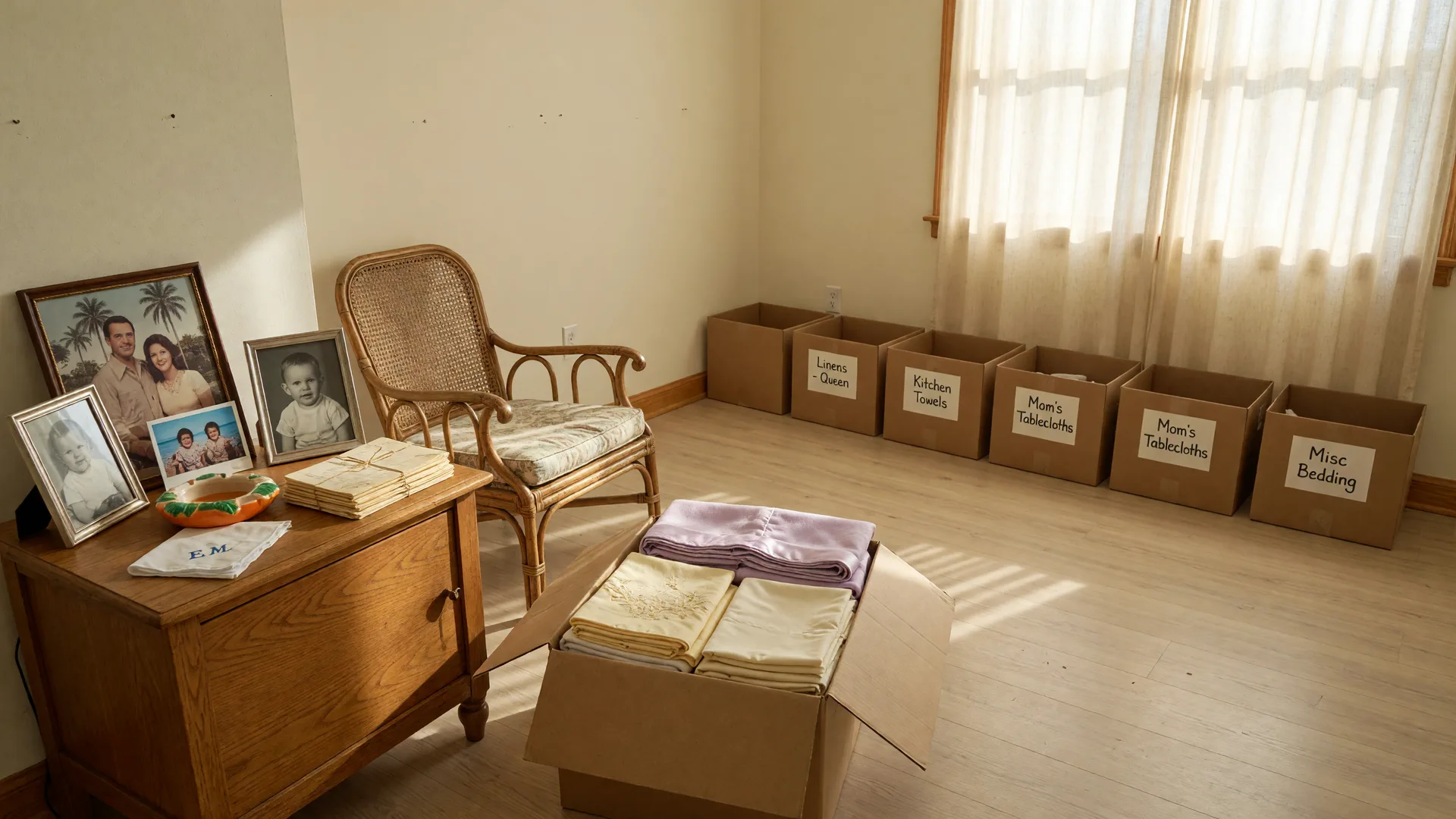
Let me tell you why I wrote this. A while back I drove to Vero Beach to meet a brother and two sisters standing in their parents’ ranch house of forty years. Their mother had moved into assisted living, and the house held everything a life collects: china in the cabinet, recliners by the window, decades of photos on every wall, tools in the garage, and a sewing room that had not been touched in years. One of them finally said what all of them were thinking: “Wiz, we don’t even know where to start.”
They are not the only family in that position, not by a long shot. Every week I sit down with families from Fort Pierce to Boca Raton, from the Treasure Coast to South Florida, and nearly every senior transition includes a version of this moment: a house full of a lifetime, a family full of love, and nobody sure what to do with any of it. Raised on Midwest values and the Golden Rule, I believe in treating people the way I want my own family treated, which means plain language, honest numbers, and a steady hand through a hard season. That is the spirit of this guide.
This guide is the roadmap I wish that family had on day one. It answers, in plain language, what an estate cleanout is, how long it takes, the five steps in order, how to keep, donate, sell, or toss, how to handle the emotional side, what donations and taxes mean, and when to bring in professionals. Every claim stays true to my estate cleanout guide, every figure is a conservative, commonly cited number with its unit attached, and nothing is invented. Read it before you open the first box, and the first box gets easier.
Here is the honest headline: an estate cleanout is the full process of emptying a family home after a move or a passing, and it gets done the same way for every family: set a deadline, sort room by room into keep, donate, sell, and toss piles, and let the plan, not the pressure, carry you through. Start with the date the home must be empty by, let the piles do the deciding, and call in help the moment the load is too heavy.
What this guide covers
Eight questions, answered answer-first so you can skim, search, or ask your voice assistant and still get the point. Each answer stands alone, then expands into the full story below.
- What is an estate cleanout?
- How long does an estate cleanout take?
- Should we keep, donate, sell, or toss?
- Is an estate sale worth it?
- Can we deduct donated items on taxes?
- What do senior move managers do?
- How do we handle the emotional side?
- When should we hire professional help?
What Is an Estate Cleanout?
An estate cleanout is the full process of emptying a family home after a senior moves into care or passes away: sorting decades of belongings, deciding what goes where, donating, selling, and clearing the house for its next use.
It happens after a move to care, after a death, or when the family home is sold, and it is equal parts logistics and emotion, which is exactly why it feels so big at the start. The job is far more manageable than it looks when it is approached as a series of small decisions instead of one giant one, and that is the secret: it is not a single “clean the whole house” moment, it is thousands of small yes-and-no decisions made room by room, box by box.
An estate cleanout is also a beginning, not just an ending. It clears the way for the next owner of the home, the next chapter of the person moving, and the family that gets to stop carrying the weight of the stuff. If you want the shorter, step-only version first, my estate cleanout resource page walks it once, and this guide is the fuller, question-and-answer edition of that same walk.
How Long Does an Estate Cleanout Take?
An estate cleanout takes as long as the home, the volume inside it, and the hours your family can give each week allow, which is why the first step is setting a deadline, not guessing a number.
A full house sorted by the family on weekends takes longer than the same house worked by a professional crew five days a week, and that is not a criticism, it is just math. The honest estimate comes from a quick walkthrough, a calendar, and the date the home must be empty by, and families who work backward from that date keep the entire project moving.
When a move-in date, a lease start, or a closing date is already set, that date sets the pace for everything else. When there is no hard date, pick one anyway, because a date turns “we should sort the house someday” into a plan with a finish line. Blocks of a few focused hours beat an all-day marathon every time.
What Are the Steps, in Order?
An estate cleanout follows five steps in order: set the timeline first, sort with a plan, donate and gift with intention, sell what has value, and bring in professionals when the load is heavy.
These five steps hold for almost every cleanout, whether the home held one person or a full household. Work them in order and each step makes the next one easier: the timeline gives the sort a pace, the sort fills the donation and sale piles, and the sale and the donations decide what is left for the professionals to carry away.
01
Set the timeline first
Know the date the home must be empty by, then work backward. A clear timeline keeps the cleanout moving and keeps everyone on the same page.
02
Sort with a plan
Work room by room with keep, donate, sell, and toss piles. Involve family early so everyone has a chance to claim the items they treasure.
03
Donate and gift with intention
Donate usable items to local charities that pick up, and gift meaningful pieces to the people who will use them. Generosity turns a burden into a positive act.
04
Sell what has value
Estate sales, consignment, or online sales can recover real money from furniture and collectibles. An estate sale company handles the pricing, the setup, and the crowd.
05
Bring in professionals
When the load is heavy, estate sale companies, senior move managers, and cleanout services exist for exactly this reason. They keep it moving and lighten the emotional weight.
10% to 30%
Typical resale value of secondhand goods
Secondhand furniture and household goods typically sell for a fraction of their original cost, commonly 10% to 30% of retail value, so keep expectations realistic when you price the sell pile.
Most
Of a senior’s possessions are never used again by family
Experts estimate that most of a senior’s possessions are never used again by family members, which is why a planned, kind goodbye beats a storage unit. Both figures are commonly cited and kept conservative on purpose.
Should We Keep, Donate, Sell, or Toss?
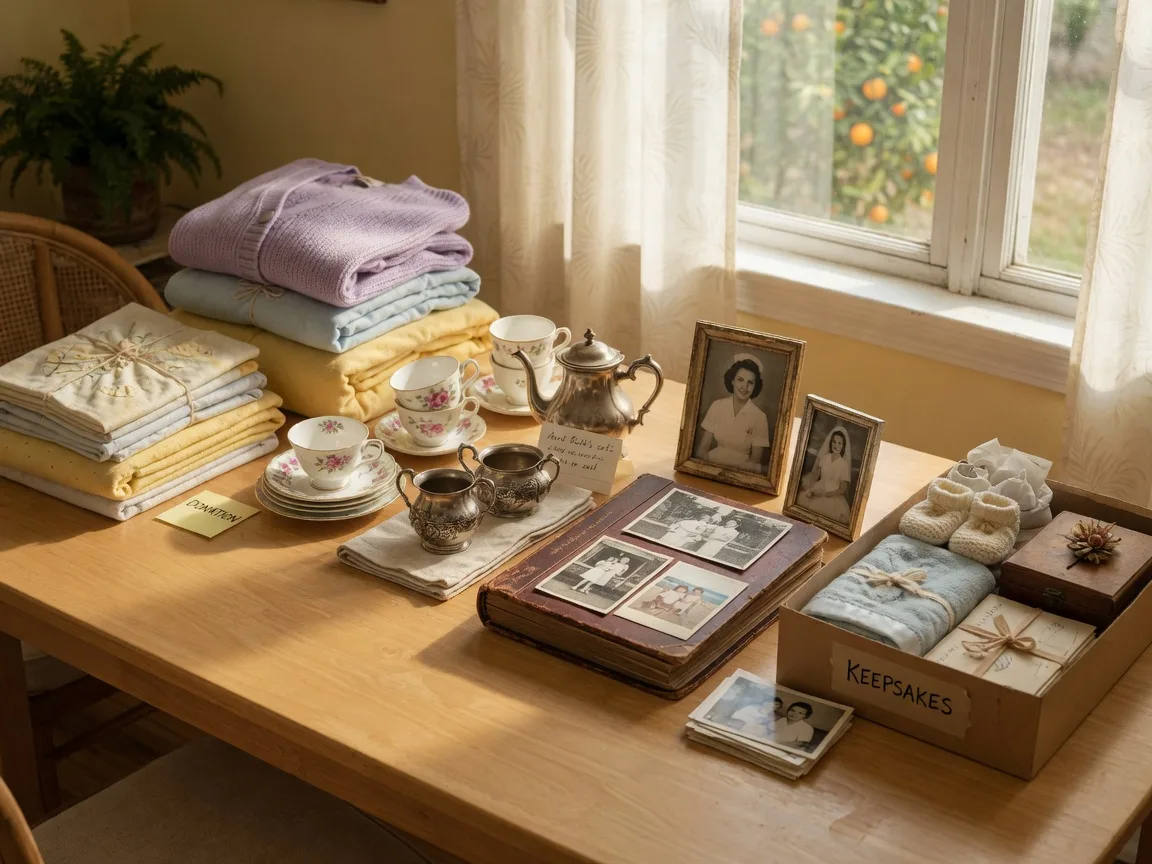
Sort every item into one of four piles: keep what you use and love, donate what still has life, sell what has real resale value, and toss the rest, and let the piles make the decisions for you.
Standing over a single chair and asking “what should we do with it?” is exhausting because every item demands a fresh judgment. The four piles remove the judgment: you are not deciding the fate of Grandmother’s dresser, you are only deciding which of four labeled piles it belongs in, and the system carries the rest.
Keep
The smallest pile and the easiest to defend: the things used weekly and loved daily. If no one has used it in a year and no one wants it, it is probably not keep.
Donate
Usable goods go to local charities that pick up, which is often the fastest path. You get a receipt, the charity gets inventory, and the items get a second life.
Sell
Estate sales, consignment, and online marketplaces recover real money from furniture and collectibles, commonly 10% to 30% of original retail. Let a professional price and run the sale when there is volume.
Toss
A legitimate decision. Recycling, junk removal, and the dump are honest endings for what no one will use, and a clean home closes the chapter.
The toss pile deserves the same respect as every other pile. Experts estimate that most of a senior’s possessions are never used again by family members, so it is not a failure to let something go, it is arithmetic. Secondhand furniture and household goods typically sell for a fraction of their original cost, commonly 10% to 30% of retail value, which is a useful number to hold onto when the “but we paid money for it” guilt shows up.
How Do We Handle the Emotional Side?
Handle the emotional side by letting family call dibs in advance, photographing what you cannot keep, and focusing on the stories rather than the stuff, because the memory lives in the people, not in the possessions.
Every item carries a memory, and the cleanout is as much a goodbye as a task, so the gentlest approach makes the goodbye an explicit, shared step instead of a silent one. Let family members claim the pieces they treasure before the sorting begins, and treat the cleanout as a passing along rather than a purge.
It is far gentler on everyone when an old mixing bowl goes to the grandchild who baked with grandma instead of into a donation bin, and a photograph of what cannot be kept keeps the memory alive without keeping the thing. The stories travel with the people. The house empties, and the family keeps what actually mattered all along.

When Should We Bring in Professionals?
Bring in professionals as soon as the cleanout is more than your family can carry: estate sale companies run the sale, senior move managers run the whole transition, and junk removal crews haul away what remains.
The right moment to call is early rather than late. Professionals bring experience, labor, and emotional distance to a process that is hard to do alone, and their cost is usually repaid in weeks saved and weight lifted, not money spent.
Estate sale company
Prices, stages, and runs the sale so furniture, antiques, and collectibles sell for what they are worth, with the pricing, the setup, and the crowd handled for you.
Senior move manager
Plans and coordinates the whole transition: sorting and downsizing, packing, scheduling movers and cleanout teams, and setting up the new home.
Junk removal crew
Arrives with trucks and takes the toss pile away in a single visit, so the end of the cleanout does not end with boxes stacked in the driveway.
I coordinate these trusted specialists as part of a senior transition, so the cleanout, the home sale, and the move all happen on one coordinated plan with one point of contact. If the cleanout is part of a move to a smaller home, the Downsizing and Rightsizing guide walks the whole transition through room by room, keep pile to sold sign. If the cleanout follows a passing and the home is part of an estate, my probate estate home guide covers how the sale fits the court process, and the inherited home guide helps you decide whether to keep, rent, or sell before you touch a single box.
What About Donations and Taxes?
Donations to qualified charities can be tax-deductible at their fair market value when you get a written receipt, and families should confirm the current IRS rules with a CPA or tax professional before claiming them.
Keep an itemized list of what you donated and ask for a written receipt at pickup or drop-off, because the documentation is what makes the deduction real. Donated household goods are valued at their fair market value, not what they cost decades ago, which is another reason the 10% to 30% rule of thumb matters: honest expectations make honest paperwork.
Tax rules for donated property change, so the reliable path is simple: donate to qualified organizations, keep the paperwork, and let a CPA or tax professional confirm the details. That is the same advice I give every family, because a cleanout should never create a tax surprise later. Once the house is empty and you are deciding what it is worth on the market, get a free, no-pressure home valuation so the numbers on paper match what the family home can really sell for.
Questions Florida Families Ask About Estate Cleanouts
The same eight questions, answered short and quotable, the way you would hear them on a strategy call.
What is an estate cleanout?
An estate cleanout is the full process of emptying a family home after a senior moves into care or passes away: sorting decades of belongings, deciding what goes where, donating, selling, and clearing the house for its next use. It is equal parts logistics and emotion, which is why it feels so big at the start. Approached room by room, box by box, it gets done.
How long does an estate cleanout take?
An estate cleanout takes as long as the home, the volume inside it, and the hours your family can give each week allow, which is why the first step is setting a deadline, not guessing a number. A full house sorted by family on weekends takes longer than the same house worked by a professional crew. Work backward from the date the home must be empty by, and the whole project stays on pace.
Should we keep, donate, sell, or toss?
Sort every item into four piles: keep what you use and love, donate what still has life, sell what has real resale value, and toss the rest, and let the piles make the decisions for you. Keep is the smallest pile and the easiest to defend. Experts estimate that most of a senior’s possessions are never used again by family members, so a planned, kind goodbye beats a storage unit.
Is an estate sale worth it?
An estate sale is worth it when the home is full of furniture, antiques, and collectibles that people will actually buy, because a professional sale can recover real money from those items. It is less worth it when the contents are mostly everyday household goods, because secondhand furniture and household goods typically sell for a fraction of their original cost, commonly 10% to 30% of retail value. Ask an estate sale company for an honest preview of what your contents could bring before you commit.
Can we deduct donated items on taxes?
Donations to qualified charities can be tax-deductible at the fair market value of the items when you have a written receipt from the organization. Keep an itemized list of what you donated and the receipt from pickup or drop-off. Confirm the current IRS rules with a CPA or tax professional before you file.
What do senior move managers do?
A senior move manager, sometimes called a transition specialist, plans and coordinates the whole move: sorting and downsizing, packing, scheduling movers and cleanout teams, and setting up the new home. Families use one when adult children live out of state, when the move is complex, or when everyone wants the project done right by someone who does it every day. They pair naturally with an estate cleanout when both need to happen on one calendar.
How do we handle the emotional side?
Handle the emotional side by letting family call dibs in advance, photographing what you cannot keep, and focusing on the stories rather than the stuff, because the memory lives in the people, not in the possessions. Treat the cleanout as a passing along rather than a purge. It is far gentler on everyone when a treasured piece goes to the person who will use it and love it.
When should we hire professional help?
Bring in professionals as soon as the cleanout is more than your family can carry, because estate sale companies, senior move managers, and cleanout crews exist for exactly this reason. They bring experience, labor, and emotional distance to a process that is hard to do alone. The right moment to call is early rather than late, so the cleanout, the home sale, and the move all happen on one coordinated plan.
Keep reading: the guides families pair with this one
The cleanout is one chapter of a bigger story. These pages walk with you through the rest of it, from the sale itself to the valuation and the contact to start.
Estate cleanout, step by step
The source guide this post expands: the five steps of emptying a family home, in plain language, for the family standing in the doorway today.
Read the guideDownsizing & rightsizing guide
When the cleanout is part of a move to a smaller home, this walks the whole transition through room by room, keep pile to sold sign.
Read the guideProbate & estate home sale
When the cleanout follows a passing, here is how the family home fits the estate, the court process, and the sale.
Read the guideInherited home help
Sell it, rent it, move in, or pass it on: the honest trade-offs of an inherited house once the estate settles.
Read the guideFree home valuation
Get the researched number for the family home once it is empty, so the price on paper matches what it can really sell for.
Read the guideContact Michael
Call, text, or send a private note about the cleanout, the home, or the whole transition. Michael responds personally.
Read the guideThe cleanout is one step. The plan is the point.
That family in Vero Beach got their plan. They set the date, sorted room by room, and spread the work across a series of Saturday mornings instead of one dreaded week. The china went to a granddaughter who remembered Sunday dinners at that table, the charity truck backed into the driveway twice, and the house was empty a full two weeks before the closing date they had picked.
They did not need to become professional organizers; they needed one clear roadmap and a steady guide. As a Certified Real Estate Planning Advisor, I help families build, protect, and transfer generational wealth through the home, and the cleanout is where that legacy gets handed along with intention instead of by accident. When you are ready to talk, reach out directly and we will start with your questions, not a sales pitch.

About the Author
Michael "Wiz" Wisniewski
Michael "Wiz" Wisniewski is The Life Transition Specialist with The Complete Real Estate Team, powered by Dalton Wade Real Estate, serving clients from the Treasure Coast to South Florida. A Certified Real Estate Planning Advisor, Certified Life Transition Specialist, and Certified A.I. Real Estate Advisor, he has worked nearly every side of real estate: fix-and-flip investing, land development, home building, and property management, and guides families through life's transitions with care, honesty, and the Golden Rule.
Certified Real Estate Planning Advisor | Certified Life Transition Specialist | Certified A.I. Real Estate Advisor
Written by
Michael Wisniewski, The Wizard of Real Estate
Certified Real Estate Planning Advisor | Certified Life Transition Specialist | Certified A.I. Real Estate Advisor
Helping Florida families protect what matters most.
Talk Soon